Diverse Living Spaces (Edexcel AS Geography): Exam Questions

Exam code: 8GE0

2 hours28 questions
1
2 marks

Study Figure 5.
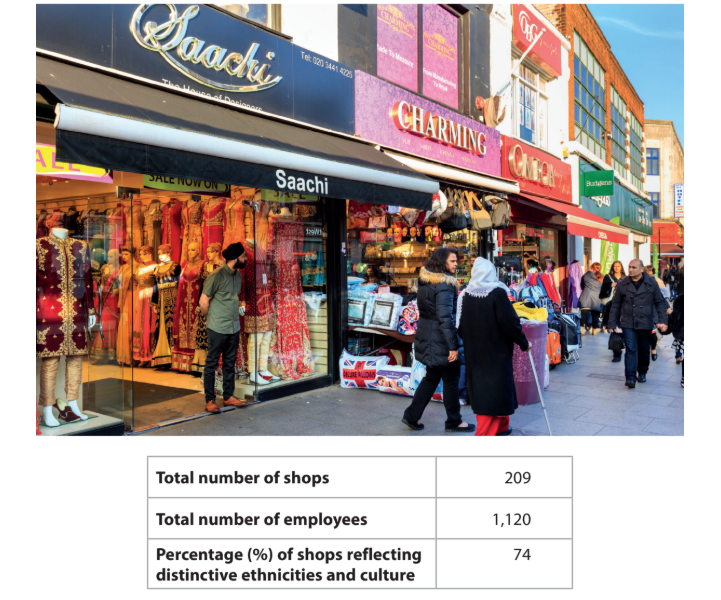
Street view of diverse shops with cultural clothing, busy pedestrian area. Below, a table shows: 209 shops, 1,120 employees, 74% cultural shops.

Figure 5
The Broadway, Southall, London, a high street that has changed due to
international migration

Calculate the mean number of employees per shop.

You must show your working.

Give your answer to one decimal place.

Answer ...............................

2
4 marks

Explain two reasons rural places are seen as undesirable by some of their residents.

3a
1 mark

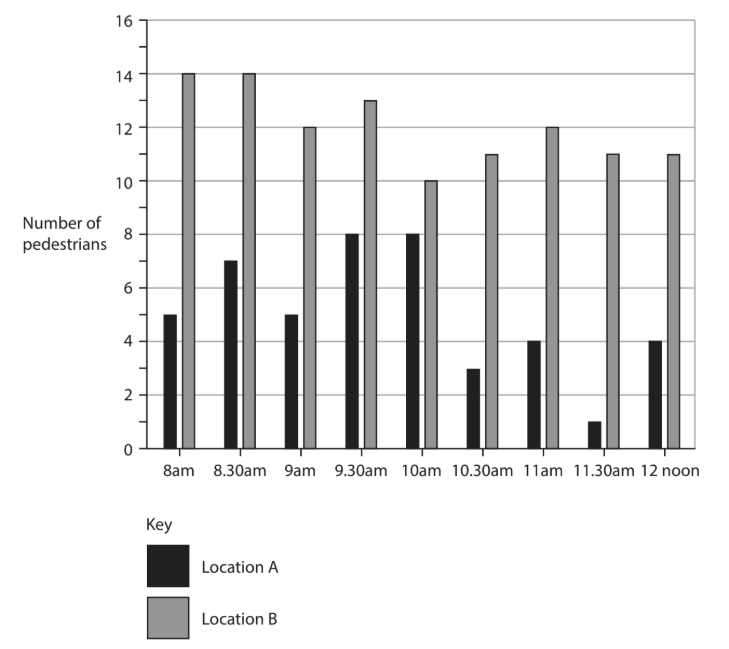
Students collected data about the number of pedestrians passing two locations (A and B) for one minute, at 30-minute intervals on a Monday between 8am and 12 noon. This was part of their research into the levels of deprivation in two locations.

The locations were 2km apart.

Study Figure 6.

Bar chart comparing pedestrian numbers at two locations from 8am to 12 noon. Location A is black, and Location B is grey. Location B has more pedestrians.

Figure 6
Pedestrians passing two locations at 30-minute intervals
between 8am and 12 noon

State the range for the data for location A.

3b
4 marks

Suggest two ways secondary data could be used to assess the levels of deprivation in places such as these.

4
1 mark

State one reason why some people perceive suburban areas as desirable places to live.

5a
1 mark

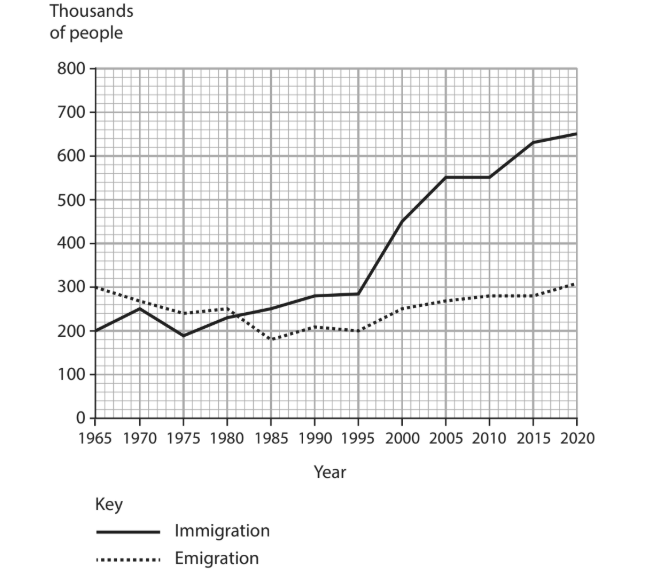
Study Figure 5a.

Line graph showing UK immigration and emigration from 1965 to 2020. Immigration increases, peaking in 2015; emigration remains stable around 200,000.

Figure 5a
Estimated emigration and immigration in UK, 1965–2020

Identify which one of the following statements is correct.

  • Immigration has been always higher than emigration

  • Emigration has always been higher than immigration

  • Immigration has always been above 100,000 people per year

  • Emigration has always been above 200,000 people per year

5b
1 mark

Calculate the difference between emigration and immigration in 2010.

Answer ..............................................................

6
6 marks

Explain why residents’ perceptions of inner-city life can be both positive and negative.

7
3 marks

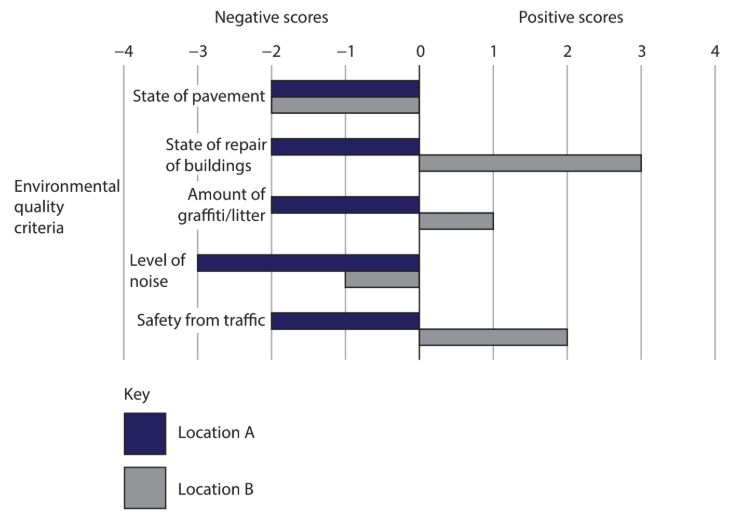
Study Figure 6.

Bar chart comparing environmental quality of Locations A and B on criteria like pavement, noise, and traffic safety, with negative and positive scores.

Figure 6
Environmental quality in two contrasting locations in the students’ local town
Scores range from –4 to +4, where –4 is the lowest score for each category

Students visited two locations in their local town.

They completed an environmental quality survey in five streets in Location A and Location B.

They then calculated the mean score for each location.

Compare the environmental quality in Locations A and B.

8
4 marks

Explain how secondary data sources could be used to investigate the reasons for differences in environmental quality.

9
1 mark

State one reason some urban areas are seen as undesirable by residents.

10
3 marks

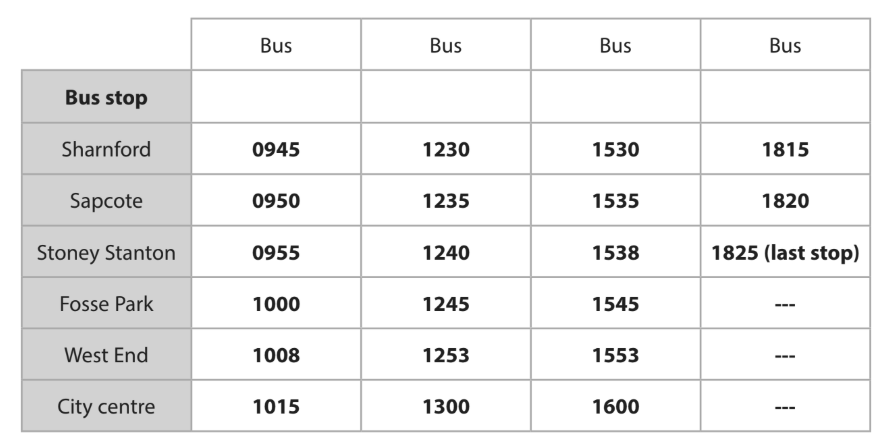
Study Figure 4

Bus timetable for stops: Sharnford, Sapcote, Stoney Stanton, Fosse Park, West End, and City centre. Departures at 0945, 0950, 0955, 1000, 1008, 1015.

Figure 4
The bus timetable from Sharnford village to Leicester city centre
Mondays to Fridays

Suggest one way access to transport may affect residents’ perceptions of Sharnford.

11
4 marks

Explain two reasons some groups of people may perceive a rural place as idyllic.

12
2 marks

Students interviewed local residents on Swanage seafront as part of an investigation into perceptions of the town.

They used a stratified sampling method to select those they interviewed.

Suggest why this method was chosen.

13a
3 marks

Study Figure 9.

Word cloud highlighting issues like community spirit, run-down areas, lack of aspiration, low pay, vandalism, closed shops, and nothing to do.

This word cloud was created by a student to present and analyse responses to an open question about perceptions of Swanage.

Describe the findings shown in Figure 9.

13b
4 marks

Explain one strength and one weakness of this method of data presentation.

14
1 mark

Identify one reason why rural places may be seen as undesirable by some groups.

15a
1 mark

Study Figure 8.

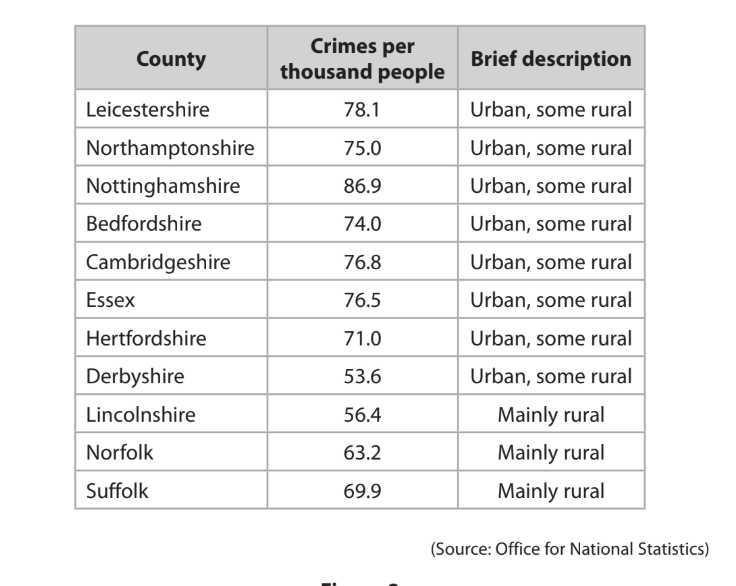
Table showing crime rates per thousand people in English counties, categorised as urban or mainly rural. Source: Office for National Statistics.

Figure 8
Crime rates for selected counties of England in 2018

Calculate the mean value for crimes in 2018 for the counties shown.

Give your answer to 1 decimal place.

................................................... crimes per thousand people

15b
1 mark

Calculate the median value for crimes in 2018 for the counties shown.

16
4 marks

Describe the contrasting evidence provided by two different media sources of the image of your local place.

Local place: ...........................................................................................

Image 1:...........................................................................................

Image 2:...........................................................................................

17
6 marks

Explain why perceptions of inner city areas have changed over time.

18a
2 marks

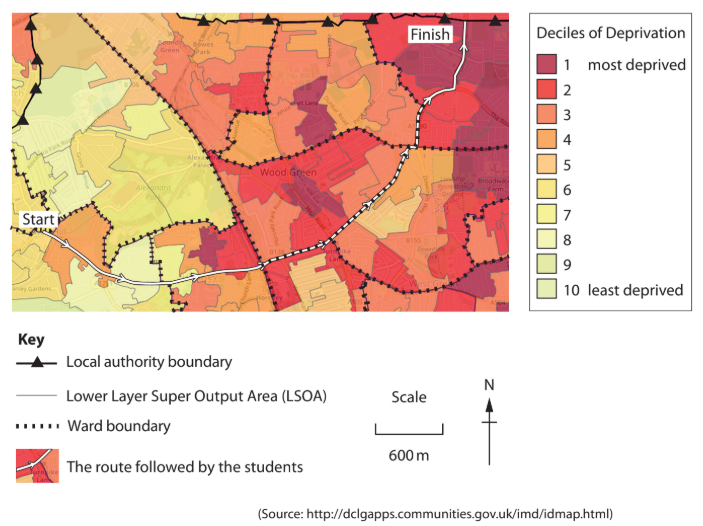
Study Figure 9.

Map showing a route from Start to Finish through areas coloured by deprivation level, ranging from most deprived (red) to least deprived (yellow).

Figure 9
The students’ transect through Haringey (a local authority in north London) plotted on an Index of Multiple Deprivation (IMD) map

A group of students travelled by minibus along the route shown in Haringey, north London and used secondary data on multiple deprivation to support their fieldwork.

Describe the change in level of multiple deprivation along the transect.

18b
2 marks

State one advantage and one disadvantage of displaying data using a

choropleth map, as shown in Figure 9.

Advantage:...........................................................................................................

Disadvantage:......................................................................................................

18c
1 mark

The students carried out a Personal Safety Survey (PSS) in the 16 LSOAs along the route. The lower the number out of the total 20, the less safe they felt.

Spearman’s rank correlation coefficient was chosen to test the statistical relationship between PSS scores and IMD.

State a suitable null hypothesis the students could use to test the relationship between multiple deprivation and personal safety.

18d
1 mark

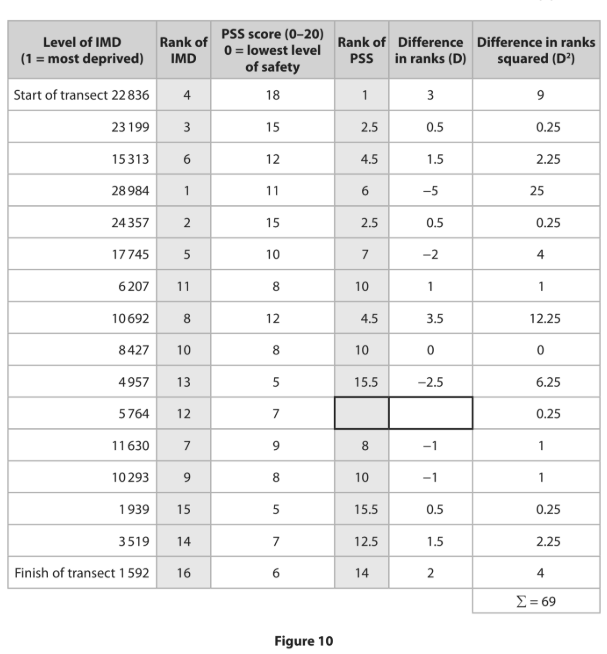
Their partially-completed table to calculate the Spearman’s rank correlation coefficient is shown in Figure 10.

Complete the missing data in Figure 10 below.

Table showing data comparing Level of IMD, PSS score, ranks, and differences with calculations of rank differences squared, labelled as Figure 10.
18e
2 marks

The students used the Spearman’s rank correlation coefficient formula to calculate R and their result was 0.892.

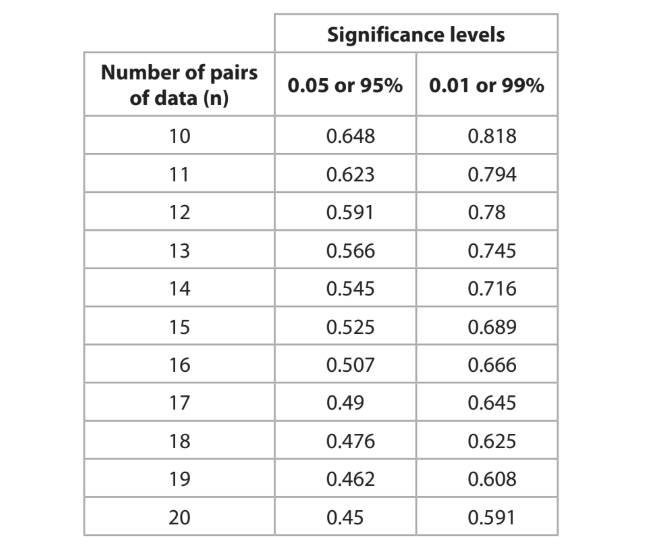
They used a critical values table, shown in Figure 11, to decide if they should accept or reject their null hypothesis.

Table of significance levels showing critical values for various numbers of data pairs, with confidence levels 95% and 99% for ten to twenty pairs.

Figure 11
Table of critical values for Spearman’s rank correlation coefficient (R)

Explain why they should accept or reject the null hypothesis.

19
9 marks

You have also carried out fieldwork into Diverse Places.

Assess the accuracy and reliability of the methods used to collect primary data for your own enquiry.

Geographical enquiry question:

20
1 mark

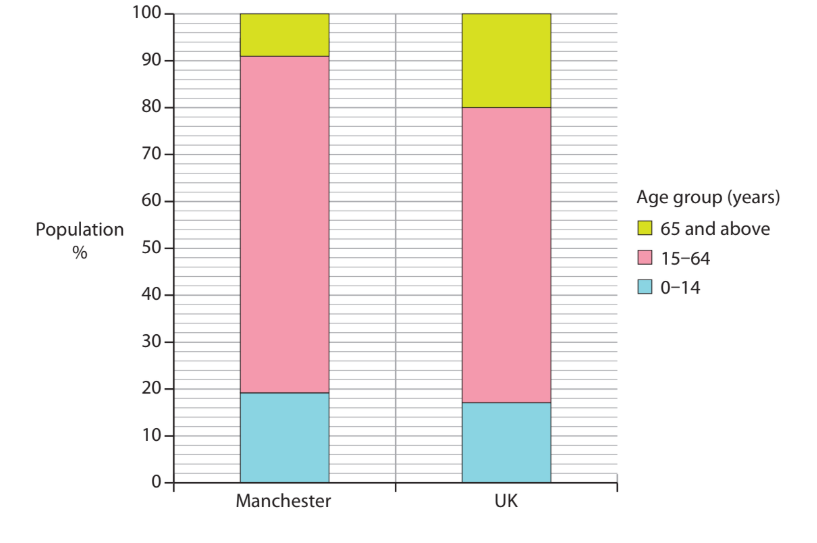
Study Figure 5a.

Bar chart comparing age distribution in Manchester and the UK; age groups: 0-14, 15-64, 65 and above. Detailed by percentage.

Calculate the percentage (%) of those who were aged 15–64 in Manchester.

21
1 mark

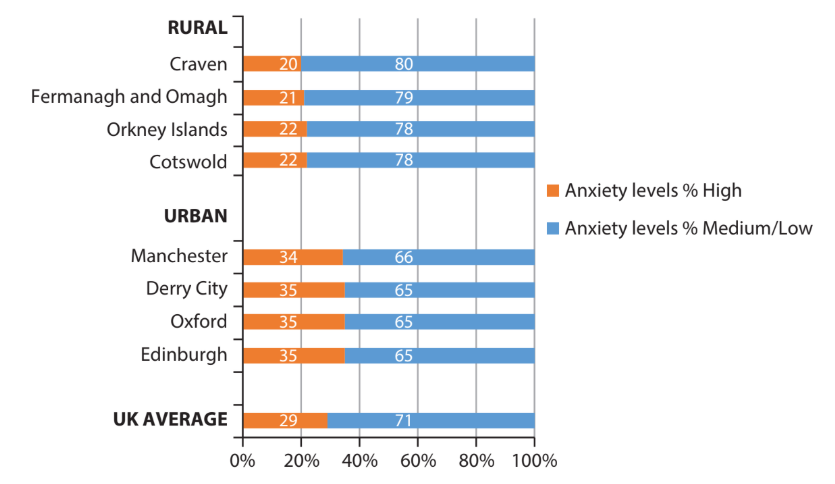
Study Figure 5b .

Bar chart comparing high and medium/low anxiety levels in rural and urban UK areas, with most urban areas showing higher anxiety than rural ones.

Figure 5b
Residents’ perceptions of place, measured by anxiety levels, 2016
(from a survey by the Office of National Statistics)

Identify which one of the following statements is correct.

  • The lowest anxiety levels were in Orkney Islands

  • Oxford had higher anxiety levels than the UK average

  • The highest anxiety levels were in Fermanagh and Omagh

  • Rural areas had higher anxiety levels than urban areas

22a
3 marks

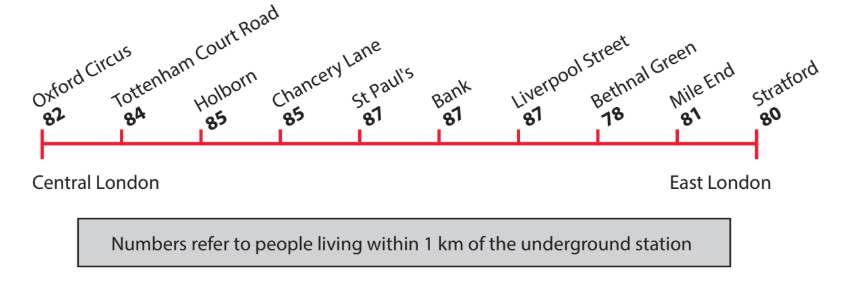
A student used secondary data about average life expectancy along a transect in London, as part of research on deprivation.

Study Figure 6.

Diagram of a London Underground line showing stations from Oxford Circus to Stratford with numbers indicating residents within 1 km; highest at Bank and St Paul's.

Figure 6
Average life expectancy in years along a London Underground train line, 2017

Describe the variation in average life expectancy from central to east London.

22b
2 marks

State one strength and one weakness of using average data to compare areas.

23
4 marks

Explain how one qualitative and one quantitative technique could be used as part of the student’s primary data collection into the level of deprivation.

24
9 marks

You have also carried out fieldwork and research into Diverse Places.

Assess the contribution of the secondary research data you used in investigating your geographical enquiry question.

Research question:

25
16 marks

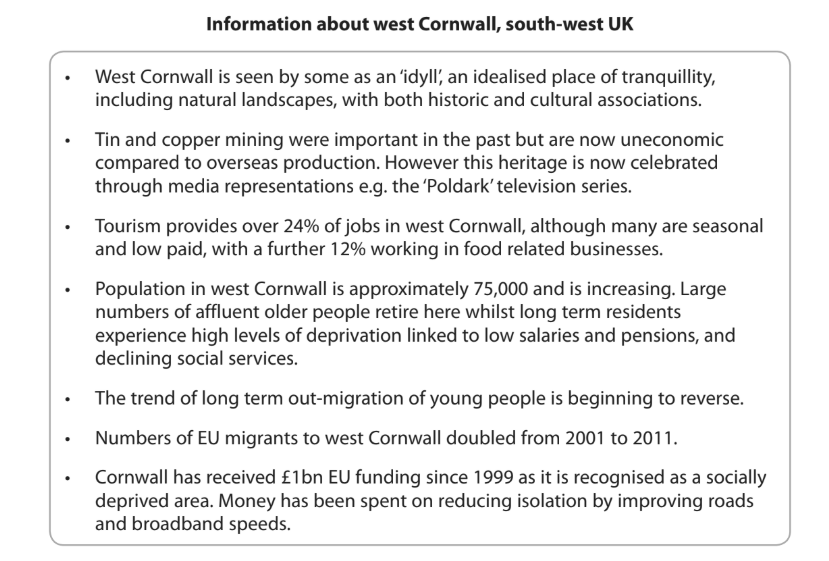
Study Figures 7a, 7b, 7c and 7d.

Information about west Cornwall, highlighting its idyllic nature, historical tin mining, tourism jobs, migration trends, EU funding, and population details.

Figure 7a
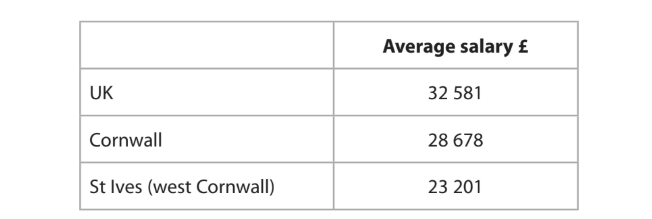
West Cornwall fact file

Table comparing average salaries: UK £32,581, Cornwall £28,678, St Ives (west Cornwall) £23,201.

Figure 7b
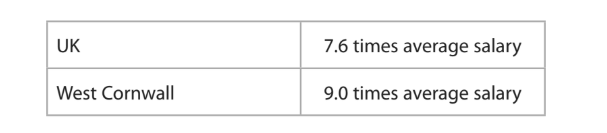
Average salaries for jobs in 2017

Table comparing UK and West Cornwall house prices as multiples of average salary, with UK at 7.6 times and West Cornwall at 9.0 times.

Figure 7c
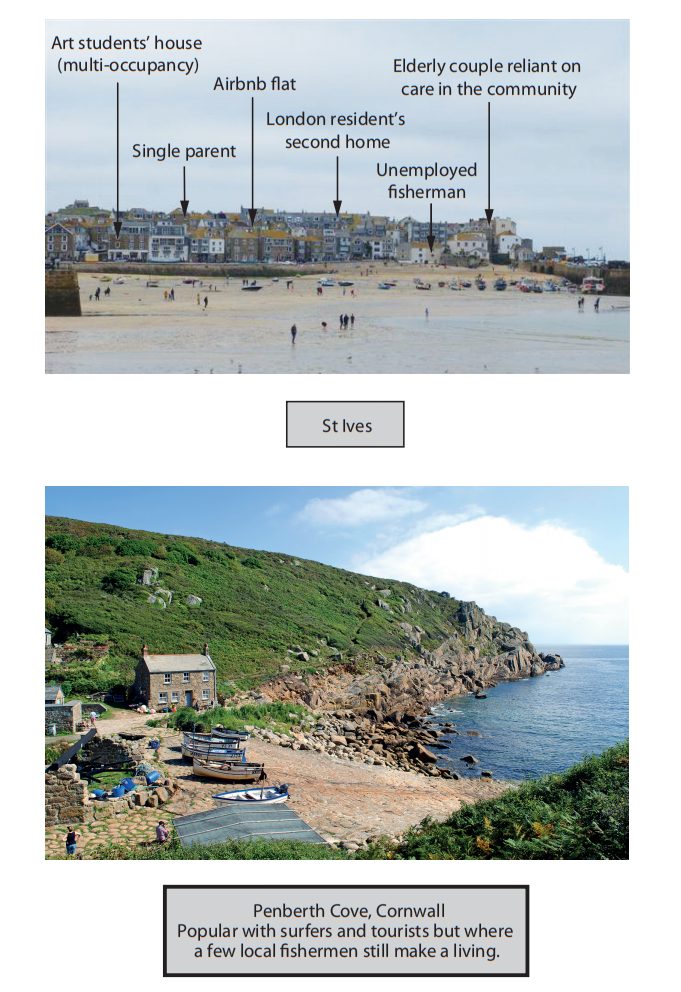
House price affordability in 2017

Top image: St Ives beach with diverse housing annotations. Bottom image: Penberth Cove, Cornwall, showing a picturesque shoreline with boats and a coastal path.

Figure 7d
Contrasting views of west Cornwall

Evaluate the extent to which west Cornwall could be described as a rural idyll.

26a
1 mark

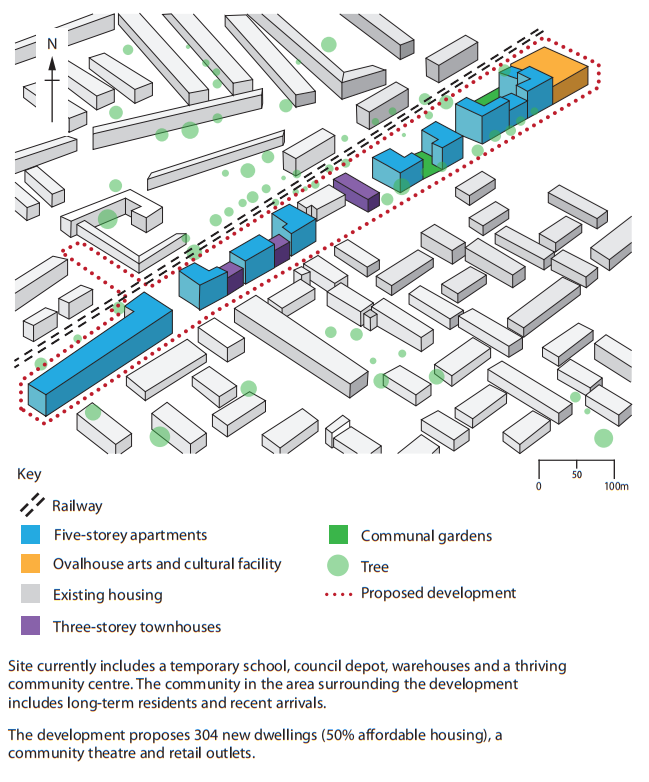
Study Figure 5.

Proposed urban development plan with five-storey apartments, townhouses, arts facility, communal gardens, and railway, highlighted by red dotted boundary.

Figure 5
Somerleyton Road development, Brixton, inner city London

Calculate the length of the railway which runs alongside the proposed development.

.................................................... m

26b
1 mark

Identify the approximate area of the proposed development.

  • 2,500 m2

  • 10,000 m2

  • 30,000 m2

  • 75,000 m2

27a
1 mark

Study Figure 6 (opens in a new tab), showing Chapeltown, near Sheffield, UK, which has experienced significant change in recent years.

Students collected data in this town on one day in November 2016 to investigate the changes.

Identify the building at location 352967.

27b
1 mark

State the 6-digit grid reference for the mast south-east of Mortomley.

27c
1 mark

The students started at the roundabout on the B6546, in Chapeltown. Each group collected data every 200m as they walked along one of the roads.

Identify the sampling method they used.

  • random

  • qualitative

  • systematic

  • stratified

27d
4 marks

Explain two data collection techniques that could be used at the sampling points to investigate urban deprivation.

28
9 marks

You have collected data during your fieldwork relating to Diverse Places.

You then used a number of data presentation methods.

Assess how effective these were in showing the results of your fieldwork.

Research question: