Employment Law (OCR GCSE Business): Exam Questions

Exam code: J204

9 mins6 questions
1
2 marks

Case Study

C & J Clark International Ltd (Clarks)

Clarks is a successful UK footwear brand with ranges for children, women, and men. Their market is very competitive. Clarks employs specialist designers who create new shoe styles in response to fast-changing fashion trends.

The designers interpret quantitative data carefully when planning new shoe styles. The designers work closely with employees from other functional areas of the business, such as marketing, finance, and retail, to ensure that the new shoe styles meet customers’ needs profitably.

Clarks works hard to retain its team of designers, as they are central to its success. However, Clarks sometimes needs to recruit new designers and uses several selection methods to help find the best person available to fill the vacancy.

State two aspects of employment law that may affect a business.

2
1 mark

Case Study

McDonald’s

Six weeks ago James saw an advertisement for a job at McDonald’s. He went into the restaurant and was given an application pack, including a job description, a person specification and a link to an online application form.

James completed the application form and emailed it to the restaurant. A manager then telephoned James and asked him to come for an interview at the restaurant. James had to bring his GCSE certificates to the interview. After the interview, James had to do a group activity where he was asked to complete a task as a member of a team.

James was very pleased to get a letter two weeks ago offering him a job. Included with the letter was a contract of employment, which he has to sign and bring with him on his first day of work. His starting wage will be £7.00 per hour, with a 10% increase after he has been fully trained.

State one way in which the law affects business recruitment.

3
1 mark

A contract of employment is:

  • a diagram showing the formal lines of authority in a business

  • a formal document outlining the objectives of a business

  • a law that makes discrimination in the workplace illegal

  • a legal agreement between an employer and an employee

4
2 marks

Case Study

Greggs

Greggs is a modern ‘food-on-the-go’ retail brand. It specialises in selling sandwiches, cakes, pastries and pies. Most of these are made by Greggs, using raw materials such as flour, meat and yeast. The company opened its first bakery 80 years ago and has since grown significantly. It currently has 20 000 employees. Greggs’ aim is to become the customer’s favourite for ‘food-onthe-go’ in the UK. This sector is growing quickly and is forecast to be worth £23.4 billion by 2024 (up from £18.5 billion in 2019).

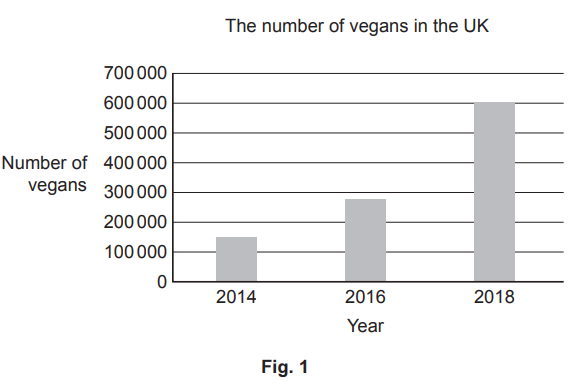
According to The Vegan Society, the number of people in the UK choosing a vegan diet has increased during recent years (see Fig. 1).

Bar chart showing the increase in the number of vegans in the UK from 150,000 in 2014 to 276,000 in 2016, reaching 600,000 in 2018.

Using the market data, Greggs responded to this change by launching vegan sausage rolls in January 2019. The publicity generated helped Greggs’ total sales to increase by 9.6% in its next seven weeks of trading. Following this success the business launched other products, including vegan doughnuts and vegan steak bakes, based on consumer demand.

Managers at Greggs constantly monitor changes in consumer tastes. Similarly, they keep up-to-date with changes in employment law. Greggs’ managers also take pride in the business being named one of the happiest places to work in the UK. Greggs offers many ways of working, including part-time roles.

Explain one way that employment law may affect Greggs’ employment of workers.

5
2 marks

Case Study

Superdry plc

Superdry is a successful international brand of clothing featuring American- and Japanese-inspired graphics. In 2018, over 4800 people were employed by the company, which is committed to high quality. Superdry’s policies include one against discrimination in its workforce and another to support employee retention.

The company uses many different distribution channels. These include:

  • 135 Superdry stores across the UK and Europe

  • Superdry’s own website

  • other retailers, including Next in the UK, which allows the brand to reach new customer groups.

Superdry regularly invests in its own stores. To keep its retail stores exciting and encourage customers to visit, there is a regular re-fit programme. In 2017, the company spent £41.4m on store-related investment, including the re-fitting of 11 stores.

The company faces competition from retailers of all sizes, ranging from sole traders to other public limited companies.

Explain one advantage for Superdry of having a policy against discrimination in its workforce.

6
1 mark

Which one of the following is required by law?

  • All employees must be given a voucher for a free eyesight test each year

  • Employees who work from home must work a maximum of 16 hours a week

  • Everyone who is self-employed must have private medical insurance

  • Full-time employees must be given at least 5.6 weeks paid holiday per year