3.2a Organisational Structures (OCR GCSE Business): Exam Questions

Exam code: J204

26 mins9 questions
1
1 mark

A clothing designer may choose to flatten its organisational structure to reduce the:

  • creativity of its garment designers

  • independence of its fabric buyers

  • need for innovation and change

  • time it takes to respond to changes in fashion

2
1 mark

A business with a tall organisational structure will have:

  • a high market share

  • lots of distribution channels

  • multiple layers of authority

  • short chains of command

3
1 mark

Who is a director’s subordinate?

  • A customer

  • A manager

  • A shareholder

  • A supplier

4
1 mark

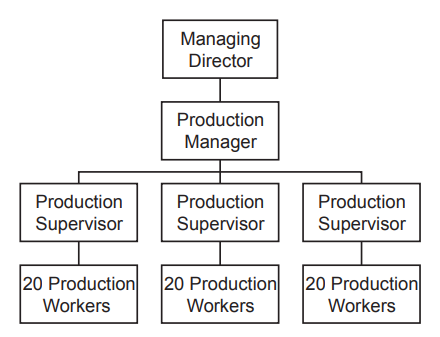
An extract from the organisation chart of a manufacturing company is shown below.

Organisational chart showing a managing director, a production manager, three production supervisors, and sixty production workers.

The span of control of the Production Manager is:

  • 1

  • 3

  • 21

  • 63

5
2 marks

Case Study

Dyson

Disappointed with the performance of vacuum cleaners on the market, James Dyson thought he could design a better product. He started to create his first vacuum cleaner in the late-1970s. In 1984, after trying thousands of designs over several years, James Dyson launched a bagless vacuum cleaner in partnership with Amway, a US consumer goods manufacturer. This partnership did not work out, so James Dyson formed his own company in 1991.

Today, Dyson Ltd produces a range of home appliances including vacuum cleaners, hand dryers, heaters, hair dryers and lights. Creating new and innovative products continues to be important for the company, as seen by its expanding product range. The company has over 12 000 employees worldwide. Dyson Ltd has a unique organisational structure.

All new employees of Dyson Ltd go through an induction training programme. In addition, the company encourages employees to progress by offering apprenticeships and other staff development opportunities. James Dyson promotes careers in engineering, both in schools and in universities.
Explain one reason why businesses have different organisational structures.

6
9 marks

Case Study

Miles Ahead

Miles Ahead is a bicycle retailer which was set up in 2001 by entrepreneur, Reg Patel. Reg started with one shop, but the business has gradually expanded. There are now six ‘Miles Ahead’ shops. Despite the growth in Miles Ahead, Reg still operates the business as a sole trader, with 15 employees and a tall organisational structure. Reg segments the market (e.g. different bicycles according to age, gender, lifestyle and income), which he thinks has supported his success.

Reg is going to retire in six months’ time. He is selling the business to Nessa Watts. Nessa has a lot of business experience. She has sold jewellery online as a sole trader for many years. Nessa has plans to expand Miles Ahead.

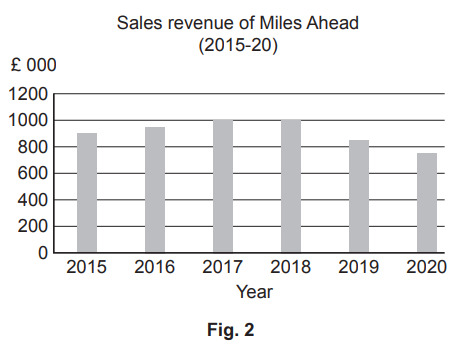
Nessa has had to borrow £500 000 to purchase the business from Reg. Nessa is considering whether to open more ‘Miles Ahead’ shops or launch a ‘Miles Ahead’ website so that customers can purchase online. Sales within the business have fallen over the past two years (see Fig. 2) which Nessa feels is due to the traditional appearance of the shops.

Bar chart depicting sales revenue of Miles Ahead from 2015 to 2020 in thousands of pounds, showing peaks in 2016 and 2019.

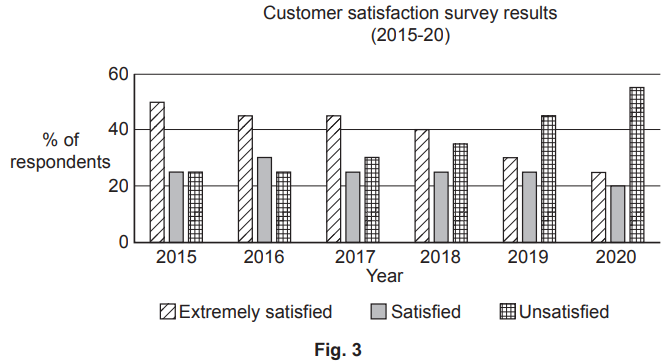
The latest customer satisfaction information is also of concern to Nessa (see Fig. 3).

Bar chart showing customer satisfaction from 2015-2020. Categories: Extremely satisfied, Satisfied, Unsatisfied. Highest in 2020 for Extremely satisfied.

Nessa is thinking about the best organisational structure for Miles Ahead when she becomes the new owner.

(i) Analyse one benefit for Miles Ahead of each of the following organisational structures.

Tall organisational structure

......................................................................................

Flat organisational structure

......................................................................................

[6]

(ii) Recommend which type of organisational structure would be the most appropriate for Nessa to use at Miles Ahead. Give reasons for your answer.

[3]

7
1 mark

A business may choose to have a flat organisational structure because it:

  • gives employees more opportunities for promotion

  • lengthens the organisation’s chain of command

  • reduces the likelihood of mistakes in vertical communication

  • slows down the organisation’s response to changes in the market

8
1 mark

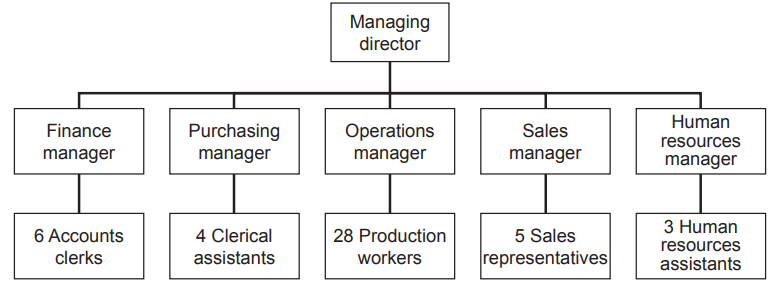
The organisation chart for a furniture manufacturer, POD Ltd, is shown below.

Organisational chart showing a managing director overseeing managers in finance, purchasing, operations, sales, and human resources with their respective staff.

What is the mean average managerial span of control at POD Ltd?

  • 7.7

  • 8.5

  • 9.2

  • 10.2

9
9 marks

Case Study

Beautiful Buds plc

Beautiful Buds plc is a company which grows plants that are sold to garden centres throughout the UK. Beautiful Buds plc has a new Managing Director who has proposed a merger with Green Gardens plc, a chain of garden centres selling a wide range of plants and other garden products.

Green Gardens plc is currently one of the country’s largest plant and garden retailers, with a market share of approximately 12%. The vertical merger will result in one company owning a chain of garden centres as well as growing the plants which are sold in these retail outlets.

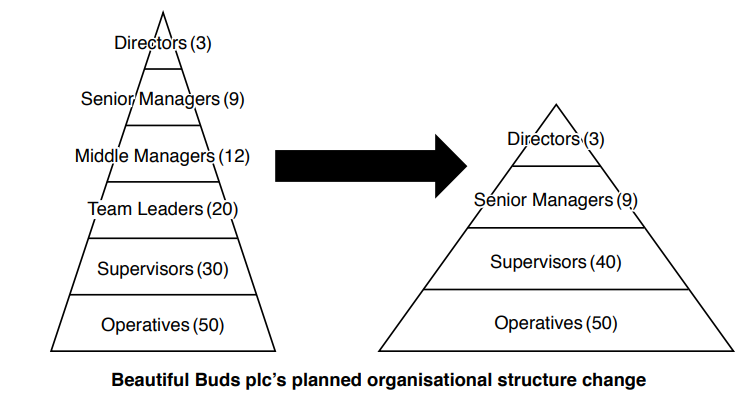
Beautiful Buds plc currently has 124 employees. Its Managing Director is looking to make the business more efficient and is planning to change its organisational structure by removing two layers of management (see below). This change is planned before the proposed merger. The Managing Director believes that the tasks carried out by Middle Managers and Team Leaders can be effectively completed by employees either below or above them in the structure. The estimated redundancy costs due to the restructuring are £200000.

Two pyramids show Beautiful Buds plc's organisational change: roles consolidate from Directors to Operatives, reducing levels and team leaders.

Job role

Average salary

Directors

£110 000

Senior Managers

£80 000

Middle Managers

£50 000

Team Leaders

£35 000

Supervisors

£30 000

Operatives

£22 000

Beautiful Buds plc’s current salary structure

Discuss, with reference to the data in the case study, whether Beautiful Buds plc should go ahead with the plan to change its organisational structure.