Taking Citizenship Action (AQA GCSE Citizenship Studies): Revision Note
Exam code: 8100

An introduction to the investigation
As a part of your course, you must take part in carrying out a Citizenship Investigation that leads to you taking some citizenship action
This work can be done alone, with others or as a whole class exercise
You will be asked some questions about your Investigation in Part A - Active Citizenship of Paper One
These questions are worth 15% of the marks of the whole GCSE
The investigation: deciding and researching the Issue
At the start of your Citizenship Action, you must choose an issue that matters and clearly links to the GCSE Citizenship course
The issue can be local, national or global, but it must be realistic and safe to investigate
You should turn your issue into a clear question and decide your aims
Your aim explains what you want to change or improve.
You may also decide on a hypothesis
This is your main idea or belief that you want to test using evidence
An example issue, question, aim and hypothesis
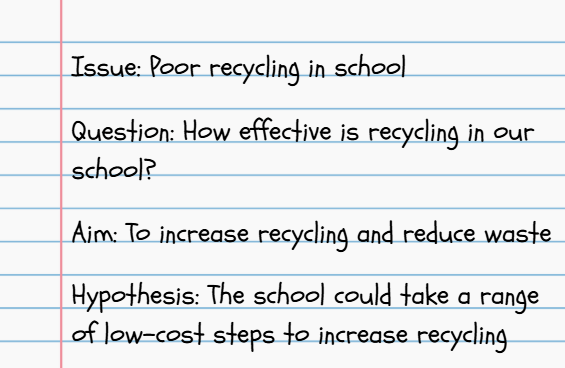
Once you have chosen your issue, you must carry out research.
Secondary research is information that already exists, such as:
News articles
Government or charity websites
Statistics and reports
Primary research is information you collect yourself, such as:
Surveys
Interviews
Petitions or opinion polls
You should use a range of sources, including some that may disagree with your original ideas
After researching, you should use your research to decide whether your question or hypothesis needs to be changed based on the evidence you have found
The investigation: planning
Before taking action, you must plan carefully
You should decide:
What action (or actions) will best help you achieve your aim
Why you have chosen this action
Who will be involved and what their roles are
When the action will take place
This should be written as a clear Action Plan, showing the order of actions and how they link back to your aims
Your teacher must approve your plan before you begin
You should also think about:
Possible problems or barriers, such as
What you will do if part of the plan cannot go ahead
Whether the action is realistic within the time available
Whether you have the resources, time and information required
Example actions include
Writing to an MP or local pressure group
Running a school awareness campaign
Organising a petition
Creating posters or presentations
Supporting a local organisation
The investigation: taking action
This stage is where you carry out your planned action.
You should
Follow your Action Plan
Be prepared to adapt if something does not go as expected
Communicate clearly with anyone involved
Consider and record the views of others
It is important to record evidence of what you do
This might include:
Photos
Emails or letters
Survey results
Attendance numbers
Screenshots of online activity
Examples of evidence
If you organised a petition, record how many people signed it and what feedback you received
Keep copies of letters, emails or other correspondence
Take photos or keep an attendance list of the event or participants involved
Ask teachers or other adults for witness statements
Even if your action does not fully succeed, this is still valid citizenship action, as long as you can explain what happened and why
The investigation: assessing the impact and evaluation
After completing your action, you must assess its impact and evaluate the whole process
To assess impact, you should ask:
Did the action achieve your aims?
Did it make a difference to people, a group or the community?
What evidence shows this?
To evaluate, you should reflect on:
What worked well
What was less successful
What you would change if you did the project again
What you learned about citizenship, democracy and participation
You should also explain:
How your skills improved
For example research, teamwork or communication
How the investigation helped you understand how citizens can make a difference
This reflection is very important, as exam questions in Paper 1 Section A will ask you to apply and evaluate what you did during your citizenship action
Examiner Tips and Tricks
In the exam, examiners are not judging how “successful” your action was
They are looking for clear links between your issue, research, action and evaluation
Always explain why you chose your action, use evidence to show what happened, and reflect honestly on what you would improve next time

Unlock more, it's free!
Join the 100,000+ Students that ❤️ Save My Exams
the (exam) results speak for themselves:

Was this revision note helpful?
