The UK & UN, NATO, EU and Council of Europe (AQA GCSE Citizenship Studies): Revision Note
Exam code: 8100
The UK and the United Nations (UN)
The United Nations (UN) was created in 1945 after the Second World War to help prevent future conflict and encourage cooperation between countries
The United Kingdom was a founding member
It is based in New York and today has 193 member states
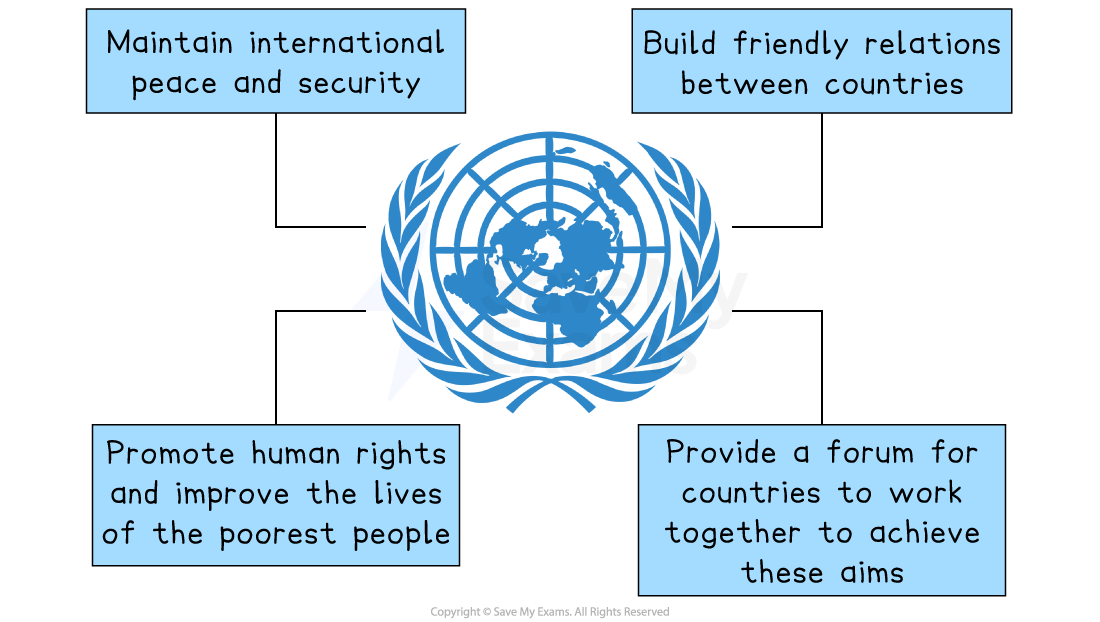
The four main goals of the UN
The UN Security Council
The UK is one of five permanent members of the UN Security Council, alongside
the USA
Russia
France
China
Each of these countries has a veto, meaning they can block any Security Council resolution
This gives the UK significant influence in international decision-making.
The UK’s influence at the UN
As it has a permanent seat on the Security Council, the UK has significant diplomatic influence, even though it has less military and economic power than other leading members
This influence, gained through cooperation, diplomacy and reputation, is an example of soft power
UK civil servants, experts and non-governmental organisations (NGOs) also contribute to the work of many UN agencies, such as
the World Health Organisation (WHO)
UNESCO (United Nations Educational, Scientific and Cultural Organisation)
UNRWA, the UN agency supporting Palestinian refugees, which is currently in the news because of its work in Gaza
The UK and NATO
NATO (the North Atlantic Treaty Organisation) was created in 1949 as a mutual defence alliance
The UK was a founding member
It was originally formed to protect Western countries from the Soviet Union and other communist states in Europe, which were part of the Warsaw Pact
Membership and defence commitment
Today, NATO has 32 member countries
Finland joined in 2023
Sweden joined in 2024
All members agree to support each other if one is attacked
This is known as Article 5, the core of the NATO treaty
NATO organisation
NATO’s headquarters are in Belgium
It has both a military structure and a political structure that work together to coordinate defence and decision-making
In October 2024, Mark Rutte, former Prime Minister of the Netherlands, became the Secretary General, the organisation’s senior political leader
NATO and recent events
In recent years, the USA has pushed NATO members, including the UK, to increase their defence spending
Many NATO countries have recently supported Ukraine in its conflict with Russia by providing
military equipment
financial assistance
training for Ukrainian forces
The UK and the EU
The European Union (EU) began as the European Economic Community (EEC) in 1957
Six countries - France, Germany, Italy, Belgium, the Netherlands and Luxembourg - agreed to work together to boost economic growth
They created a customs union, allowing goods to move freely between them
This group was often called the Common Market
The UK originally chose not to join, and both major political parties were divided on the issue
However, the EEC helped drive rapid economic growth in Europe, and eventually the UK joined in 1973, along with Ireland and Denmark.
Debates about closer union
As membership grew, some countries pushed for
a single market for goods and services
a single currency (the euro)
and for some, a more federal Europe with stronger shared institutions
Others preferred a looser economic partnership.
In the UK, opposition increased towards deeper integration, especially once the EEC became the European Union (EU)
Brexit: A brief summary
In 2016, the UK held a referendum on its membership of the European Union
The result was close, with 51.9% voting to Leave and 48.1% voting to Remain
This decision, known as Brexit, meant the UK would no longer be part of the EU
How the UK’s relationship with the EU has changed
Since leaving the EU, the UK’s relationship with the EU has changed significantly
The UK is no longer part of the EU’s political structures, the single market, or customs union, and the previous rules on free movement of people no longer apply
The UK now negotiates its own trade deals, manages its own immigration system, and must agree new arrangements with the EU in areas such as trade, security, travel and cooperation
The UK and the Council of Europe
The Council of Europe is Europe’s main human rights organisation, with 46 member states
The UK was a founding member and helped create the European Convention on Human Rights (ECHR), which all members must uphold
Citizens can take cases to the European Court of Human Rights once they have used all legal options in their own country
The Court is made up of judges nominated by each member state
Articles of the European Convention on Human Rights
Article | Explanation |
|---|---|
1 - Respect for human rights |
|
2 - Right to life |
|
3 - Protection from torture |
|
4 - Ban on slavery and forced labour |
|
5 - Right to liberty and security |
|
6 - Right to a fair trial |
|
7 - No punishment without law |
|
Some UK politicians argue the Court has exceeded its original purpose and want a British Bill of Rights so UK courts make the final decisions
In October 2024, the Reform Party attempted to bring forward a bill for the UK to leave the ECHR, but it was defeated in Parliament
Examiner Tips and Tricks
When writing about the UK and international organisations, avoid vague statements like “the UK has influence”
Be specific - for example, explain that the UK has a permanent seat and veto on the UN Security Council, or that it supports collective defence through NATO. Precise examples show strong knowledge and gain marks

Unlock more, it's free!
Join the 100,000+ Students that ❤️ Save My Exams
the (exam) results speak for themselves:

Was this revision note helpful?