Civil & Criminal Courts (AQA GCSE Citizenship Studies): Revision Note
Exam code: 8100

An introduction to the court system
The court system in England and Wales is structured in a clear hierarchy to ensure that cases are dealt with fairly and at the appropriate level
It separates criminal courts, which deal with crimes, from civil courts, which deal with disputes between individuals or organisations
The system allows decisions to be appealed to higher courts
Different types of courts in England and Wales
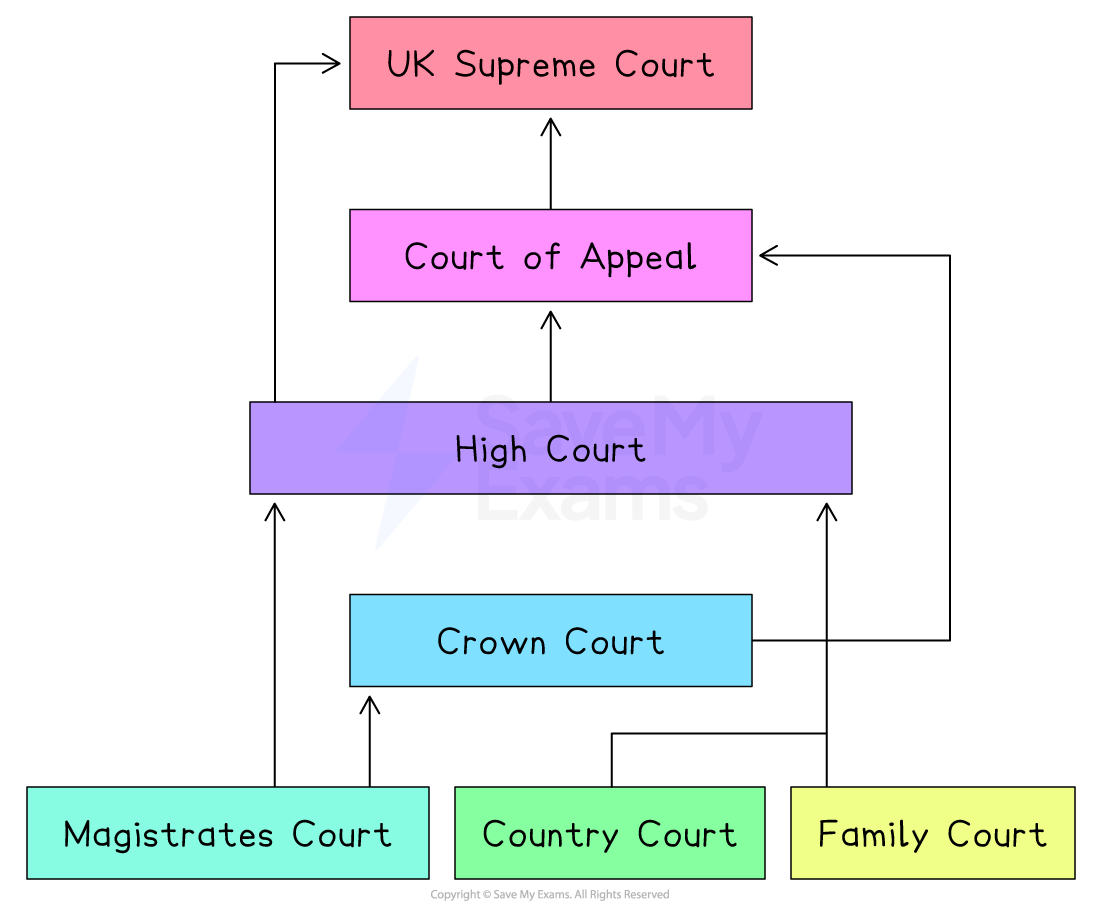
Magistrates’ Court
This is where most criminal cases start and where less serious offences are dealt with by magistrates or a district judge
It can also handle early hearings for serious crimes before they are sent to the Crown Court
County Court
The County Court deals with civil cases, such as disputes over money, housing or personal injury
Cases usually involve individuals or organisations rather than criminal offences
Family Court
The Family Court deals with cases involving children and families, such as divorce, child arrangements and care orders
Its main focus is protecting the welfare of children
Crown Court
The Crown Court deals with serious criminal cases, such as robbery or murder, and hears appeals from the Magistrates’ Court
Cases are decided by a judge and a jury
High Court
The High Court deals with complex or high-value civil cases and important legal issues
It also has the power to review the lawfulness of decisions made by public bodies
Court of Appeal
The Court of Appeal hears appeals against decisions made by the Crown Court and the High Court
It considers whether the law was applied correctly in earlier cases
UK Supreme Court
The UK Supreme Court is the highest court in the UK and deals with cases of the greatest legal importance
It makes final decisions on points of law and can affect how laws are interpreted in the future
Examiner Tips and Tricks
Students often mix up which courts hear cases and appeals
Remember the hierarchy: Magistrates’ → Crown → Court of Appeal → Supreme Court
To gain marks, clearly place the case in the correct court and explain why it starts or moves there, rather than listing courts without purpose
Civil courts
Civil courts deal with disputes between individuals or organisations
Most cases do not involve a jury
Libel and slander cases do have juries
Minor cases are dealt with by local county courts, where claims up to £5,000 can be settled
If it is a serious or high-value case, it goes to the High Court
Civil courts deal with issues such as personal injury claims and contract issues
The Family Court deals with family concerns, such as child protection issues
Trials in a civil court
Many civil cases are resolved before they go to court
If they reach court:
The claimant’s counsel will outline the facts of the case
Witnesses for the claimant give evidence and can be cross-examined
The defendant's counsel will then open their case and witnesses will be called and cross-examined
Final statements are then made by each side
In straightforward cases judgment will be given immediately
In more complex cases the judge can reserve judgment for a later date
Judges decide the amount to be paid if the claim is supported and also who is responsible for the payment of the legal costs
Decisions can be appealed
Criminal courts
Criminal courts deal with cases where someone is accused of breaking the law and decide whether they are guilty and, if so, what punishment should be given
Minor offences are dealt with in a Magistrates Court that can imprison for a maximum of 12 months
More serious cases have their first hearing in a Magistrates Court to decide whether the case should proceed
If the potential sentence is beyond the powers of the court, the case is referred to the Crown Court
Some people request that their case goes to a Crown Court to be decided by a jury instead of by magistrates
There is more legal financial help for criminal than civil cases
Trials in a criminal court
Charges are read out by the judge, and the defendant is asked after the to plead guilty or not guilty
In 2024, 76% of defendants in 2024 pleaded guilty
If the defendant pleads guilty, a statement is made by the defence
The magistrates or judge determines the sentence
If the defendant pleads not guilty
Less serious offences are dealt with by the magistrates court
The most serious offences, such as murder or rape, are sent to trial in the Crown Court
Offences that fall between these two groups are called ‘either way’ and magistrates decide which court should hold the trial
A criminal trial
Charges are outlined by the lawyer for the Crown Prosecution Service (CPS) who acts on behalf of the state
They call witnesses to give evidence and these can be cross-examined by the defendant or his lawyer
They aim to prove to the jury beyond reasonable doubt that the defendant is guilty
The defendant may call witnesses who can be cross-examined by the CPS lawyer
There is no requirement for the defendant to call witnesses or speak on their own behalf
Both the CPS and the defence make closing statements
In a jury trial the judge will then sum up the evidence for the jury and direct them on relevant points of law
Juries retire to consider their verdict
They can request further clarification from the judge or state that they are unable to reach a unanimous verdict
The judge can direct them to arrive at a majority verdict if 10 of the 12 are agreed
Once the verdict is given the defendant is released if found not guilty or sentenced by the judge if found guilty
If found guilty, the defendant can appeal to a higher court against either the conviction or the sentence
Case Study
Peter Sullivan - a miscarriage of justice
Peter Sullivan spent 38 years in prison for a murder he did not commit, making his case one of the longest miscarriages of justice in the UK
He was convicted in 1966, despite having learning difficulties, which made him more vulnerable during police questioning

Serious concerns
After his arrest, Peter was interviewed 22 times in four weeks, and for the first seven interviews he was not given access to a lawyer
He later said he was bullied and pressured into confessing, raising serious concerns about police conduct and suspects’ rights
Overturning the conviction
In 2023, the Criminal Cases Review Commission (CCRC) ordered new DNA tests
This evidence showed that Peter could not have been the killer
In May 2025 the Court of Appeal overturned his conviction, officially proving his innocence

Unlock more, it's free!
Join the 100,000+ Students that ❤️ Save My Exams
the (exam) results speak for themselves:

Was this revision note helpful?
