Local Government: Role & Structure (AQA GCSE Citizenship Studies): Revision Note
Exam code: 8100
The role of local government in the UK
Local government refers to elected councils and mayoralties that run services in villages, towns, cities and counties across the UK
It operates at a local level, below central government and focuses on issues that directly affect local communities
Local government helps make democracy more accessible, as decisions are made closer to the people they affect
It encourages active citizenship, such as voting, volunteering and community involvement
It helps balance power between central government and local communities
Local government gets much of its funding from central government grants, as well as council tax and business rates
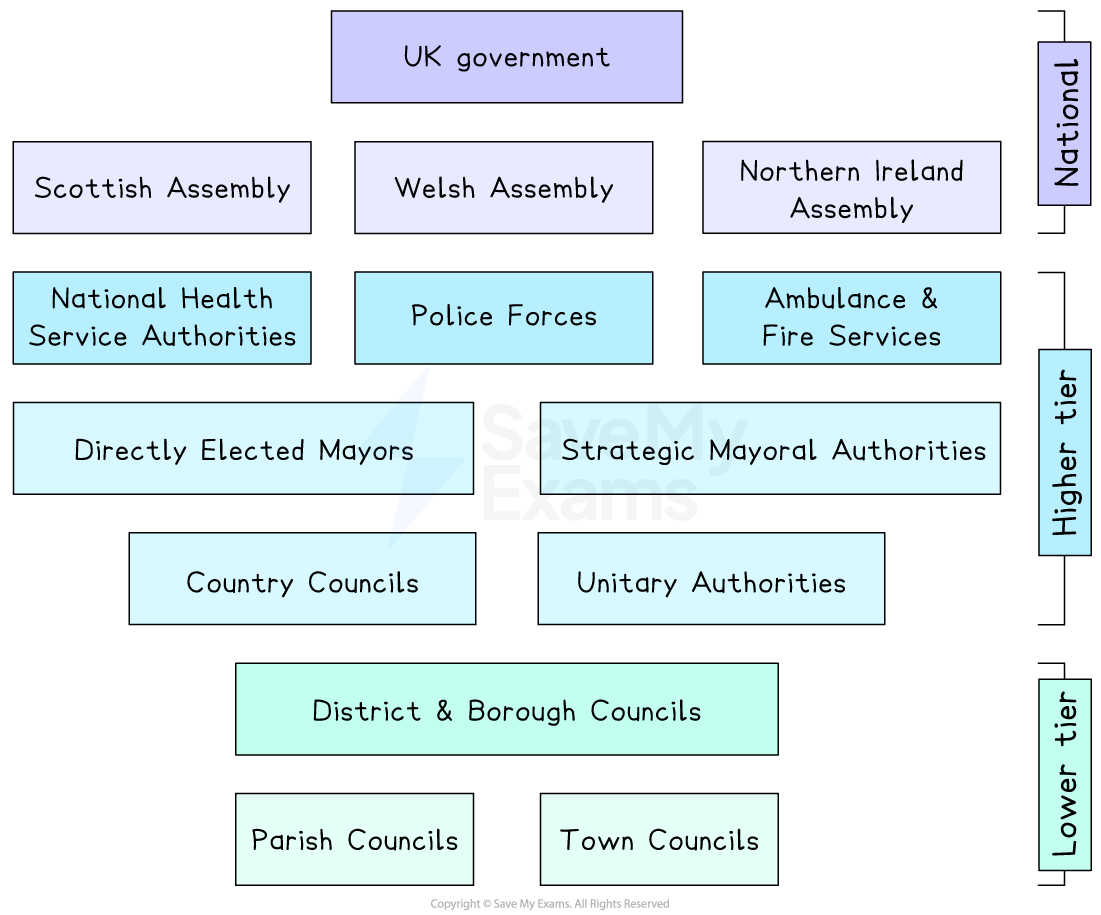
Structure of local government in the UK
Lower tier local government focuses on very local services and community needs, often covering smaller areas
Higher tier local government covers larger areas and is responsible for strategic services that require wider coordination
How local government is structured
Parish councils
Parish councils represent small villages or rural communities
They deal with very local issues such as footpaths, village halls and community events
Town councils
Town councils are similar to parish councils but operate in larger towns
They focus on local amenities, community projects and representing residents’ views
District and Borough Councils
These councils provide local everyday services, such as housing, waste collection and local planning
They serve individual or groups of towns or cities within a county or larger area
County councils
These are organisations, such as Staffordshire County Council, that provide large-scale services across a wide area, such as education, social care, highways and libraries
They usually work alongside district or borough councils in a two-tier system
Unitary authorities
Unitary authorities, such as Medway Council, combine county and district responsibilities into one council
They provide all local services in their area, making decision-making simpler
Directly Elected Mayors
Directly elected mayors, such as Andy Burnham in Manchester, lead a city or local area and provide visible leadership
They are responsible for setting priorities and representing the area locally and nationally
Public service authorities
NHS authorities
NHS authorities plan and manage health services in a local area
They ensure hospitals, GPs and community health services meet local needs
Police forces
Police forces are responsible for preventing crime, enforcing the law and protecting the public
They operate regionally and work closely with local councils and communities
Ambulance and Fire Service authorities
These authorities provide emergency response services, including firefighting, rescue and medical emergencies
They also carry out prevention work, such as fire safety education
Services provided by local government in the UK
By 2028 the aim of the government is to replace County councils in England with Unitary Authorities and Strategic Mayoral structures
Strategic Mayoral Authorities will manage regional strategy
Unitary Authorities will deliver most local services
Town or parish councils will continue to focus on very local community needs
Local government is subject to annual financial and governance audits
These audits help identify poor management or misuse of public money
The central government has the power to intervene or take over the running of a council in serious cases
This may happen if there are major financial failures or governance problems
Strategic Mayoral Authorities (SMAs)
Strategic Mayoral Authorities will cover large regions made up of several neighbouring unitary authorities.
They will usually serve a population of around 1.5 million people.
They will be led by a directly elected mayor who will provide regional leadership.
Key services and responsibilities
Service | Explanation |
|---|---|
Transport |
|
Planning and housing |
|
Economic growth |
|
Oversight and coordination |
|
Devolution |
|
Unitary Authorities
Unitary authorities will act as single councils responsible for all local government services in their area
They will combine the roles previously carried out by county and district councils
Each authority will usually serve a population of around 500,000 people
Key services and responsibilities
Service | Explanation |
|---|---|
Social services and health |
|
Education |
|
Housing & planning |
|
Environmental services |
|
Transport |
|
Leisure and culture |
|
Regulation |
|
Some services will be statutory, meaning they must be provided by law
Other services will be discretionary and may be reduced first if budgets are cut
The amount raised through council tax will be limited by central government
Town and Parish Councils
Town and parish councils will remain the most local level of government.
They will represent small communities, villages and towns.
Councillors will be elected, and the councils will have limited powers.
Key services and responsibilities
Service | Explanation |
|---|---|
Planning |
|
Community facilities |
|
Local amenities |
|
Environment |
|
Other services |
|
Not all town or parish councils will provide all of these services
They will raise money through a local council tax to fund what they provide
Examiner Tips and Tricks
To score well on local government questions, avoid listing services without explanation
Examiners reward answers that link a service to the correct level, such as housing for unitary authorities or footpaths for parish councils
Showing you know who is responsible for what helps avoid vague answers and gains marks
Role and accountability of councillors
Councillors play a key role in local democracy, representing residents, helping make decisions, and holding the council to account
What do councillors do?
Role | What this involves |
|---|---|
Representing the community |
|
Considering residents’ views |
|
Making local decisions |
|
Committee membership |
|
Specialising in key areas |
|
Dealing with casework |
|
Attending meetings |
|
Civic and community role |
|
Holding the council to account |
|
Informing the public and media |
|
Declaring interests |
|
Councillors are accountable to voters at local elections, which take place every three or four years
Voters can remove councillors who they feel have not represented them effectively
They are held to account by the public, pressure groups and the media
Poor behaviour or controversial decisions can attract public criticism
Each council has a Code of Conduct for Members
This sets out expected standards of behaviour and includes sanctions for breaches

Unlock more, it's free!
Join the 100,000+ Students that ❤️ Save My Exams
the (exam) results speak for themselves:

Was this revision note helpful?