British Society: Principles & Values (AQA GCSE Citizenship Studies): Exam Questions

Exam code: 8100

1 hour17 questions
1
8 marks

‘The right to freedom of speech should not be limited, even if this means offending people.’

Considering a range of views, to what extent do you agree or disagree with this statement?

In your answer you should consider:

  • the key principles and values of modern British society

  • how successful the law is at balancing the rights of individuals when dealing with injustice and discrimination.

2
1 mark

Why is tolerance an important value in modern Britain?

Because modern British society is...

  • insular.

  • isolated.

  • monocultural.

  • multicultural.

3
2 marks

Using one example, explain the term ‘rule of law’.

4
4 marks

Source A

The key British value of democracy

Democracy is a key British value. However, in 2020 the YouGov Democracy Study found that 70% of Britons thought democracy had weaknesses and that modern British society could be more democratic.

The criticisms of democracy in modern Britain include the beliefs that:

  • the public should be better informed about politics and government

  • the public should have more say in political decision-making and government

  • the media should provide reliable information to citizens

  • the government should protect all citizens against poverty.

With reference to Source A, discuss two ways the British value of democracy could be strengthened.

5
1 mark

In 2010, 116 pieces of legislation were brought together to form a single law.

This law protects UK citizens from discrimination.

What was the name of the law?

  • Equality Act

  • Geneva Conventions

  • Hague Convention

  • Human Rights Act

6
8 marks

‘The actions of government, not citizens, are the best way to promote respect and understanding in British society.’

Considering a range of views, to what extent do you agree or disagree with this statement?

7
1 mark

What is meant by the term ‘equal opportunities’?

8
8 marks

‘British citizens have a duty to participate in democracy even if they feel apathetic about politics.’

Considering a range of views, to what extent do you agree or disagree with this statement?

In your answer you should consider:

  • the political rights and duties of British citizens

  • issues relating to voter apathy.

9
2 marks

Explain the term ‘tolerance’.

10
4 marks

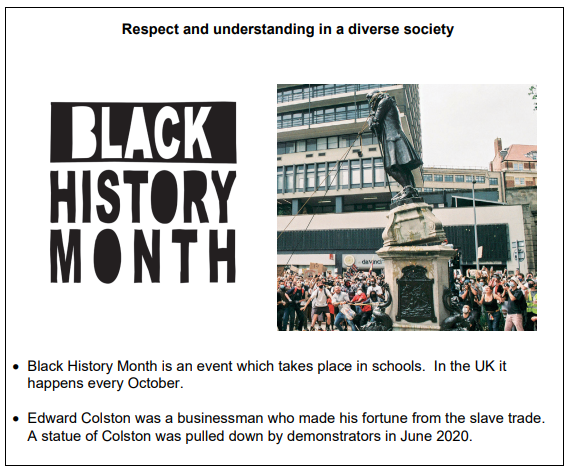
Source A

Black History Month text with a crowd surrounding the toppled statue of Edward Colston in a city setting, emphasising diverse societal respect.

With reference to Source A, discuss ways UK citizens can promote respect and understanding in a diverse society.

11
1 mark

In which year was the Equality Act passed?

  • 1990

  • 1998

  • 2000

  • 2010

12
8 marks

‘Freedom of speech is a threat to the British value of tolerance.’

Considering a range of views, to what extent do you agree or disagree with this statement?

13
1 mark

Define the term ‘individual liberty’

14
2 marks

Name two ‘British values’.

15
4 marks

Source A

Rights and duties

The rights a citizen has in a democracy are often linked to duties. Some duties are legally binding. Others are not. For example, citizens have a right to vote but voting is not compulsory in the UK.

Voting is often seen as a duty because many people think that for a democracy to be successful, the voices of all citizens should be heard. This is achieved most effectively when all citizens vote.

Describe why it is important for British society that citizens fulfil two other duties, not mentioned in Source A.

16
1 mark

What does the 2010 Equality Act protect citizens from?

  • Discrimination

  • Increases in taxation

  • Jury service

  • War crimes

17
4 marks

Source B

The need for mutual respect and understanding in a diverse society

UK politicians often talk about the need for greater tolerance of difference in Britain’s diverse society.

One way this was attempted was the introduction in 2011 of the National Citizenship Service (NCS) for 15-17 year olds.

One purpose of the NCS is to help young people gain an understanding of social diversity and the importance of tolerating others.

Describe two ways, not mentioned in Source B, that could make British citizens more tolerant of diversity