Taxation (Edexcel GCSE Citizenship Studies): Revision Note

Exam code: 1CS0

Lisa Eades

Written by: Lisa Eades

Reviewed by: Steve Vorster

Updated on

Introduction to taxation

  • Each year the government presents its Budget to Parliament, showing what it wants to spend for the following year and how the monies will be raised

  • In the 2025 Budget, the government announced that it expected to raise £1,304 billion, mainly through taxation, in 2026-27

Expected sources of taxation 2026-2027
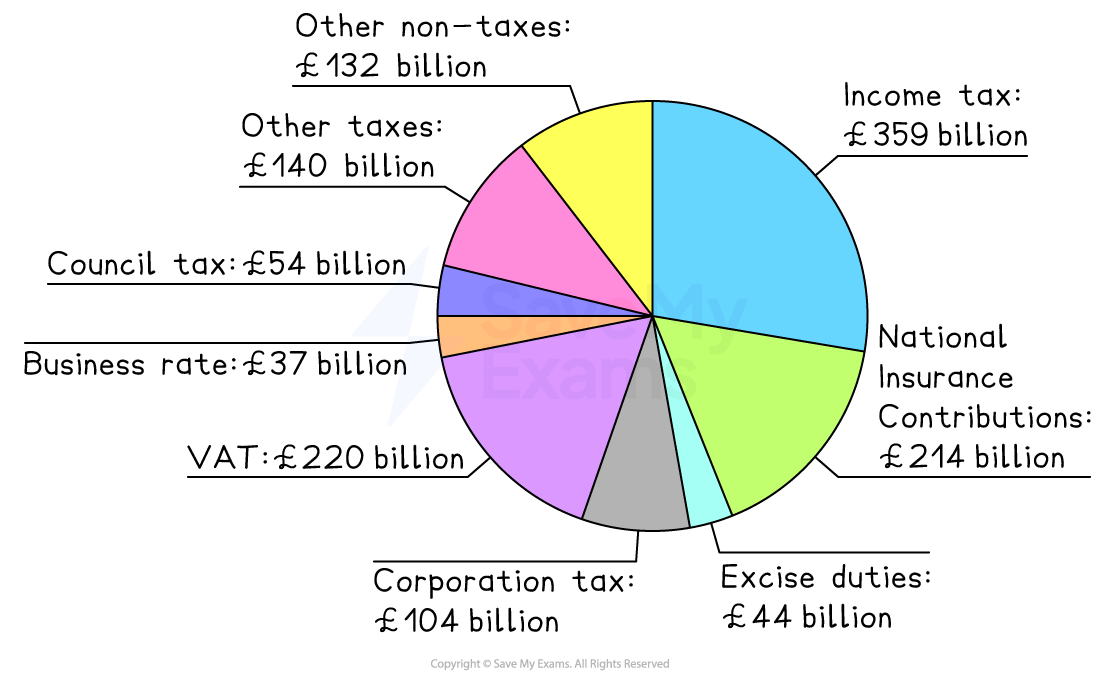
Pie chart showing UK tax revenue sources: Income tax £359bn, VAT £220bn, NI £214bn, Corporation tax £104bn, and others totalling £1,314bn.

Direct taxation

  • Direct taxation refers to taxes that are paid directly to the government by individuals or businesses rather than being passed on through prices of goods and services

    • Direct taxes are typically levied on income, profits, gains and wealth

  • They are a major source of government revenue, funding public services like healthcare, education and infrastructure

Main types of direct taxation in the UK

Type of tax

Explanation

Income Tax

  • Income Tax is charged on individual earnings, including salaries, self-employment income, pensions and some benefits

  • For the 2025/26 tax year, most people have a Personal Allowance of £12,570 before any income tax is due

  • Above that, the rates for England, Wales and Northern Ireland are 20% (basic), 40% (higher) and 45% (additional) on successive bands of income

National Insurance Contributions (NICs)

  • NICs are also direct taxes on earnings, paid by employees, employers and the self-employed to fund the NHS and state pensions

Corporation Tax

  • Corporation Tax is charged on company profits rather than personal income

  • Businesses calculate their taxable profits and pay the rate directly to HMRC

Capital Gains Tax (CGT)

  • Capital Gains Tax is paid on profits from selling assets, such as property (not main homes) or shares, when the sale price exceeds the purchase price

Inheritance Tax (IHT)

  • Inheritance Tax is charged on estates passed on after a person’s death above a set threshold

  • Only a small percentage of estates currently pay IHT

Indirect taxation

  • Indirect taxation refers to taxes that are charged on goods and services rather than on income or profits

    • Indirect taxes are usually paid to the government through businesses, but the cost is passed on to consumers in prices

  • They provide a major source of income for the government

    • Governments can adjust indirect taxes quickly to raise revenue or influence behaviour

Main types of indirect taxation in the UK

Type of tax

Explanation

Value Added Tax (VAT)

  • VAT is the main indirect tax in the UK and is charged on most goods and services

  • The standard rate of VAT is 20%

  • A reduced rate of 5% applies to some goods and services, such as domestic energy

  • Some goods are zero-rated, including most basic food items, children’s clothing and books

Excise duties

  • Excise duties are indirect taxes placed on specific goods

  • These include fuel duty, alcohol duty and tobacco duty

  • Alcohol and tobacco duties are often increased to discourage harmful consumption

Environmental taxes

  • Some indirect taxes are designed to reduce environmental damage

  • Examples include the Climate Change Levy and taxes on plastic packaging

  • These taxes aim to encourage businesses and consumers to make greener choices

Unlock more, it's free!

Join the 100,000+ Students that ❤️ Save My Exams

the (exam) results speak for themselves:

Lisa Eades

Author: Lisa Eades

Expertise: Business Content Creator

Lisa has taught A Level, GCSE, BTEC and IBDP Business for over 20 years and is a senior Examiner for Edexcel. Lisa has been a successful Head of Department in Kent and has offered private Business tuition to students across the UK. Lisa loves to create imaginative and accessible resources which engage learners and build their passion for the subject.

Steve Vorster

Reviewer: Steve Vorster

Expertise: Economics & Business Subject Lead

Steve has taught A Level, GCSE, IGCSE Business and Economics - as well as IBDP Economics and Business Management. He is an IBDP Examiner and IGCSE textbook author. His students regularly achieve 90-100% in their final exams. Steve has been the Assistant Head of Sixth Form for a school in Devon, and Head of Economics at the world's largest International school in Singapore. He loves to create resources which speed up student learning and are easily accessible by all.