Government & Opposition (Edexcel GCSE Citizenship Studies): Revision Note
Exam code: 1CS0
The role of the Prime Minister
The Prime Minister is the Head of Government in the UK
They are normally the leader of the political party that has the support of the House of Commons
The Prime Minister is almost always a Member of the House of Commons
They also act as a constituency MP, representing local voters
In the 19th century, it was common for Prime Ministers to sit in the House of Lords, but this is no longer the case
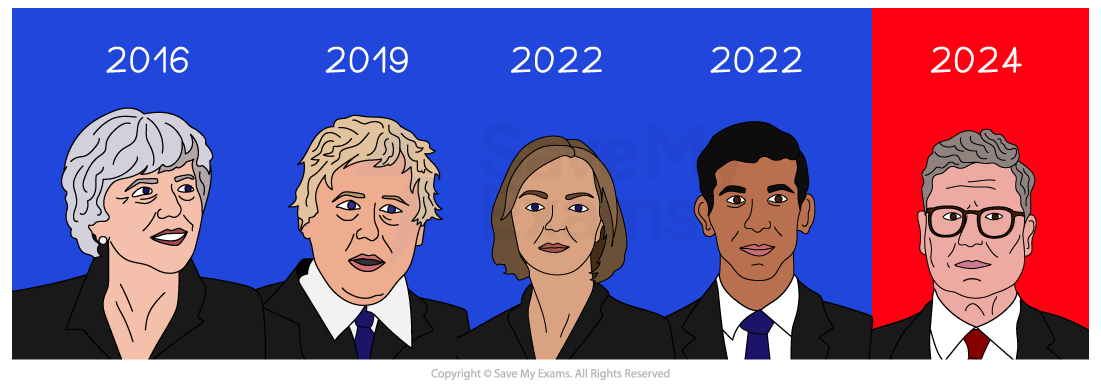
Recent UK Prime Ministers
What does the Prime Minister do?
The Prime Minister appoints Cabinet ministers and junior ministers
They have the power to reshuffle, promote or dismiss ministers at any time
The Prime Minister chairs Cabinet meetings and decide who attends and who chairs Cabinet committees
They give overall policy direction to the government and makes appointments to a wide range of public bodies
For example, they recommend individuals to the monarch to become bishops of the Church of England
They appoint political advisers who work with them in 10 Downing Street
These advisers help with strategy, media and policy coordination
The Prime Minister is accountable to Parliament
They must answer questions from MPs, especially at Prime Minister’s Questions (PMQs)
They are responsible to Parliament for the actions of the whole government
The Prime Minister can decide the date of the next general election
This power applies unless the House of Commons passes a vote of no confidence
The Prime Minister also acts as a spokesperson for the UK
This includes representing the country at international summits and meetings
During crises or major events, the Prime Minister speaks for the nation
For example, during the Covid pandemic, the Prime Minister addressed Parliament and the public on a regular basis
The role of the cabinet
The Cabinet is made up of the most senior members of the government
Cabinet members hold their posts at the will of the Prime Minister
This means the Prime Minister can appoint, reshuffle or dismiss them at any time
The Cabinet usually consists of around twenty senior ministers
These ministers receive an additional salary on top of their MP’s pay
It can include unpaid members or ministers invited to meetings for specific issues
Responsibilities of Cabinet ministers
Each Cabinet minister is responsible for a major area of government business.
They lead a government department
Key Cabinet roles
Cabinet role | Main responsibilities | Current holder |
|---|---|---|
Chancellor of the Exchequer |
| Rachel Reeves |
Foreign Secretary |
| David Lammy |
Home Secretary |
| Yvette Cooper |
Defence Secretary |
| John Healey |
Within each department, Cabinet ministers are supported by junior ministers
These ministers help manage policy and answer questions in Parliament
What does the Cabinet do?
The Cabinet meets regularly to discuss government policy and major national issues
Cabinet members advise the Prime Minister based on their areas of responsibility
Cabinet decisions are usually made by discussion and agreement, not formal votes
At the end of a discussion, the Prime Minister summarises the decision
Collective responsibility
Cabinet government operates under the principle of collective responsibility.
This means that:
All Cabinet members must publicly support Cabinet decisions, even if they disagreed in private
Cabinet members must defend decisions in Parliament and the media
If a minister cannot support a decision, they are expected to resign
This principle helps present a united government and maintains stability
The role of ministers
Government ministers are responsible for running individual government departments, such as Health, Education or Work and Pensions
Most senior ministers use the title Secretary of State
E.g. the Secretary of State for Work and Pensions.
Some senior ministers have special historic titles, such as the Chancellor of the Exchequer
Ministers are also bound by the principle of collective responsibility
Junior ministers and departmental teams
Cabinet ministers lead a team of junior ministers within their department
Each junior minister has specific responsibilities, such as Minister for Schools
This structure allows departments to manage large and complex areas of government effectively
What do Ministers do?
Role | Explanation |
|---|---|
Policy development and legislation |
|
Accountability to Parliament |
|
Public communication and representation |
|
Working with external organisations |
|
The role of the opposition
The opposition in Parliament is the second largest party in the House of Commons
A strong opposition can shape policy debates but their influence can be limited by large government majorities
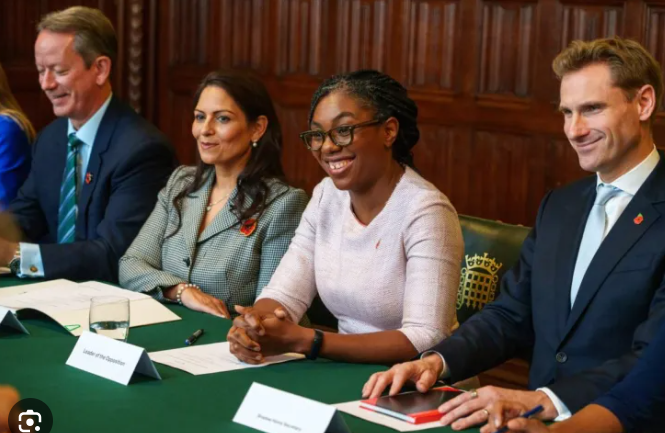
Roles of the opposition
To provide alternative government, or a ‘government-in-waiting’
To hold the government to account
To scrutinise legislation and policy proposed by the government
To present alternative policies to the electorate
To lead on opposition days
To trigger confidence motions if needed

Unlock more, it's free!
Join the 100,000+ Students that ❤️ Save My Exams
the (exam) results speak for themselves:

Was this revision note helpful?
