Binary (Edexcel GCSE Computer Science): Exam Questions

Exam code: 1CP2

22 mins3 questions
1a
2 marks

Computers manipulate binary patterns.

Complete the table with the result of applying the shift to the binary pattern.

Binary pattern

Shift

8-bit binary result

1010 0011

Logical shift left by 3

1100 1010

Arithmetic shift right by 2

1b
1 mark

Identify the correct statement about overflow.

  • Causing the program to crash during an arithmetic operation

  • Requiring more bits to store a result than are available to store it

  • Switching between binary and hexadecimal number systems

  • Using an index less than 0 or greater than the length of an array

1c
2 marks

Convert the denary value +112 to 8‑bit binary representation.

1d
2 marks

Give the 8‑bit binary two’s complement representation of denary –73

1e
1 mark

The number of bits determines the number of patterns that can be represented.

Identify the number of symbols available in the hexadecimal system.

  • 2

  • 8

  • 10

  • 16

2a
2 marks

Shifts are performed on binary patterns.

A logical shift right is performed on a pattern.

An arithmetic shift right is performed on the same original pattern.

Describe the reason the results will be different.

2b
3 marks

Binary, denary and hexadecimal patterns represent numbers.

(i) Convert the binary pattern 0100 0010 to denary.

[1]

(ii) Convert the binary pattern 0101 1011 to hexadecimal.

[2]

2c
1 mark

Data storage is measured in bits and bytes.

State the number of unique values that can be represented with 6 bits.

3
8 marks

Computers manipulate binary patterns. Patterns can represent signed or unsigned integers.

(i) Convert the denary number 57 to 8-bit binary.

[2]

(ii) Convert the binary number 0010 1101 to hexadecimal.

[2]

(iii) Describe the process of converting a binary number to two’s complement.

[2]

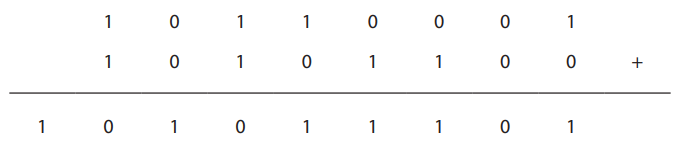
(iv) Explain what has happened as a result of adding these two 8-bit binary numbers.

Binary addition of two numbers: 10110001 and 10101100, resulting in 101011101, with a plus sign between the numbers and a line below them.

[2]