Impact of the Depression (WJEC Eduqas GCSE History): Revision Note
Exam code: C100

Summary
The Wall Street Crash and the Great Depression that followed were key in getting Hitler and the Nazis into power. Huge levels of unemployment and a drop in living standards caused many Germans to turn against the moderate parties of the Weimar Republic. A combination of effective propaganda and broad appeal meant the Nazis began to perform very well in elections. By 1932, they were the biggest party in the Reichstag.
President Hindenburg disliked and distrusted Hitler and initially refused to appoint him as Chancellor. However, political scheming between two key politicians led to Hitler being handed the keys to power in January 1933.
Social and Political Impact of the Depression
The Wall Street Crash caused economies across the world to crash but Germany was hit particularly hard
The USA had invested heavily in Germany since the end of the war and had enabled Germany to pay the reparations by lending it large loans
After the Wall Street Crash, America began recalling its loans to save its own economy
This caused the sudden and complete collapse of the German economy

Hitler’s Electoral Appeal
Mass Unemployment
The economic issues triggered an employment crisis
German banks recalled loans, which forced businesses to close and workers to lose their jobs
Other countries stopped purchasing German goods, which further increased unemployment
Unemployed workers did not spend money on goods or services
This resulted in even more companies having to make redundancies
By September 1931, 4.3 million German workers were unemployed
At least 40% were factory workers
Half of all 16 and 30-year-olds did not work
By January 1933, unemployment hit 6.1 million people
To make matters worse, the government cut unemployment benefits as it could not afford to pay all of the newly unemployed people
Those who had savings saw their value drop due to the collapse in share prices
People who had managed to keep their jobs faced a large tax increase to help pay to support the unemployed
Many also had their wages cut by employers who were trying to stay open
The combined effect was to create a lot of desperate people, which led to an increase in crime and homelessness
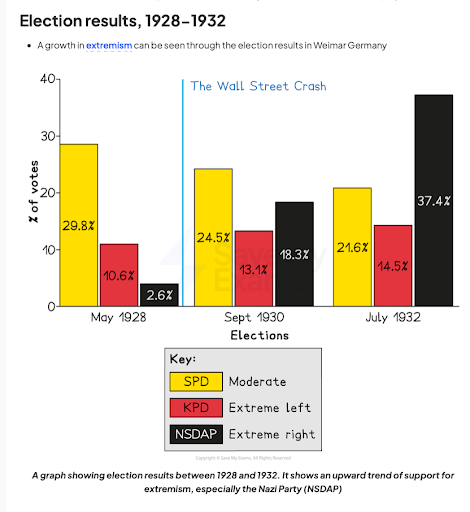
The Growth in Extremism
People blamed their financial hardship on the Weimar Government
Those with jobs were angry with the government about having to pay more tax
Those without jobs were angry with the government for linking the economy too closely to the USA
As a result, people began to look to the extremist parties for a different solution
The Munich Putsch had utterly failed and ended with Hitler being imprisoned, but it also made him and his ideas well-known all across Germany
Whilst in prison, Hitler wrote Mein Kampf (My Struggle), which became a bestseller and helped spread his ideas even further
The key ideas in Mein Kampf were that:
The Treaty of Versailles should be abolished
Jewish people were the cause of all problems in Germany and should be removed from Germany
All German-speaking people should be united in one nation that would require more living space (Lebensraum), which would be taken from other countries
All races of the world are locked in a struggle for domination and the Aryan race must emerge victorious
Hitler also argued that he was going to restore traditional German family values and remove Weimar’s freedoms for women and the arts
His promise to seize the profits of wealthy landowners and industrialists to share amongst the workers was also very popular
Reorganising the Nazi Party
The failure of the Munich Putsch convinced Hitler that he was going to have to get voted into power rather than seize it by force
As a result, he completely reorganised the NSDAP to make it more professional and electable:

A flow diagram showing the restructuring of the NSDAP in the Lean Years
A National Nazi Party
Hitler divided Germany into 35 regions (called gaue)
Each Gau (single region) had a local Nazi Party leader called a Gauleiter
Gauleiters were not often appointed
Hitler left it to the Nazi members in the Gaue to fight over who would become the Gauleiter
Hitler strongly believed in the survival of the fittest mentality
Whoever wanted the position more would win it by any means necessary
Financial Backers
To fund a national party, Hitler persuaded business owners who shared his nationalist vision for Germany to contribute
Big corporations such as Thyssen, Krupp and Bosch funded the Nazi Party
The business owners believed Hitler’s influence over the workers would limit the power of trade unions
Business owners feared trade unions because they could make unreasonable demands for increased pay and benefits
Trade unions had strong links to communism
If communism became powerful, business owners would lose their ability to make lots of profit

Unlock more, it's free!
Join the 100,000+ Students that ❤️ Save My Exams
the (exam) results speak for themselves:

Was this revision note helpful?
