Factors Leading to War in 1939 (WJEC Eduqas GCSE History): Revision Note
Exam code: C100

Summary & Timeline
Timeline
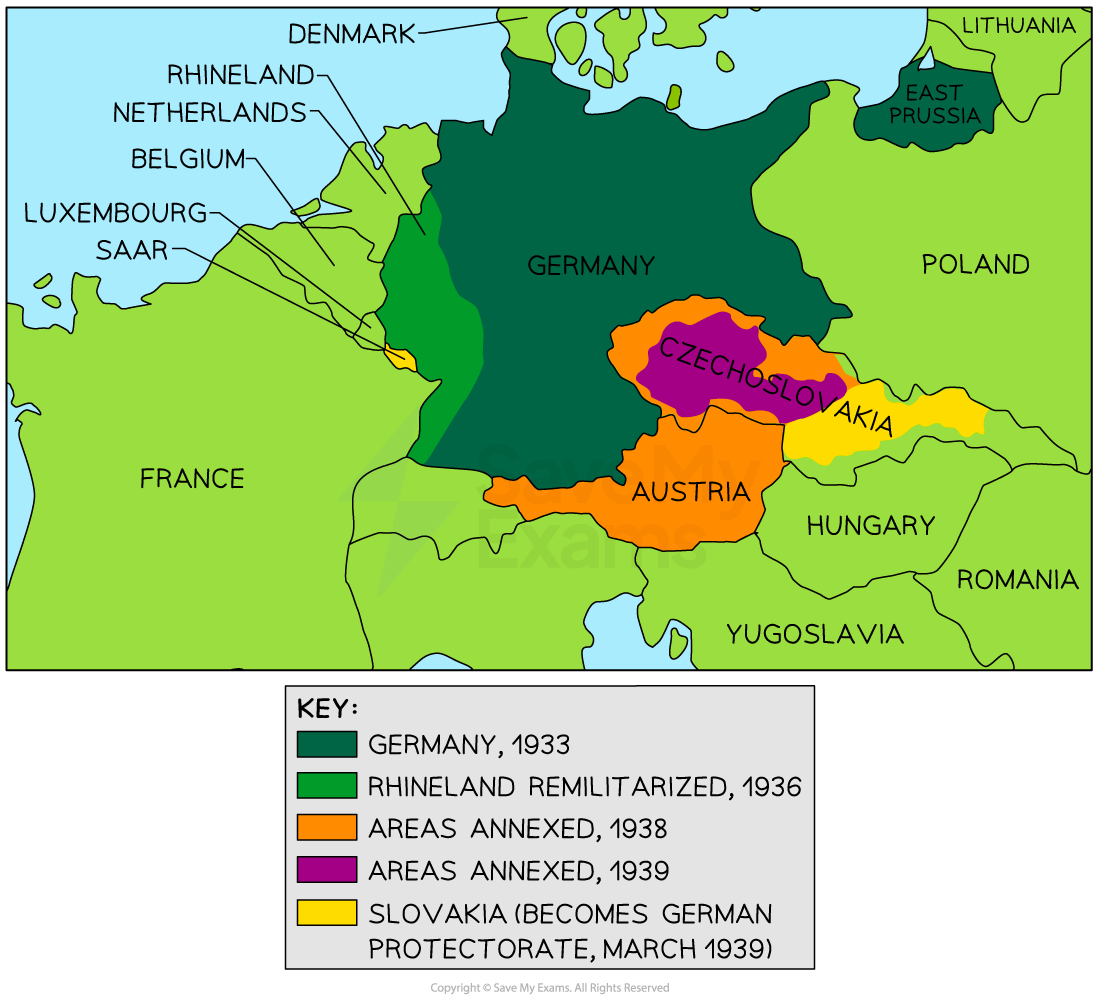
Hitler’s foreign policy aims led to the start of the Second World War in September 1939. Things began gradually as Hitler was in a weak position when he first came to power. But when Britain and France failed to act as Hitler repeatedly broke the agreements made in the Treaty of Versailles, Hitler became increasingly bold. Britain and France then missed opportunities to stop Hitler when he occupied the Rhineland, united with Austria and began rebuilding Germany’s armed forces. When Hitler started to demand land from Czechoslovakia, Britain and France gave in to his demands rather than go to war with Germany again. This policy of giving in to Hitler’s demands was known as appeasement, and Hitler became convinced that Britain and France would give in to any demand to avoid war. However, his invasion and occupation of all of Czechoslovakia convinced the leaders of Britain and France that the policy of appeasement had failed. When Hitler sent his troops into Poland, they declared war.
Hitler’s Foreign Policies
Image
Hitler had clearly stated his aim to reverse the Treaty of Versailles
But he had other aims that he also wanted to achieve
Hitler was born in the Austro-Hungarian Empire and wanted Germany and Austria to unite as one country
This was known as the Anschluss and was forbidden by the Treaty of Versailles
Hitler had destroyed the German Communist Party (KPD) and persecuted Germany’s communists
He saw communism as a great evil and blamed communists for Germany’s defeat in the First World War
He was convinced that Stalin, the leader of the communist USSR, was planning on invading Germany
By invading and defeating the USSR, Hitler believed he would rid the world of the most powerful communist country
Hitler wanted to create a Grossdeutschland or Greater Germany
It was not just Austria that Hitler wanted Germany to unite with, but all German-speaking people
This included the German-speaking populations of Czechoslovakia and Poland
Hitler wanted to expand Germany’s borders east by taking land from countries such as Poland and the USSR
Hitler called this Lebensraum, or ‘living space’, and believed it was necessary to support Germany’s growing population
He also thought it was essential to enable Germany to be self-sufficient
Rearmament and conscription
When Hitler first came to power in January 1933, his position was too weak to enable him to achieve his aims
In January 1934, he signed a non-aggression pact with Poland, which meant Germany was safe from attack from Poland
It also convinced many people that Hitler had peaceful intentions and that military action against him would not be necessary
The people of the Saarland had been governed by the League of Nations since 1920 as part of the Treaty of Versailles
When they voted overwhelmingly to rejoin Germany in January 1935, more people became convinced that Hitler would go about achieving his aims through legal and democratic ways
This vote gave Hitler the confidence to announce in March 1935 that he was going to rebuild Germany’s armed forces
He claimed this was because both France and the USSR were building up their armed forces, and therefore rebuilding German forces was necessary for the country’s defence
Rearmament and conscription were not only vital in enabling Hitler to achieve his foreign policy aims
They also helped reduce unemployment in Germany
The Rhineland, 1936
By rearming and introducing conscription, Hitler broke the terms of the Treaty of Versailles
Although alarmed by Hitler’s actions, Britain and France failed to act
This encouraged Hitler to reoccupy the Rhineland
The Treaty of Versailles had designated the Rhineland as a demilitarised area - meaning that no German troops, weapons or defences were allowed in it
Allied troops had been stationed there, but they withdrew in 1935
In March 1936, Hitler sent his troops in
This was a gamble because, even by sending nearly all of his troops, the Germans could easily have been defeated if France and Britain had sent their armies to remove them
Hitler knew this and gave his commanders orders to retreat if they met any opposition
Britain and France did nothing to try and stop the German troops
This convinced Hitler that he was free to break the terms of the Treaty of Versailles whenever he wished, without punishment by Britain and France
Anschluss, 1938
By 1938, Hitler was in a much stronger position
He had built up his military and was confident that Britain and France would not move against him
Hitler set about achieving one of his main foreign policy aims - unification with Austria
Hitler ordered Austrian Nazis to create disorder by bombing public buildings and holding mass rallies
Hitler then claimed that Austria was in chaos and demanded talks with the Austrian Chancellor, Schuschnigg
Schuschnigg gave in to Hitler’s demands to place two Austrian Nazis in his cabinet, but then announced a plebiscite
This would enable Austrians to decide on the future direction of their country
Hitler feared this would lead to a vote against the Nazis and immediately threatened invasion
Schuschnigg resigned, and the leader of the Austrian Nazis, Arthur Seyss-Inquart, replaced him as Chancellor
Seyss-Inquart then announced that Austria was in chaos and appealed to Hitler to send troops to restore law and order
In March 1938, German troops crossed into Austria, and the Anschluss was proclaimed
In the following month, a plebiscite was held and 99.75% of Austrians voted for the Anschluss
Many people have questioned how free and fair this vote was
Britain and France protested, but again took no action
Many people, including British Prime Minister Neville Chamberlain, believed that the Treaty of Versailles had been too harsh on Germany
They believed that many of Hitler’s demands about reversing the Treaty of Versailles were reasonable
They also assumed that Hitler’s demands would stop once the worst aspects of the Treaty of Versailles had been reversed, and war would be avoided
This policy was known as appeasement
Sudetenland, 1938
Within weeks of the Anschluss, Hitler was making demands over the Sudetenland
This was an area of Czechoslovakia that had previously been part of the Austro-Hungarian Empire
Hitler control of the region because it contained three million German-speaking people
He also wanted it because it contained most of Czechoslovakia’s industry, arms factories and defences
Occupying Czechoslovakia would also create more ‘lebensraum’ for Hitler
Removing Czechoslovakia as a threat was important to Hitler because it would mean he could attack France in the west without fear of being attacked from the east
In the First World War, German troops fought on two fronts
One of Hitler’s key aims was to avoid this happening again
To gain control of the Sudetenland, Hitler followed the same strategy as he had with Austria
He ordered the Sudeten Nazis to cause trouble and then, when the Czechoslovakian authorities took action, he claimed that Sudeten Germans were being persecuted
Nazi newspapers published claims of atrocities against German speakers
Hitler threatened to invade the Sudetenland to protect the German speakers
Britain’s Neville Chamberlain then became involved, believing he could find a solution that would satisfy Hitler’s demands and avoid another war in Europe
He met with Hitler three times in September 1938
15th September 1938 - Berchtesgaden
Chamberlain met with Hitler at his mountain retreat, where Hitler demanded that Germany be given the Sudetenland
Chamberlain agreed to discuss the idea of handing over the areas that contained a majority of German speakers
22nd September 1938 - Godesberg
When they met the following week, Hitler changed his demands
He now wanted other areas of the Sudetenland to be granted to Poland and Hungary
He threatened war if his demands were not met by the 1st October
Chamberlain and the French leader Daladier refused to meet his demands
29th September 1938 - Munich
In a last effort to avoid war, Chamberlain flew to Munich for a summit with Hitler
Before he left for Munich, Chamberlain gave the following speech:
“How horrible, fantastic, incredible it is that we should be digging trenches and trying on gas masks here because of a quarrel in a far-away country between people of whom we know nothing … However much we may sympathise with a small nation confronted by a big and powerful neighbour, we cannot in all circumstances undertake to involve the whole British Empire in war simply on her account. If we have to fight it must be on larger issues than that. I am a man of peace to the depths of my soul. Armed conflict between nations is a nightmare to me…”
Chamberlain was joined in Munich by Mussolini of Italy and Daladier of France
The leader of Czechoslovakia, Benes, was not invited and did not attend
The four leaders agreed that:
The Sudetenland was to become part of Germany
Poland and Hungary were to be given other parts of Germany
Chamberlain met with Hitler alone on the day after the Munich Conference and both signed the Anglo-German Declaration
This stated that both countries would settle their disputes by talks and would never again go to war with each other
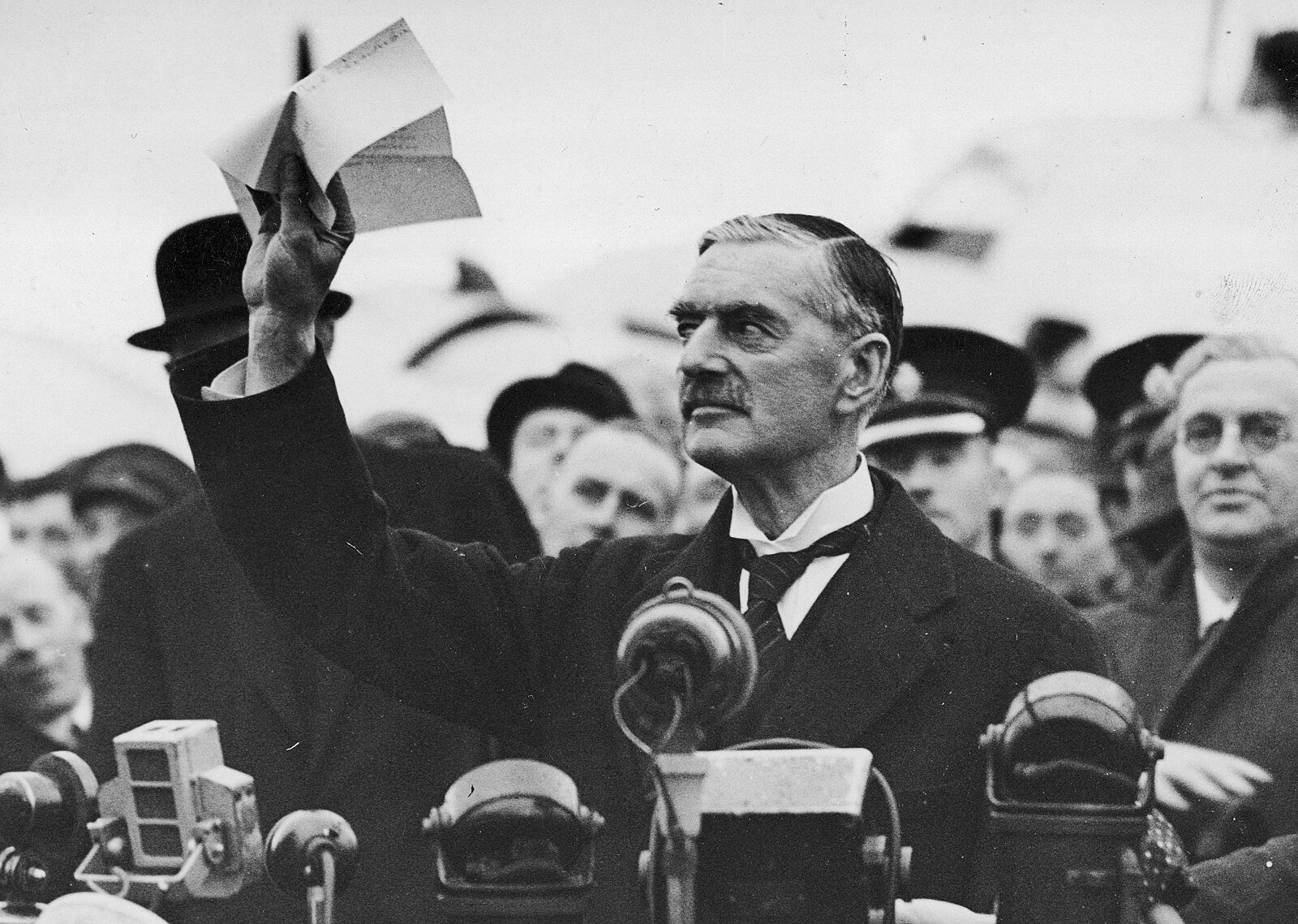
Whilst many people celebrated the Munich Agreement and the Anglo-German Declaration, others were highly critical
Winston Churchill described the Munich Agreement as a “total and unmitigated defeat”
The Invasion of Czechoslovakia
In March 1939, Hitler sent his troops into Czechoslovakia to restore order, despite there being no unrest
He proved to Chamberlain and the world that his word could not be trusted
Britain and France decided to end their policy of appeasement towards Hitler
Both countries accelerated their rearmament programmes
The Pact of Steel
In May 1939, the two fascist nations of Germany and Italy formalised their good relations into a military alliance
This meant they agreed to fight alongside each other if either nation went to war
They also began to plan military operations together
Nazi-Soviet Pact, 1939
The Treaty of Versailles had divided Germany into two by granting Poland access to the Baltic Sea
Once Hitler had gained control of Czechoslovakia, he turned his attention to gaining the “Polish Corridor”
Invading Poland would put German troops on the border with the USSR
Hitler feared this might cause Stalin, the Soviet Leader, to launch an attack in the East, whilst Britain and France attacked Germany from the West
As a result, Hitler decided to try to improve relations with Stalin
An agreement with the USSR seemed highly unlikely because Hitler and Stalin were sworn enemies
Hitler was a fascist who had openly declared his wish to destroy communism
Hitler held highly racist views about Slavic people, whom he considered ‘sub-human’
Stalin was a communist who wanted to expand the influence of the USSR
Despite this, Hitler and Stalin shocked the world on 23rd August 1939 when they announced the signing of the Nazi-Soviet Pact (also known as the Molotov-Ribbentrop Pact)
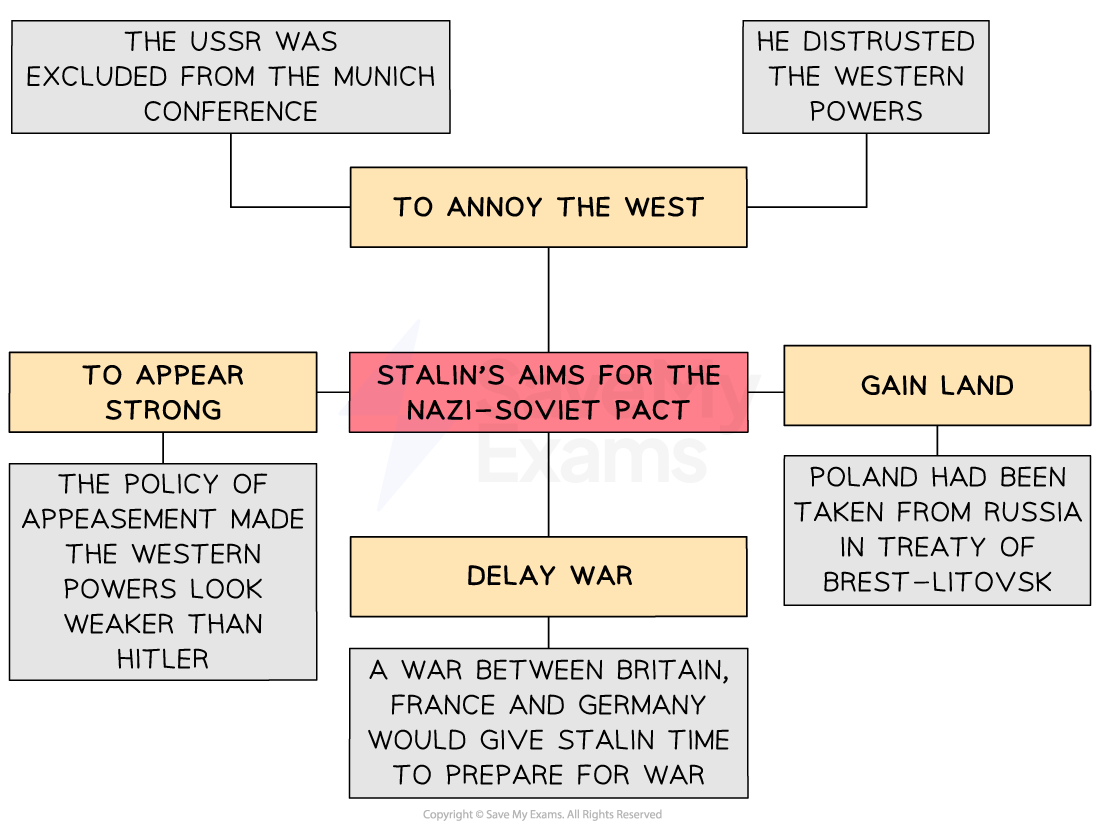
Why did Stalin sign the pact?
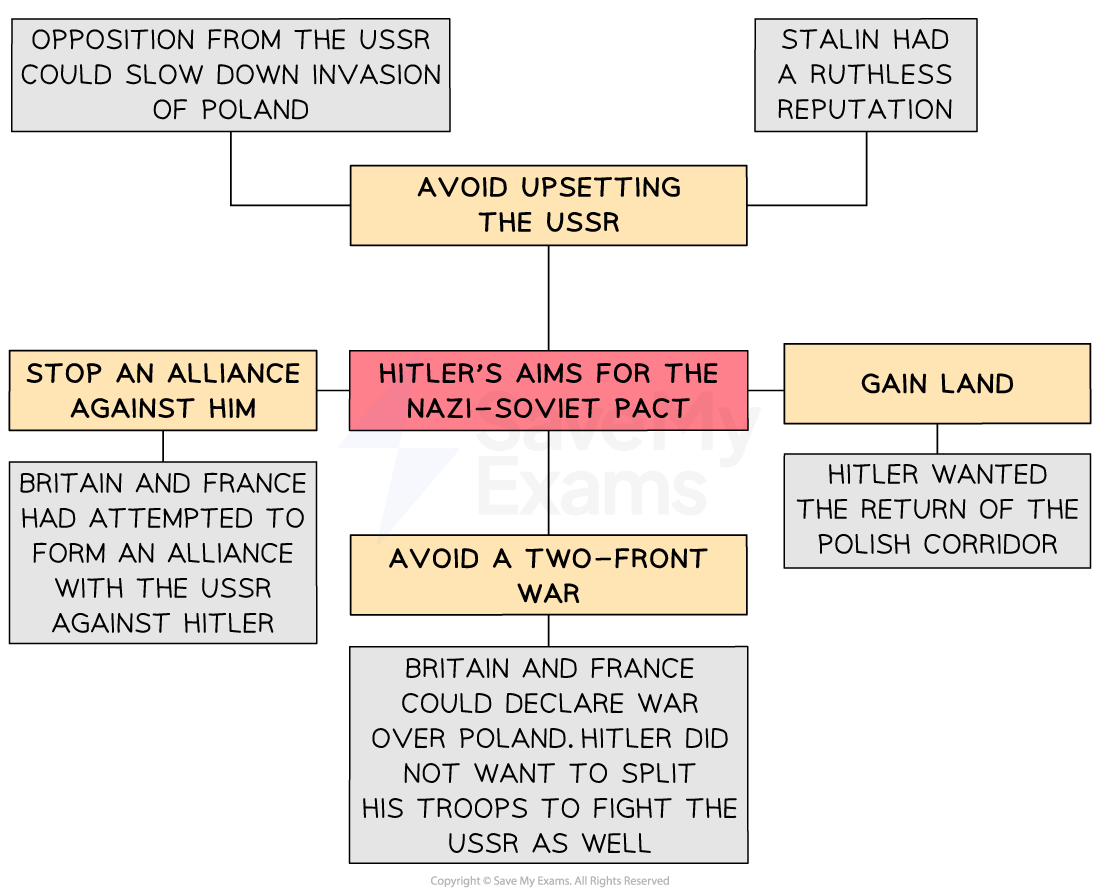
Why did Hitler sign the pact?
Consequences of the Nazi-Soviet Pact
The pact meant both sides had agreed to peace for the next ten years
They had also secretly agreed to divide Poland between themselves
Germany would take the western half of Poland and the city of Danzig
The USSR would take the eastern half of Poland and the Baltic States of Lithuania, Latvia and Estonia

The Outbreak of War
German troops invaded Poland on 1st September 1939, just nine days after the Nazi-Soviet Pact was signed
Britain and France had promised to protect Poland
They gave Hitler an ultimatum to withdraw all German troops from Poland
When he did not meet those demands, Britain and France declared war on Germany on 3rd September 1939
Examiner Tips and Tricks
You may need to remember the different motivations of Stalin and Hitler for the Nazi-Soviet Pact. In your revision, draw a Venn diagram. The aims in the middle should be shared aims between Hitler and Stalin.

Unlock more, it's free!
Join the 100,000+ Students that ❤️ Save My Exams
the (exam) results speak for themselves:

Was this revision note helpful?
