Political Instability (WJEC Eduqas GCSE History): Revision Note
Exam code: C100
Summary & Timeline
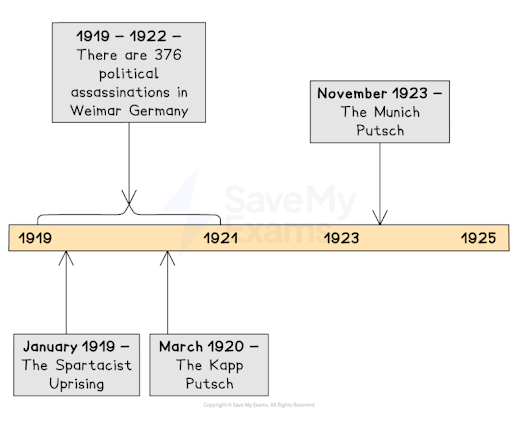
The Weimar Republic came under immediate attack from all sides of the political spectrum. The first challenge came from the extreme left when the communist Spartacists tried to seize control of Berlin in January 1919. The Spartacist leaders, Rosa Luxemburg and Karl Liebknecht, were killed and the Spartacist Uprising was soon stopped. But the government had needed the help of the right-wing former soldiers known as the Freikorps to stop the revolt.
In 1920, the Freikorps launched their own uprising under the leadership of Wolfgang Kapp. Known as the Kapp Putsch, the rebels managed to seize control of the capital city before a general strike caused its leaders to flee Germany, which enabled the Republic’s leaders to regain control.
The third attempt to seize power occurred in 1923 and was also by a right-wing group. Spurred on by the hyperinflation crisis and led by Adolf Hitler, the Nazi Party aimed to seize control first of Munich and then Berlin. The Munich Putsch failed, but it led to Hitler becoming a nationally known figure for the first time.
Spartacist Uprising 1919
Who were the Spartacists?
The Spartacist League was a German communist group
The KPD supported their cause
The name Spartacist came from the name Spartacus, the leader of a revolt of enslaved people in Ancient Rome
Rosa Luxemburg and Karl Liebknecht were the Spartacist leaders
What Triggered the Spartacist Uprising?
Friedrich Eber (opens in a new tab)t sacked Berlin’s police chief, Emil Eichhorn
Eichhorn was popular amongst the workers as he was respected and capable
Luxemburg and Liebknecht saw the anger and unrest caused by Eichhorn’s sacking as an opportunity to challenge the Weimar government
The Weimar Republic had only been established for a matter of weeks
It was unpopular with many workers and vulnerable to being overthrown
Events of the Spartacist Uprising
The uprising began on 4th January 1919
By 6th January, Berlin was in chaos:
Luxemburg and Liebknecht had encouraged the workers to go on a general strike
Over 100,000 workers protested on the streets
The Spartacists had taken control of the government’s newspaper and various telegraph offices across Berlin
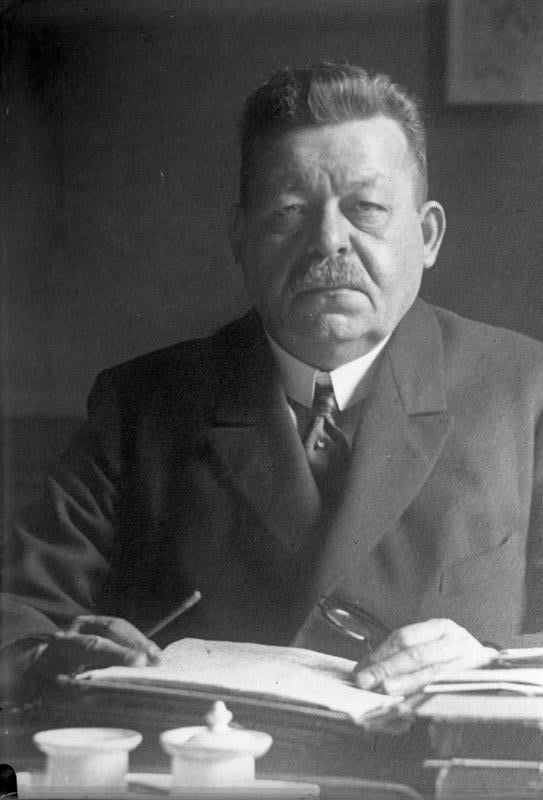
Chancellor Friedrich Ebert was in a desperate position
The German Army or Reichswehr had been all but disbanded at the end of the First World War
There were not enough soldiers available for him to bring order back to the streets
Fearing a complete communist takeover, he turned to the rightwing militia known as the Freikorps
Many members of the Freikorps were former members of the Reichswehr and still owned uniforms and weapons
The Freikorps were fiercely anti-communist and agreed to help Ebert crush the Spartacists
The inexperienced and poorly-armed Spartacists were no match for the disciplined and battle-hardened Freikorps
The Freikorps showed no mercy
By 16th January, both Luxembourg and Liebknecht had been executed and the Spartacist Uprising was over
The Kapp Putsch, 1920
A putsch is a sudden and often violent attempt to seize power
The Freikorps had helped Ebert stop a violent takeover of the country in 1919,
By 1920, many members of the Freikorps started to believe they should launch their own
The Freikorps had turned against the government
They believed the leaders of the Weimar Republic had betrayed Germany and ‘stabbed it in the back’ by signing the armistice and the Treaty of Versailles
Fearing their power, Ebert planned to disband the Freikorps in March 1920
Events of the Kapp Putsch
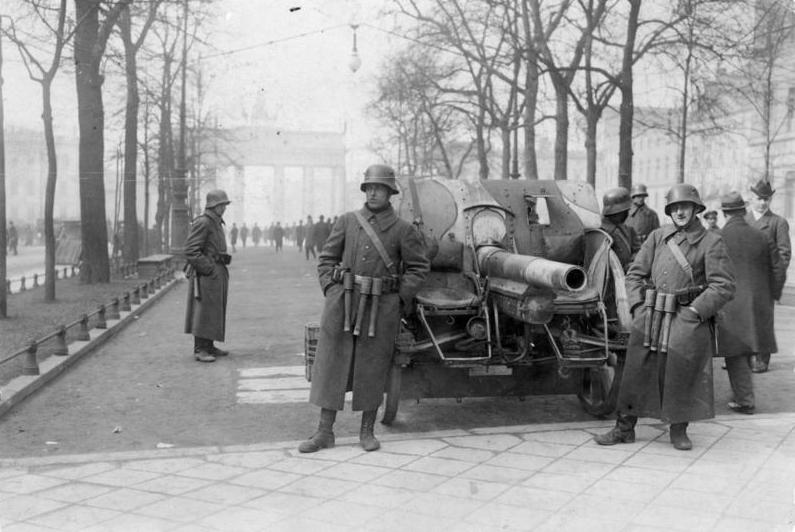
Before Ebert could disband them, 5,000 members of the Freikorps, led by Wolfgang Kapp, seized control of key areas of Berlin
Ebert ordered General Seeckt, the Head of the Army or Reichswehr, to attack the Freikorps rebels
In response, Seeckt said, “The Reichswehr does not fire on Reichswehr”, and refused to act
The government was not in control of either its own army or its capital and was forced to flee Berlin and seek safety in Weimar and Stuttgart
The End of the Kapp Putsch
Once Wolfgang Kapp announced that he intended to invite the Kaiser to return to power in Germany, many workers turned against him
Germans had far more political rights and freedoms under the Republic than they had under the Kaiser's rule
To prevent the Kaiser’s return, and with the support and encouragement of the government, the trade unions organised a general strike
Gas, electricity and water supplies were cut off, and public transport stopped running
The strike paralysed Berlin
Unable to govern and with the workers turning against him, Kapp and his fellow conspirators fled to Sweden
He was brought back to Germany in 1922 to stand trial for treason, but died before the trial began
The Munich Putsch 1923
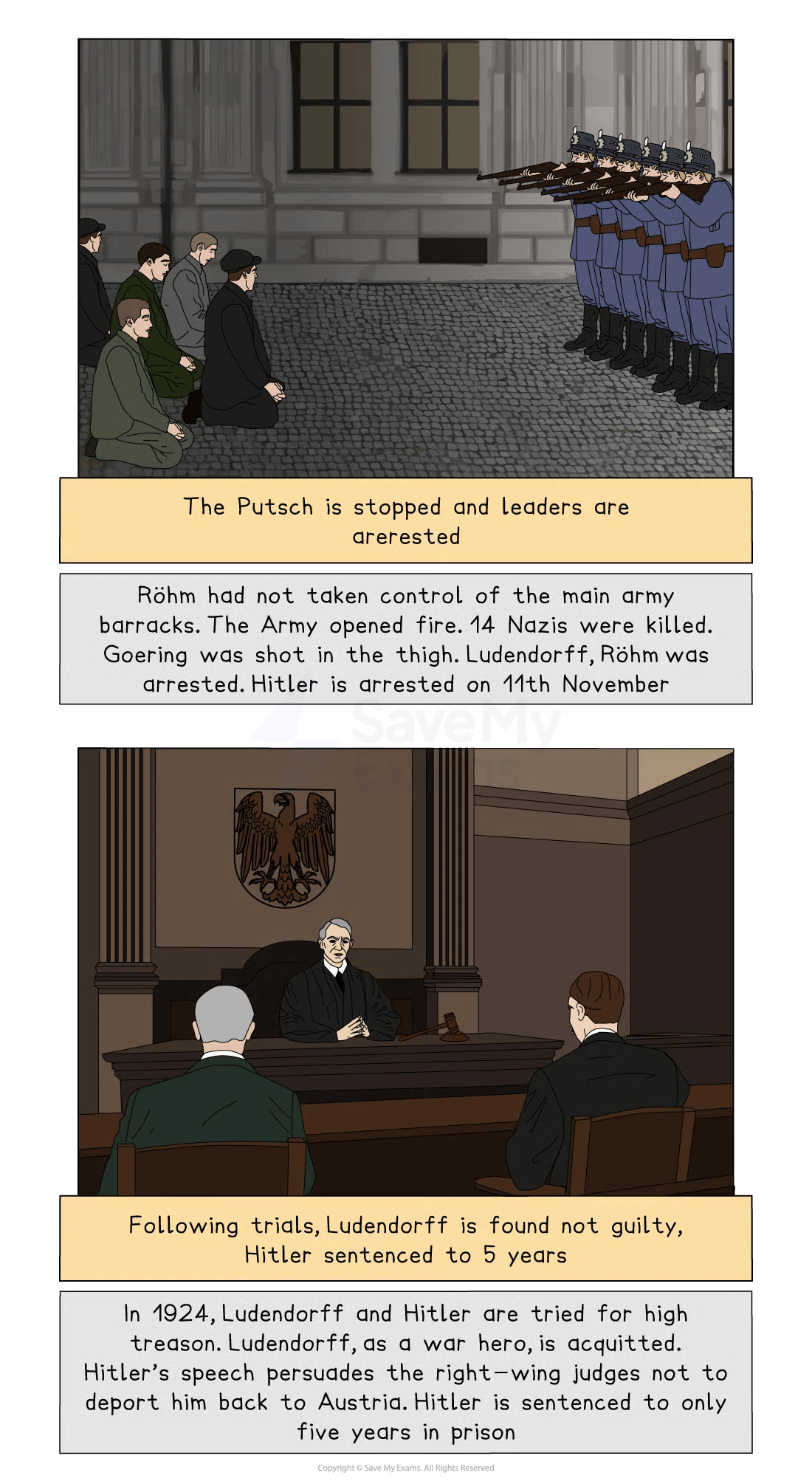
The Munich Putsch was an attempt to seize power by the Nazi Party
The Nazi Party was a right-wing group that had formed in 1919 and was originally called the German Workers’ Party or DAP (Deutsche Arbeiterpartei)
It was led by Anton Drexler and had just a handful of members when Adolf Hitler joined in September 1919
In 1920, the DAP changed its name to the National Socialist German Workers’ Party (the NSDAP or Nazi Party)
Drexler and Hitler released the Nazi Twenty-Five Point Programme, stating the party's aims
Hitler began to make speeches
He was a very talented orator (speaker), which increased his popularity
Party membership started to increase
In 1921, Hitler seized control of the Nazi Party
He created an armed paramilitary wing to the Party, known as the Sturm Abteilung (SA) or Storm Troopers
They were also known as ‘Brown Shirts’
What Caused the Munich Putsch?
Under Hitler’s leadership, the Nazi Party’s popularity rapidly increased, particularly in the city of Munich and in the Bavaria area of Germany
By 1923, the Nazi Party had 50,000 members
Hitler’s promise to tear up the Treaty of Versailles greatly appealed to many Germans
The hyperinflation crisis of 1923 caused enormous anger and frustration among Germans from all social classes
More and more people began to look to extreme parties like the Nazis for solutions
Hitler believed the Nazi’s surge in popularity, caused by the hyperinflation crisis, meant it was the perfect time for him to seize power
Events of the Munich Putsch
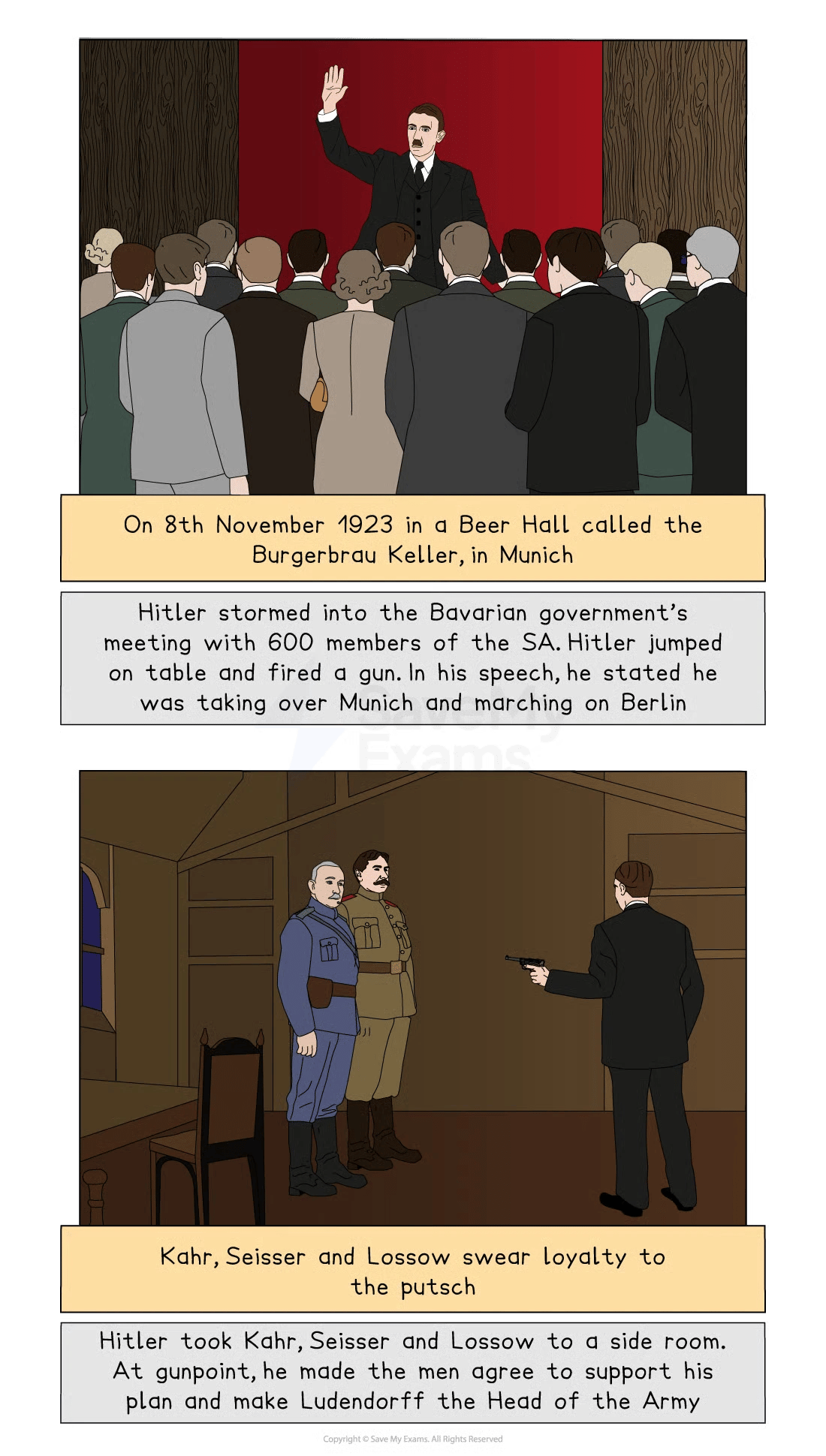
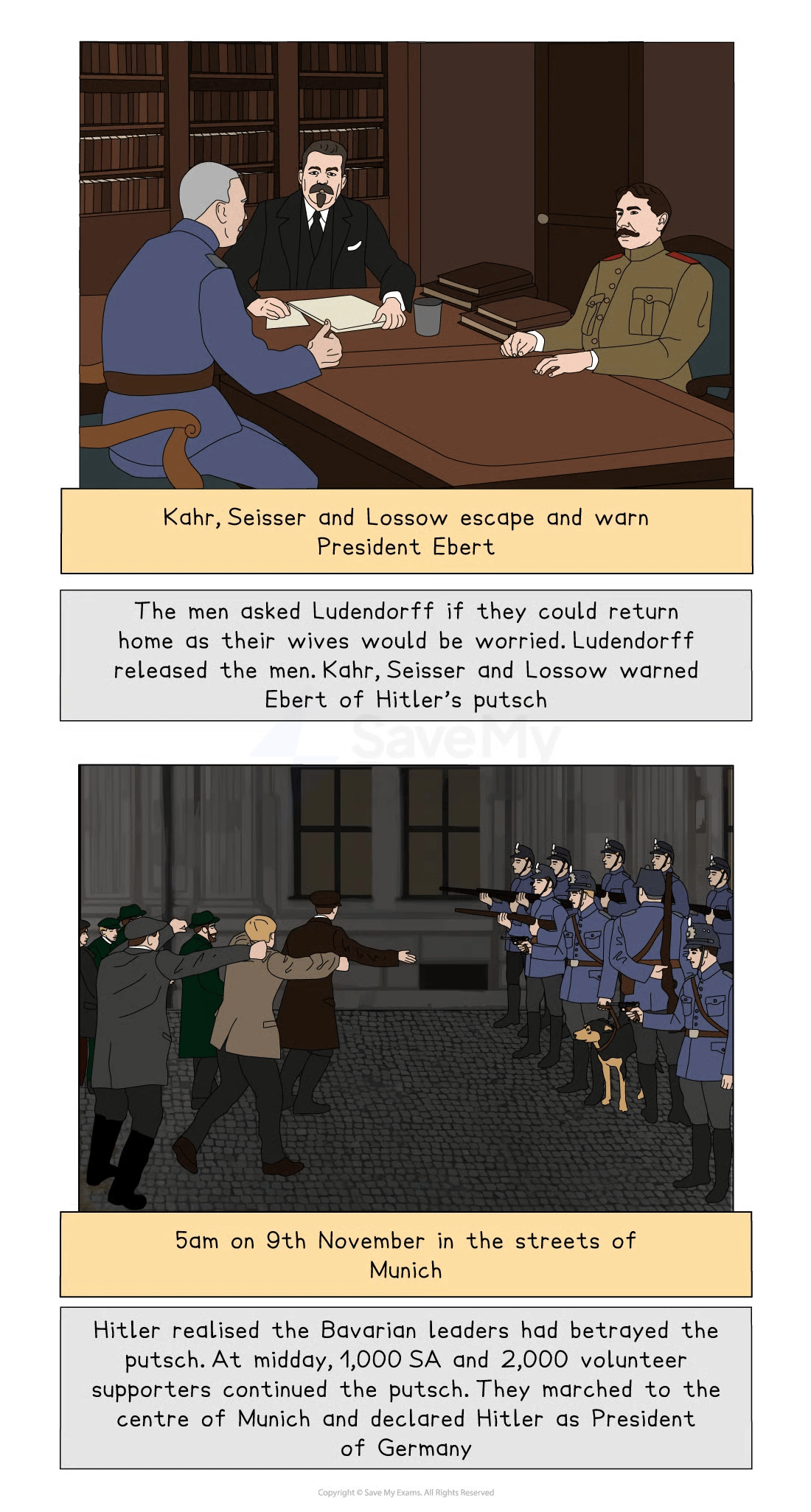
On 8th November 1923, the leader of the Bavarian Government, Gustav von Kahr, met with the leader of the Bavarian Army, General von Lossow, and the head of the Bavarian police, Colonel von Seisser, in the Buergerbraeukeller Beer Hall in Munich
Hitler, supported by the First World War hero Field Marshal Ludendorff and 600 Storm Troopers led by Ernst Rohm, burst into the meeting
Worked Example
Study the source below and then answer the question which follows.
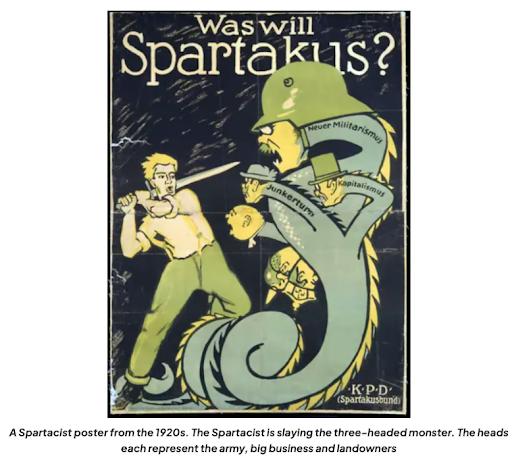
Use Source A and your own knowledge to describe the Spartacist Uprising.
(5 Marks)
Answer:
In the poster, a man dressed in workers' clothes is about to swing a sword at a four-headed monster. The monster represents the army, big business, landowners and the Church. The poster was produced by the Spartacists and suggests that they wanted to destroy the influence of the army, big business, landowners and the Church in Germany.
The Spartacists were communists and wanted all property and wealth shared equally. Big business, landowners and the Church were the owners of much of Germany’s wealth and were protected by the army. This is why the figure with the sword, who represents the Spartacists, is attacking the monster, which represents the army, big business, landowners and the Church - because the Spartacists wanted to destroy them.
Examiner Tips and Tricks
It is easy to get details of the various attempts to overthrow the Weimar Republic muddled up. A good way to get the details straight in your head is to create a three-circled Venn diagram.
Each attempt to overthrow the Republic should have its own diagram. Details that are unique to that revolt, like the Spartacist uprising being left-wing, should be written in the main body of the circle. Where revolts share details, such as the Munich and Kapp putsch, both being right-wing, should be written where those circles overlap. Details that they all share, such as violence being used, should be written where all three circles overlap.

Unlock more, it's free!
Join the 100,000+ Students that ❤️ Save My Exams
the (exam) results speak for themselves:

Was this revision note helpful?