The Ruhr & Hyperinflation (WJEC Eduqas GCSE History): Revision Note
Exam code: C100

Summary & Timeline

The reparations demanded from Germany by Britain and France as part of the Treaty of Versailles caused enormous economic damage to Germany. Things got even worse when, due to Germany’s failure to pay, France and Belgium sent troops to occupy the Ruhr region of Germany to seize raw materials such as coal.
The Weimar government encouraged the workers to go on strike and not cooperate with the invading French but they continued to pay the workers’ wages. To pay these wages and to buy the coal needed from other countries, the government decided to print huge amounts of money.
This has the effect of making the German currency lose all value, causing more chaos in Germany and turning even more people against the Weimar Government.
Events in the Ruhr, 1923
From 1922, it was clear that Germany could not pay the reparations bill set at Versailles. This is because:
Reparations were set at 132 billion gold marks (£6.6 billion)
Reparations were purposefully set too high for Germany to be able to repay
German industry could not make enough goods to raise this money through exports
The treaty took valuable industrial lands from Germany
Germany was paying much of their reparations in goods like coal, wood and iron
This created shortages within Germany
In December 1922, France accused Germany of not sending the amount of coal required by the Treaty of Versailles
French and Belgian troops entered the Ruhr in January 1923
The Ruhr was Germany’s most valuable industrial area
The soldiers seized coal, manufactured products and machinery
The Weimar government urged the coal workers to use passive resistance against the French and Belgian soldiers
Passive resistance is protesting in a non-violent way.
The workers:
Went on strike
Sabotaged machinery
The French responded by bringing their own workers into the Ruhr
The Weimar government could not force the soldiers out of the Ruhr because:
The Treaty of Versailles restricted Germany’s army to 100,000 men, whereas the French had 750,000 soldiers
The public had a poor opinion of the Weimar government
They believed that the government could do more to force the French out of the Ruhr
Hyperinflation in Weimar Germany
What is Hyperinflation?
The term inflation means the increase in prices
Inflation happens in an economy over time
For example, a loaf of bread in January 1971 cost 10p. The average price of bread in January 2023 was £1.06
Inflation is measured as a percentage
Hyperinflation is when prices rise rapidly and become out of control
In hyperinflation, wages do not match the cost of living (prices of goods)
Hyperinflation can become so bad that currency loses its monetary value. Governments can print more money to counteract the effects of hyperinflation
Why did the Occupation of the Ruhr cause Hyperinflation?
In early 1923, the invasion of the Ruhr caused inflation
Prices rose because there was a shortage of essential goods
However, the government made this situation worse because:
They continued to pay the wages of the striking Ruhr workers
They had to purchase coal from other countries to meet Germany’s demand for coal
The Weimar government decided to print more money
In 1923, there were 300 paper mills and 2,000 printers whose sole purpose was to print currency
The decision to print an excessive amount of money caused the hyperinflation crisis
By November 1923, the German currency (mark) had become worthless
Some workers received pay twice a day so they could purchase essential goods before their wages became worthless
People filled wheelbarrows full of money to buy a loaf of bread
The Impacts of Hyperinflation in 1923
Group | Positive Impacts | Negative Impacts |
Working Classes | Some workers coped with hyperinflation as their employer paid them in essential items rather than the mark People hoarded goods and sold them for a high price | Many people resorted to stealing food to survive Unemployment rose and some workers died from starvation |
People who had mortgages, rent or loans could pay off the money they owed as the debt became worthless | The middle classes lost their life savings, insurance policies and pensions The government lost their backing. The middle classes looked to extremist parties for solutions | |
Businesses | If a business took out a loan, it could fully repay the loan when the value of the mark began to decrease | Businesses could not afford to pay their workers, so they were forced to close or make redundancies |
Foreign Visitors | Visitors saw that their currency was worth more than the mark. They could buy more items in Germany with their currency | The German public did not like visitors profiting from their suffering |
Worked Example
Study the source below and then answer the question which follows.
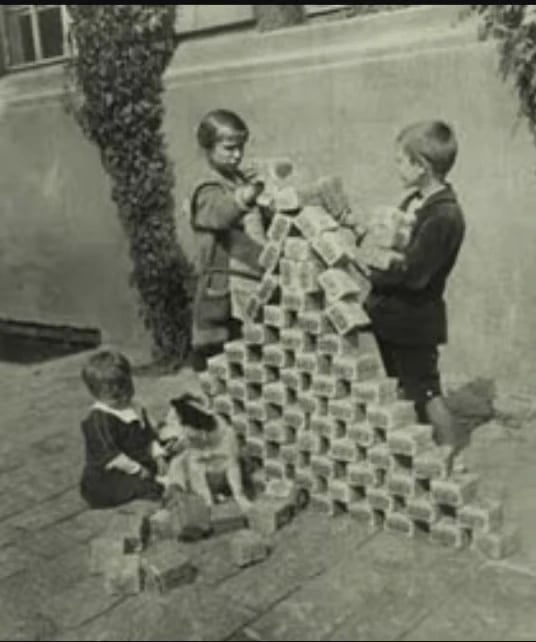
Source A
Use Source A and your own knowledge to describe the impact of the hyperinflation crisis in 1923.
(5 marks)
Answer:
In the photograph, three children and a dog can be seen playing with a large number of bank notes bundles. This clearly demonstrates the impact of the hyperinflation crisis, as it suggests that the money was practically worthless. If something has value, it is not normal to give large amounts of it to children to play with in the streets.
Inflation rose in Germany and reached its peak in November 1923 when wheelbarrows of cash were needed to purchase a single load of bread. People found that their life savings were completely wiped out overnight and money was of so little value that people began to barter for goods and, as the source shows, use money as a toy or even to light fires.
Examiner Tips and Tricks
Inflation can be a tricky concept to understand, especially how it can cause money to lose all its value.
Imagine that you have a rare diamond necklace. It would cost a lot of money to purchase the necklace because it is so rare.
Now imagine that someone made 100 more diamond necklaces. The necklace is now not as rare, meaning it would not be worth as much as it was previously.
Applying this concept to money, the more currency there is in circulation, the less it is worth. As a result, printing money can limit the impact of inflation but overprinting money can be dangerous to an economy.

Unlock more, it's free!
Join the 100,000+ Students that ❤️ Save My Exams
the (exam) results speak for themselves:

Was this revision note helpful?
