Nazi Social Policy (WJEC Eduqas GCSE History): Revision Note
Exam code: C100

Summary
Women and children were the main focus of the Nazi social policies. Women were seen as key in reversing Germany’s declining birthrate. Hitler and the Nazis wanted German women to have more children to provide the state with future soldiers and mothers. To do this, they passed laws that barred women from entering higher education and many professions. At the same time, they introduced several incentives to encourage women to stay at home and have children.
The changes introduced for children affected both schools and youth groups. Both aimed to prepare boys for a future in the army and girls for a future in the home as mothers.
Both the policies aimed at women and children had mixed success. The impact of the war meant that, with so many men away fighting, it soon became necessary for women to return to the workplace. Although many children enjoyed the adventure and opportunities the Hitler Youth organisations offered, others resented losing their free time and strict rules.
Women and the three K’s
The Nazis were determined that the changes that had occurred in women’s lives in Weimar Germany should be reversed
The Nazis believed a German woman’s life should be focused on the ‘three Ks’
Kinder (children)
Kirche (church)
Küche (cooking)
They also had strong views on the appearance and ambitions of women

Laws about marriage and family
The birthrate in Germany had declined from around 2 million per year in 1900 to less than 1 million by 1933
Several Nazi laws and policies were introduced to reverse this and increase Germany’s birth rate
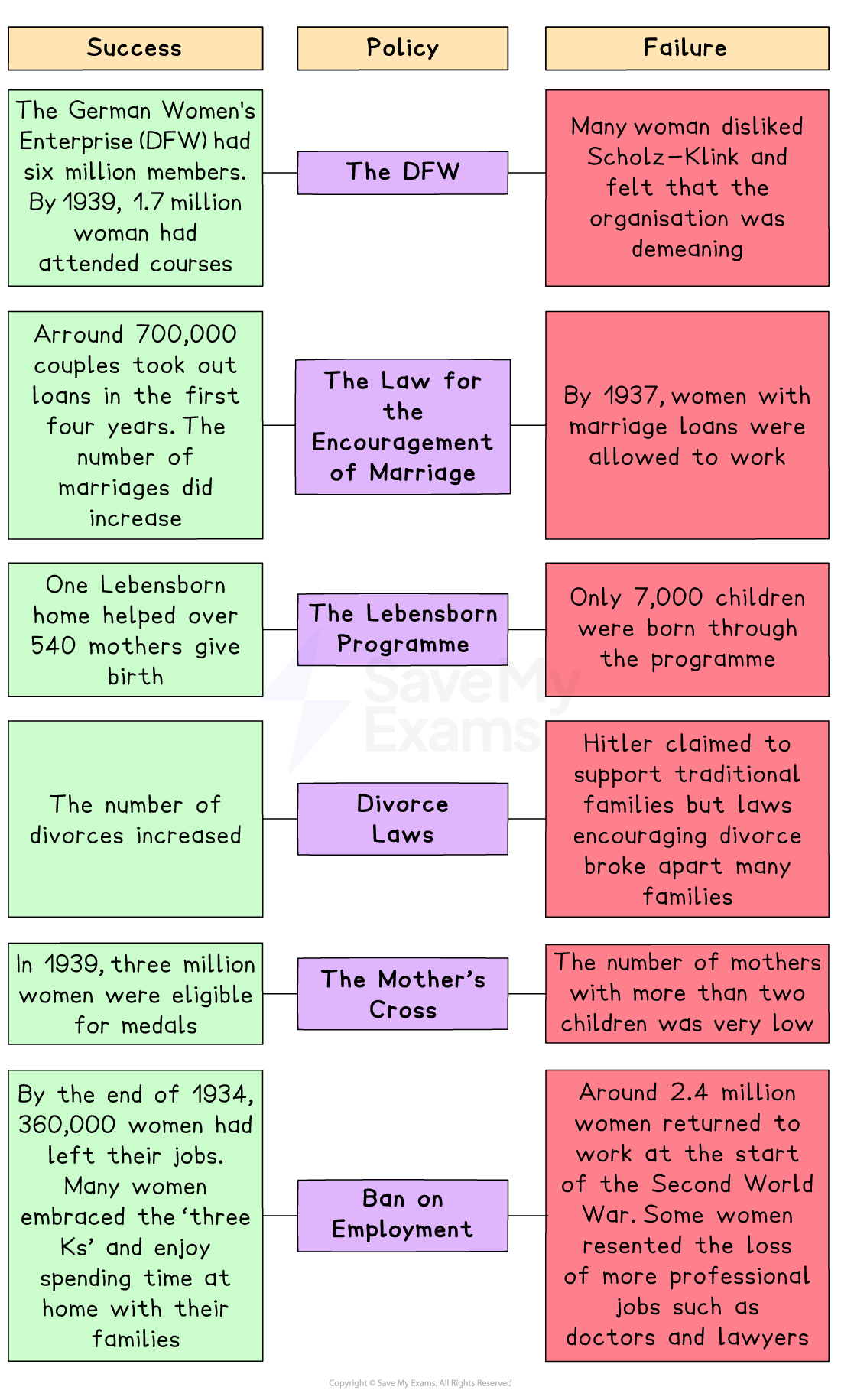
1933 - The Law for the Encouragement of Marriage
Loans of 1,000 marks (equivalent to eight months’ wages) were available to women if two requirements were met. The women had to:
Get married
Quit their jobs or stay unemployed
Mothers who gave birth to four children did not have to pay the loan back
Each child removed a quarter of the loan
1935 - The Lebensborn Programme
This programme was started by SS leader Heinrich Himmler
It paired SS men with single women to create ‘genetically pure’ children
Only women and men with a clear ‘Aryan’ ancestry were allowed to join
Special Lebensborn homes were created for women to rest after giving birth
1938 - Divorce Laws
Husbands could legally divorce their wives for failing or refusing to have children
Women caught having abortions could also be divorced
1939 - The Mother’s Cross
Awards presented on Mother’s Day in Germany were available to women who had four or more children
Mothers with gold medals were saluted in public by the Hitler Youth
Hitler was named the godfather of the tenth child in any family

The Nazis also passed laws to attempt to ensure that any children born would grow up to be soldiers and mothers
Laws about Reproduction
1933 - The Law for the Prevention of Genetically Diseased Offspring
Forced sterilisation of any woman who had:
Any experience of mental illness
Hereditary diseases
Physical disabilities
Any incident of "anti-social behaviour", such as alcoholism
This law only allowed 'racially fit' and 'desirable' women to have children
In the Nazi's opinion, this made the German race stronger and more genetically 'pure'
Laws about employment
The Nazis reduced the career opportunities available to women to encourage them to stay at home and raise children
This also created job opportunities for the millions of unemployed men

Laws about behaviour
The Nazis aimed to 're-feminise' women
They believed that developments in the Weimar era had corrupted women
Nazi local governments banned women from publicly:
Smoking
Singing or dancing
Appearing bare-legged
Cabaret and jazz clubs were closed in 1935
Whilst not illegal, the Nazi government strongly advised women not to:
Wear trousers or high heels
Wear excessive makeup
Have short hair
Pursue weight-loss
The German Women’s Enterprise (DFW)
All women-related organisations had to join the German Women's Enterprise (DFW):
Organisations that failed to join were banned
Members were enrolled on courses about childcare, cooking and sewing
Impact of Nazi policies on women
Nazi policies on women initially succeeded in increasing the marriage rate, the birth rate and the number of women unemployed
However, at the outbreak of the Second World War, many women had to work in factories and other industries to replace men who had gone away to fight
Controlling Education
Hitler knew that control of children’s education would allow him to create a generation of Nazis loyal to him
Bernhard Rust was made Education Minister in 1934 and made several changes to teachers and schools
Teachers
Those teachers not loyal to the Nazi regime were sacked
They swore an oath of loyalty to Hitler and joined the Nazi Teachers’ League
Membership of the Nazi Party was also compulsory
They attended political education courses outlining key Nazi ideas
Around 200,000 teachers had attended courses by 1939
Teachers had several responsibilities at school
Taught students the Nazi salute
Began and ended each lesson with ‘Heil Hitler’
Placed posters, Nazi flags and a picture of Hitler in each classroom
Curriculum
Boys and girls were educated separately
The Nazis took control of the curriculum so that they could influence children’s beliefs
Changes to the curriculum in Nazi Germany
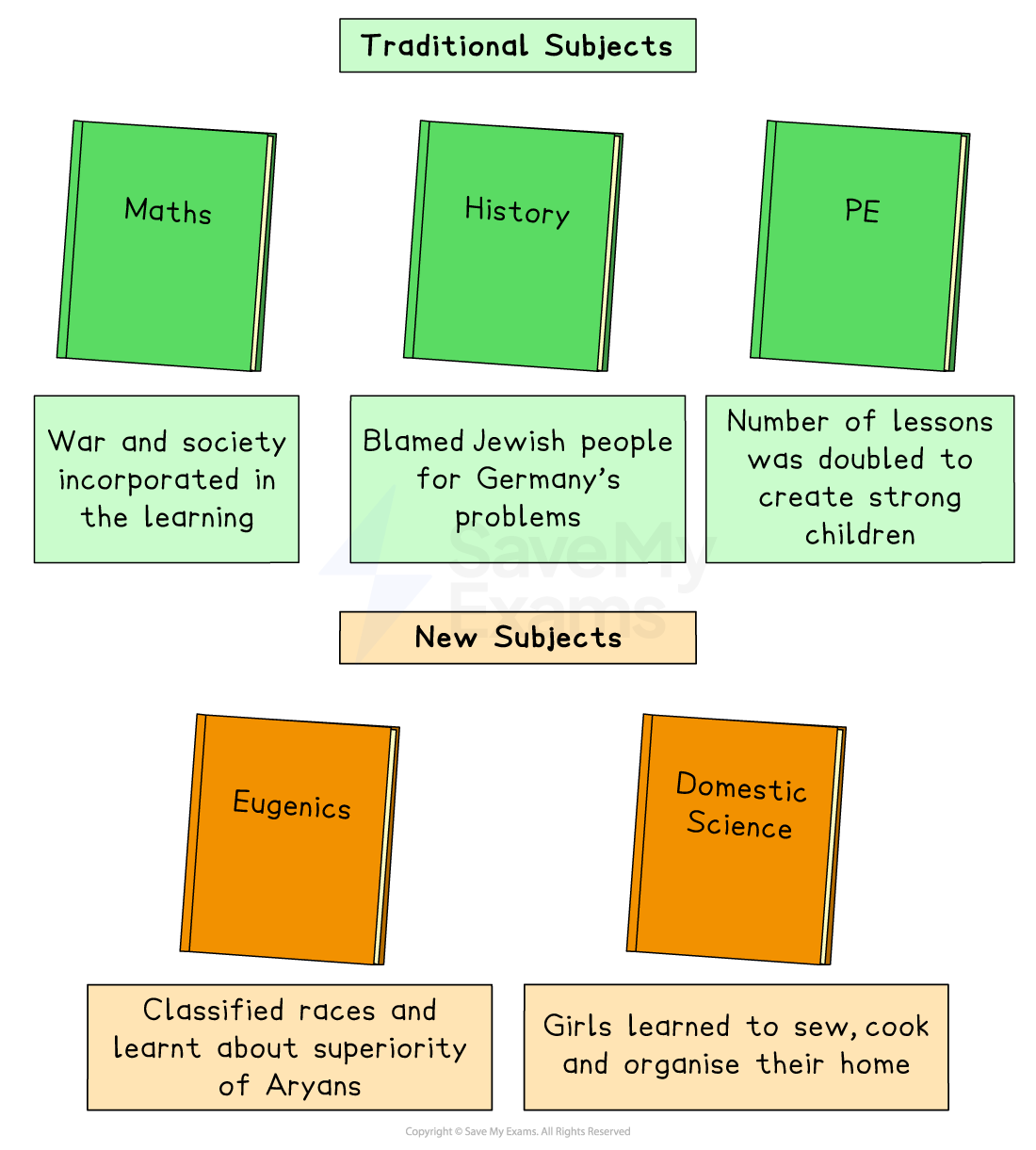
After 1935, all textbooks had to be approved by the Nazis
All books contained pictures of Hitler
Mein Kampf became a compulsory text
Events like the First World War were reworded to blame Jewish people and the "November Criminals"
Napolas
Napolas were schools for the most ‘gifted’ and racially pure children:
SS members replaced the traditional teachers
The emphasis was on sport and physical training
Students went on to join the SS or police services
By 1939, there were 16 Napolas schools
Universities
Universities were under the same strict control as schools
Nazi officials selected university lecturers
Any lecturers who did not conform to the Nazi's political or religious ideas were fired
Universities adapted their courses to teach in line with Nazi ideas
A university education was not highly regarded in Nazi Germany
Focusing on education was seen as distracting from a man's military obligation or a woman's commitment to the home
Highly educated citizens may be more likely to criticise the Nazi regime
The Hitler Youth Movement
The development of Nazi youth groups showed how important the youth were to the Nazis
Nazi policies encouraged, and finally forced, all young Germans to attend Nazi youth groups

The activities of the Hitler Youth

The League of German Maidens
The Bund Deutscher Mädel or League of German Maidens (BDM) was the female equivalent of the Hitler Youth
They shared some similarities with the Hitler Youth
The activities of the League of German Maidens
How similar was the League of German Maidens to the Hitler Youth?

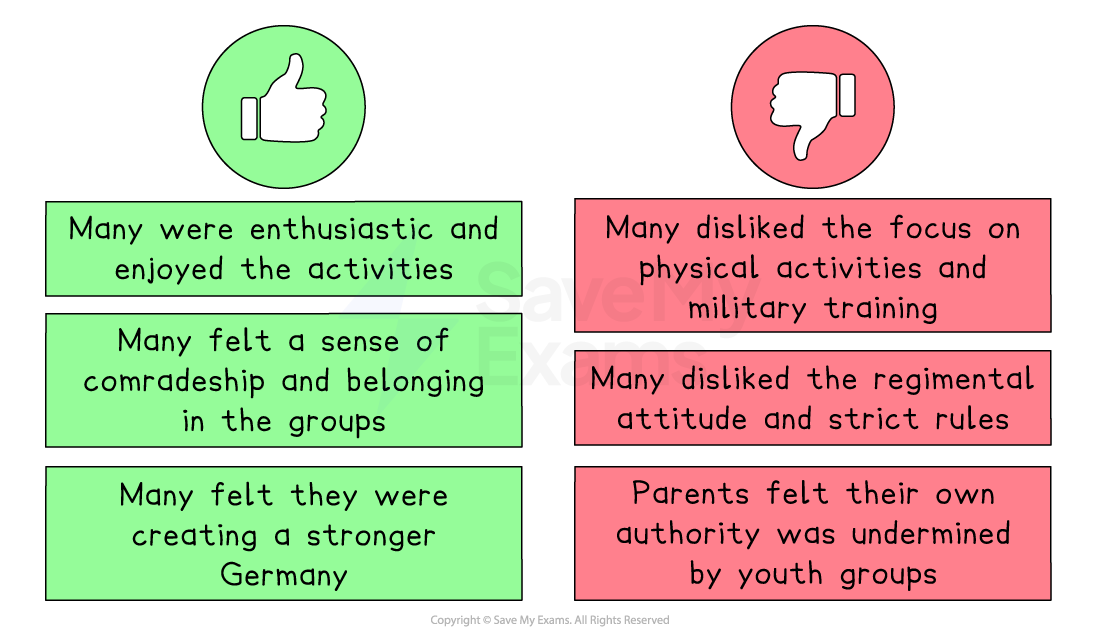
How popular were the Nazi youth organisations?
Examiner Tips and Tricks
Question 3 on this paper will ask you to examine two interpretations and explain whether they support a certain viewpoint on a historical event. As well as assessing whether both interpretations support the focus of the question, you need to reach a judgement where you explain how and why the two interpretations differ.

Unlock more, it's free!
Join the 100,000+ Students that ❤️ Save My Exams
the (exam) results speak for themselves:

Was this revision note helpful?
