Berlin Crisis (WJEC Eduqas GCSE History): Revision Note
Exam code: C100

Summary
After the defeat of Nazi Germany in 1945, the Allies decided to split Germany into four zones occupied by the USA, Britain, France and the Soviet Union.
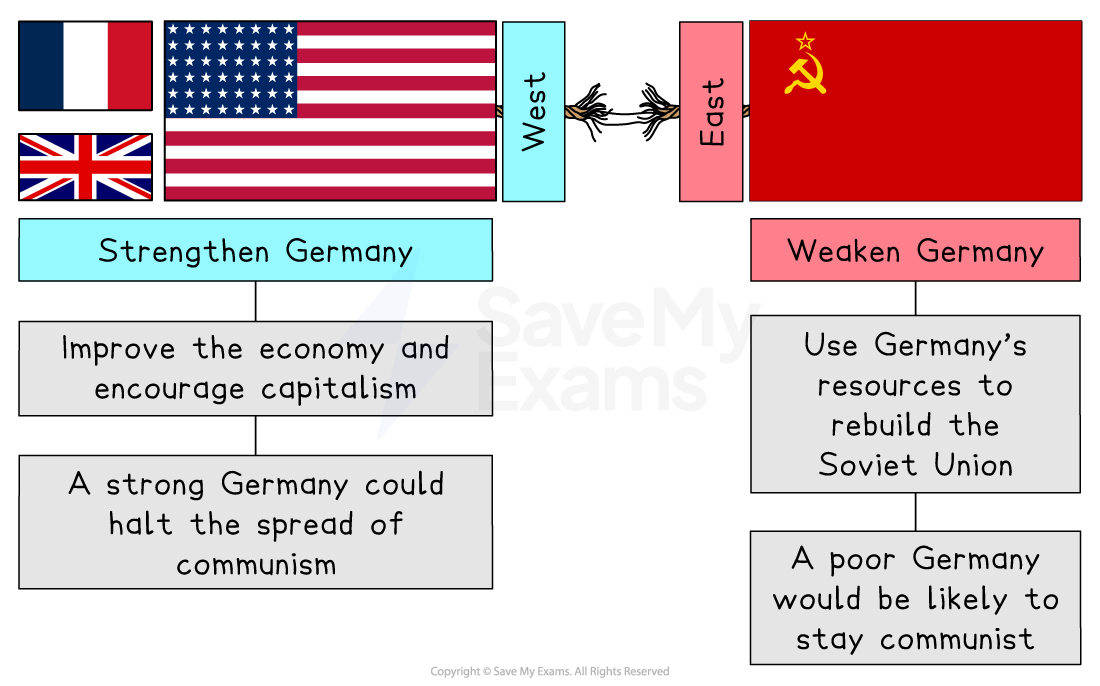
However, as tensions between the West and East increased following the end of the Second World War in August 1945, it was clear that the Allies had differing views on how to best govern Germany.
Economic differences between the Capitalist West and the Communist East prompted the countries of the USA, Britain and France to join their zones together to create Trizonia. Stalin and the Soviet Union saw this as the West’s attempt to weaken the Soviet zone in Germany. This was made worse by the creation of a new currency called the Deutschmark, which all but split Germany in two.
As a result, the Soviet Union shut off the land routes in Soviet-controlled Germany, preventing Trizonia from accessing its zone in Berlin. This became known as the Berlin Crisis.
The Berlin Airlift meant that war was avoided, and West Berlin remained under the control of the capitalist West. However, it remained a source of tension and millions of East Germans used Berlin to flee Communism and live in the West. To bring this mass migration to an end, the GDR government constructed a wall to divide East and West Berlin. The Berlin Wall became a symbol of the 'Iron Curtain' between East and West for almost 30 years.
The Division of Germany
At the Potsdam Conference, it was agreed that Germany and Berlin would be split into four zones of occupation:
Each zone was to be controlled by the USA, Britain, France and the Soviet Union
The division was only meant to be temporary, while a new German government was created
A joint organisation called the Allied Control Commission (ACC) was in charge of running Germany
However, tensions between the West and East led to disagreements between the four zones on how to best treat Germany
In March 1948, the representative for the Soviet Union’s zone stormed out of a meeting held by the ACC
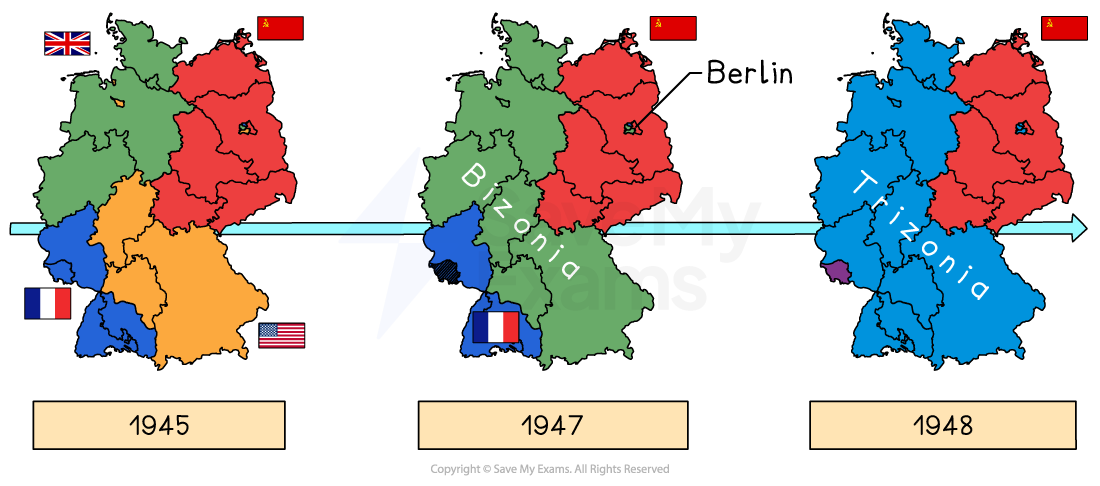
The original four zones of occupation, agreed in 1945, did not last long
In 1947, the USA and Britain merged their zones to create ‘Bizonia’
After the walkout of the Soviet representative in March 1948, France merged their zone with the USA and Britain to create ‘Trizonia’
In March 1948, Germany was split into two main zones:
The Western countries of the USA, Britain and France controlled the Western Zone
The Soviet Union controlled the Eastern Zone
The Berlin Blockade
As with Germany, Berlin was split into two parts in March 1948:
The USA, Britain and France occupied the western zone, known as Trizonia
The Soviet Union occupied the eastern zone
Trizonia introduced the Deutschmark in June 1948,
This new currency was just for the Western Zone had essentially formally divided Germany into two
Stalin wanted to demonstrate that Germany should not be divided
West Berlin was an isolated capitalist ‘island’ in the middle of Soviet controlled East Germany
Stalin decided that blockading - or preventing Western access to Berlin - would be an effective way of displaying his anger and lead to him gaining control over all of Germany’s capital

How did the Soviet Union Blockade Berlin?
As Berlin was deep inside the Soviet-occupied zone, Stalin believed it would be easy to cut off western access to the city
Members of Trizonia had to use the two agreed land routes and two air routes to access their western zone in Berlin
In June 1948, the Soviet Union closed road, rail and canal links across Soviet-controlled Germany
Without access to West Berlin, the USA, Britain and France would not be able to send supplies:
West Berlin only had enough food for 36 days
West Berlin lacked important resources like fuel and medicine
Stalin hoped that the Western powers would give up their control of West Berlin, which would allow the Soviet Union to control the whole capital
It would also allow him to spread propaganda about the triumph of Communism over Capitalism
The Berlin Airlift
The blockade put the US and Britain in a very difficult position
They risked war if they attempted to ignore the closed land routes and move supplies over land
Doing nothing would most likely lead to the Western-occupied Zone in Berlin being handed over to the Soviet Union
The West decided to fly supplies into Berlin, knowing that the Soviet Union itself would be risking war if it shot any planes down
From June 1948 to May 1949, the West flew supplies into West Berlin in what was known as Operation Vittles (the codename) or the Berlin Airlift
What happened during the Berlin Airlift?

The impact of the Berlin Crisis
Stalin could not stop the Berlin Airlift because shooting down aeroplanes carrying supplies would lead to war
The longer the airlift went on, the more humiliating it became for the Soviet Union
On 9 May 1949, the Soviet Union lifted the Berlin Blockade
The Western Allies continued to fly in supplies until 30 September 1949, so that West Berlin would be supplied in the event of a future blockade
The Berlin Airlift was a massive victory for the West over the East, but this created even greater tension between the two superpowers
Several key events happened partly as a result of the Berlin Crisis
The Creation of West and East Germany
After the Soviet Union lifted the Berlin Blockade, it was clear that Germany would continue to be divided
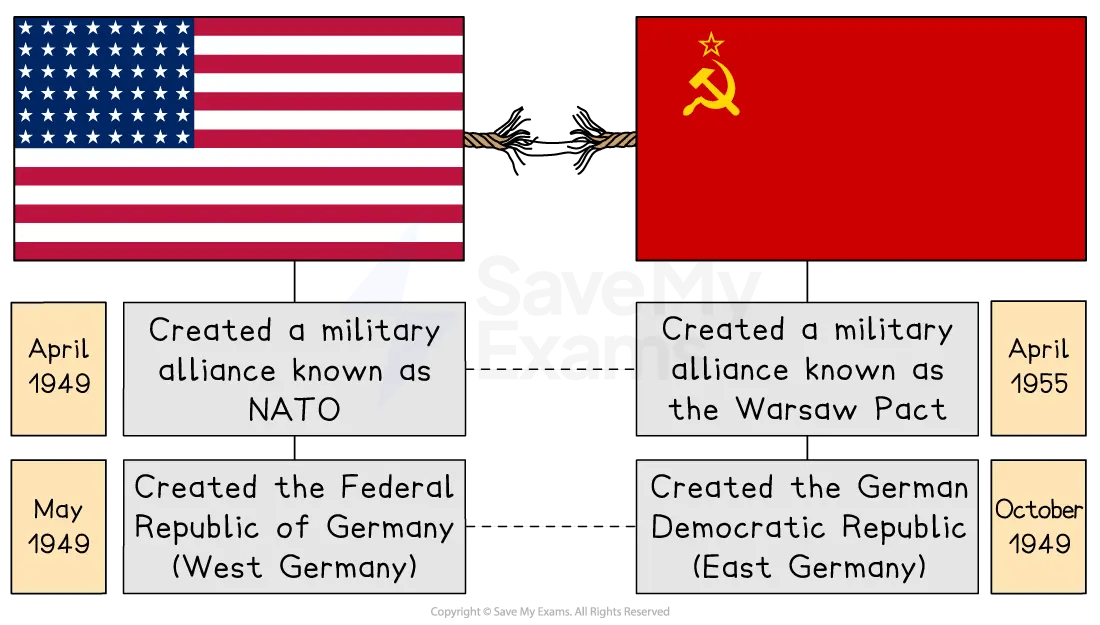
The members of Trizonia acted first and officially created the Federal Republic of Germany (FRG) in West Germany
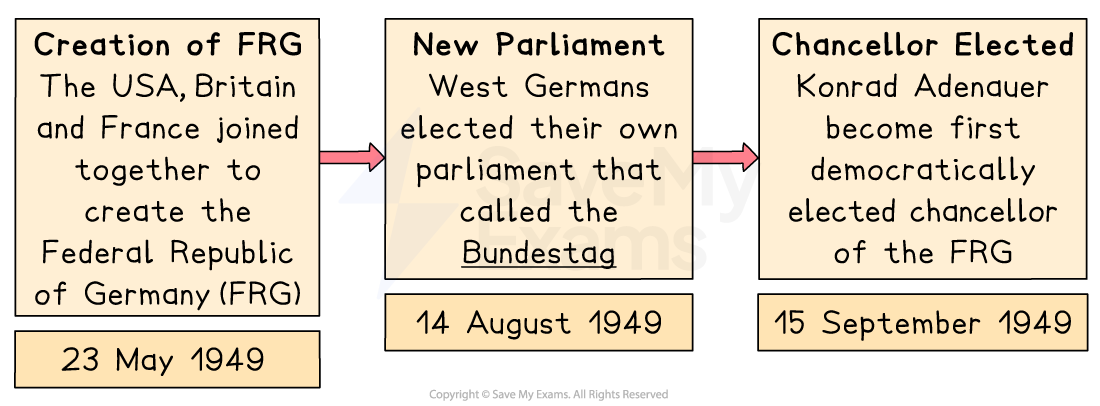
The city of Bonn was chosen as the capital
West Berlin continued to be controlled by and owned by the FRG, despite being deep inside Soviet controlled East Germany
The process of creating the GDR
The response of Stalin to the creation of the FRG was to formally create a new state in East Germany known as the German Democratic Republic (GDR)
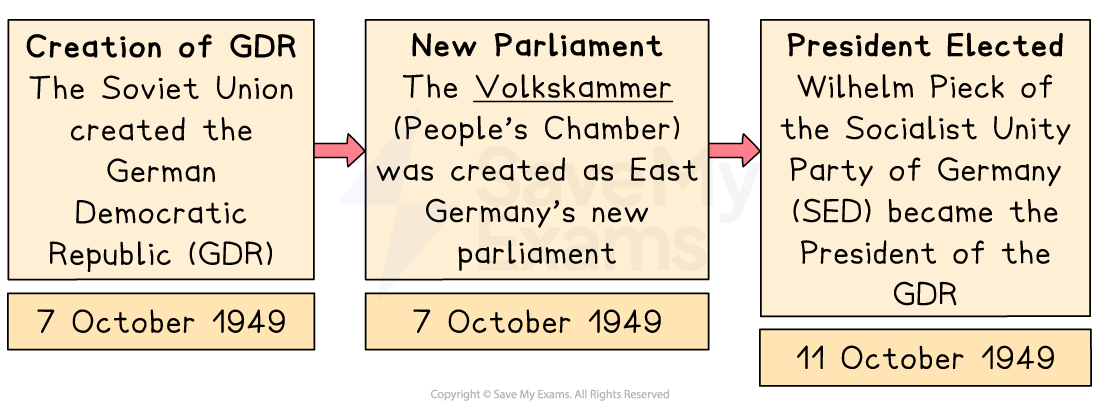
East Berlin remained the capital of the GDR
East Germany and West Germany did not recognise each other as official states until 1972
Cold War tensions increased following the creation of both the FRG and the GDR
The Berlin Wall
Throughout the 1950s, relations between the superpowers continued to be hostile, and Berlin remained a source of tension between them
Stalin had died, and there were hopes that relations would improve under the new Soviet Leader, Nikita Krushchev
However, the shooting down of a US spy plane over the Soviet Union in 1960 confirmed the USSR’s fears about American espionage and increased tensions
Khruschev believed American spies were operating in Berlin and gaining easy access to Soviet secrets
Another issue was the mass migration of East German citizens to the West through Berlin
The freedom and opportunities available in capitalist countries appealed to many East Germans
This caused a skills gap or ‘brain drain’ in East Germany
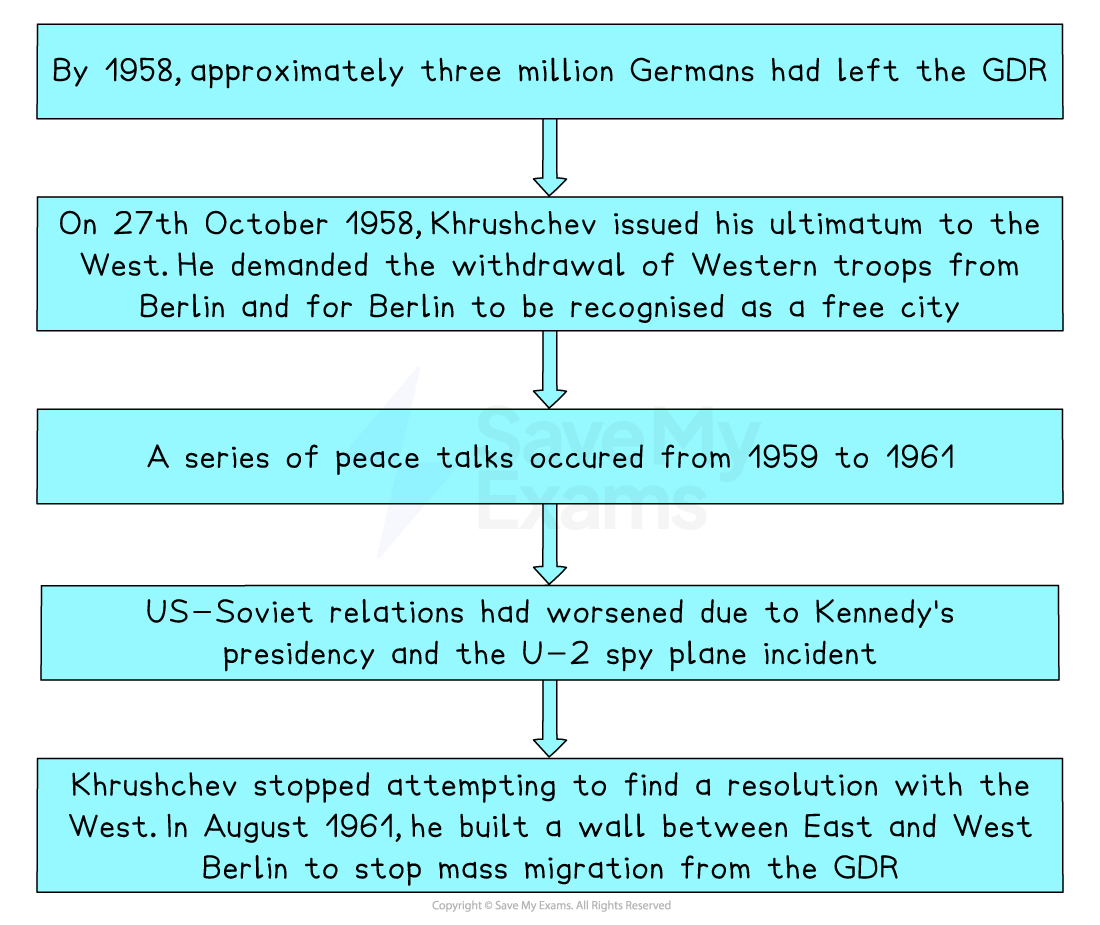
Over 40,000 East Germans escaped the GDR through Berlin in one day in August
Walter Ulbricht, the leader of the GDR, urged Khrushchev to act quickly to prevent more East Germans from leaving
Under nightfall, the East German government placed barbed wire between East and West Berlin on 12 August 1961 and placed guards near the divide
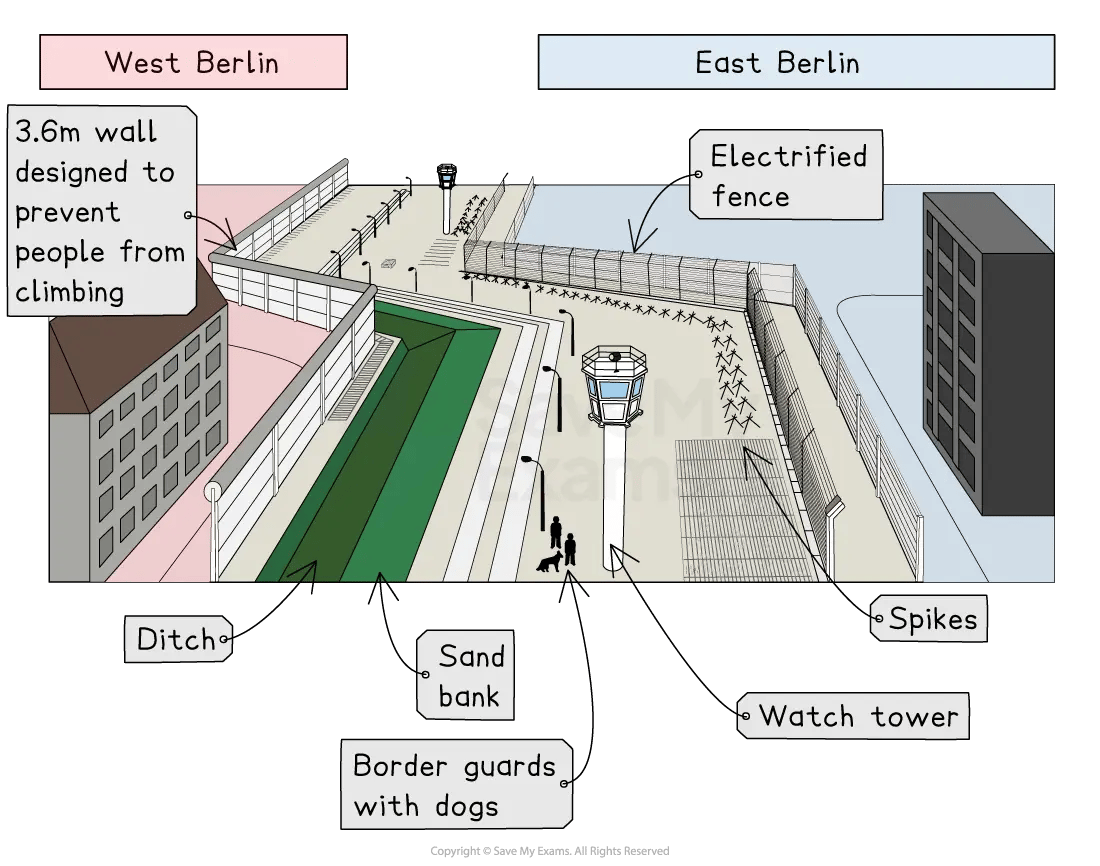
The Berlin Wall developed from simple barbed wire to a complex concrete structure during the 1960s
The consequences of the Berlin Wall
As there had been free movement between East and West Berlin, many people travelled between the two sectors to visit family and friends or for work
As a result, many people became stuck in East Berlin
The wall separated German families and friends for years
Many East Germans continued to attempt escape plans to West Berlin
The GDR killed over 130 people attempting to go over, around or under the Berlin Wall between 1961 and 1989
Escape plans included:
climbing and jumping from windows next to the wall
flying over the wall in hot air balloons
using open-top cars to duck underneath the barriers at the Berlin Wall's checkpoints
using the sewer systems to travel to West Berlin
In 1962, the failed escape attempt by Peter Fechter caused international outrage
The GDR border guards shot Fechter when he attempted to escape
Fechter fell into no-man's-land between the Wall
The FRG border guards could not go and rescue Fechter
The GDR border guards did not attempt to treat Fechter's injuries
Fechter died of his injuries 45 minutes after he was shot
The nature of Fechter's death damaged the GDR's reputation
The impact of the Berlin Wall on Cold War tensions
Initially, the Berlin Wall increased tensions between the USA and the Soviet Union
Some positive consequences occurred from the 1960s to the 1980s as a result of the Berlin Wall
Reasons why the Berlin Wall eased tensions
The Berlin Wall meant there was less chance of a nuclear war developing over Berlin
Kennedy stated: "A wall is a hell of a lot better than a war”
The Berlin Wall ended the day-to-day comparison between communist East Berlin and capitalist West Berlin
This allowed both states to develop and function independently from each other
Reasons why the Berlin Wall escalated tensions
It was a diplomatic failure for the USA and the Soviet Union
It showed that the attempts to talk about the issue of Berlin had failed
The Berlin Wall created a physical divide to match the ideological divide between East and West
It became a symbol of the Cold War until 1989
Examiner Tips and Tricks
A common misconception that students have is that the East German government constructed a concrete wall overnight. The Berlin Wall was under constant development from its creation. The GDR replaced the temporary divide of barbed wire and cinder blocks. In 1965, the divide became a series of 5-metre-high concrete walls.

Unlock more, it's free!
Join the 100,000+ Students that ❤️ Save My Exams
the (exam) results speak for themselves:

Was this revision note helpful?