US Involvement in Vietnam (WJEC Eduqas GCSE History): Revision Note
Exam code: C100

Timeline
Image
Summary
When it appeared as if Vietnam was about to become an independent communist country after the Second World War, America helped finance France’s war to take back control of its former colony.
After years of bloody fighting, France admitted defeat and withdrew from a Vietnam that was divided between a communist north and a capitalist south. America paid to support the deeply unpopular South Vietnamese leader Ngo Dinh Diem, who was coming under attack from communist guerrilla fighters that became known as the Viet Cong.
After US ships came under attack in 1964 in what became known as the Gulf of Tonkin incident, America became fully involved in the war to defeat the communist guerrillas and their supporters in North Vietnam. This involved an enormous aerial bombing campaign known as Operation Rolling Thunder and spraying millions of litres of poisonous chemicals over the jungles of Vietnam. American troops flew above the jungles in helicopters in pursuit of the Viet Cong fighters in ‘Search and Destroy’ missions.
Despite these tactics, sending enormous numbers of troops and spending billions of dollars, it was not enough to defeat the Viet Cong. In 1973, President Nixon signed the Paris Peace Accords, which he claimed brought ‘peace with honor’ and led to the withdrawal of American troops from Vietnam.
Without American support, South Vietnam was unable to defend itself and, within two years, had surrendered to the communist north. Vietnam became a unified communist country.
The Division of Vietnam
From the 18th century until the Second World War, Vietnam had been part of the French Empire
During World War II, France was conquered by Nazi Germany, and Japan invaded Vietnam
Japan stripped the region of its natural resources and took food to feed its own population
This resulted in nearly 2 million Vietnamese people starving to death
The Vietnamese Independence League (or Vietminh) fought to free the country from Japanese control
The Vietminh was led by two communists, Ho Chi Minh and Nguyen Vo Giap
When Japan surrendered to America at the end of World War II, the Vietminh declared Vietnam to be an independent country and Ho Chi Minh its president
France refused to accept this and sent an army to recapture Vietnam, and fought a war against the Vietminh from 1946 to 1954
Between 1950 and 1954, the USA spent $3 billion supporting France in its war with the Vietminh
Over 80% of France’s weaponry and vehicles were supplied by America
However, a crushing defeat at the Battle of Dien Bien Phu led to the French Prime Minister resigning and the French Parliament voting to end the war
In 1954, the leaders of the USA, USSR, Britain, France, China and Vietnam all met in the Swiss city of Geneva to decide Vietnam’s future
This became known as the Geneva Agreement
Everyone agreed that elections should be held before July 1956 to choose a government for the whole of Vietnam
In the meantime, it was also agreed that Vietnam should be divided along the 17th parallel
The North was to be governed by Ho Chi Minh
The South was to be governed by Ngo Dinh Diem
The Diem regime
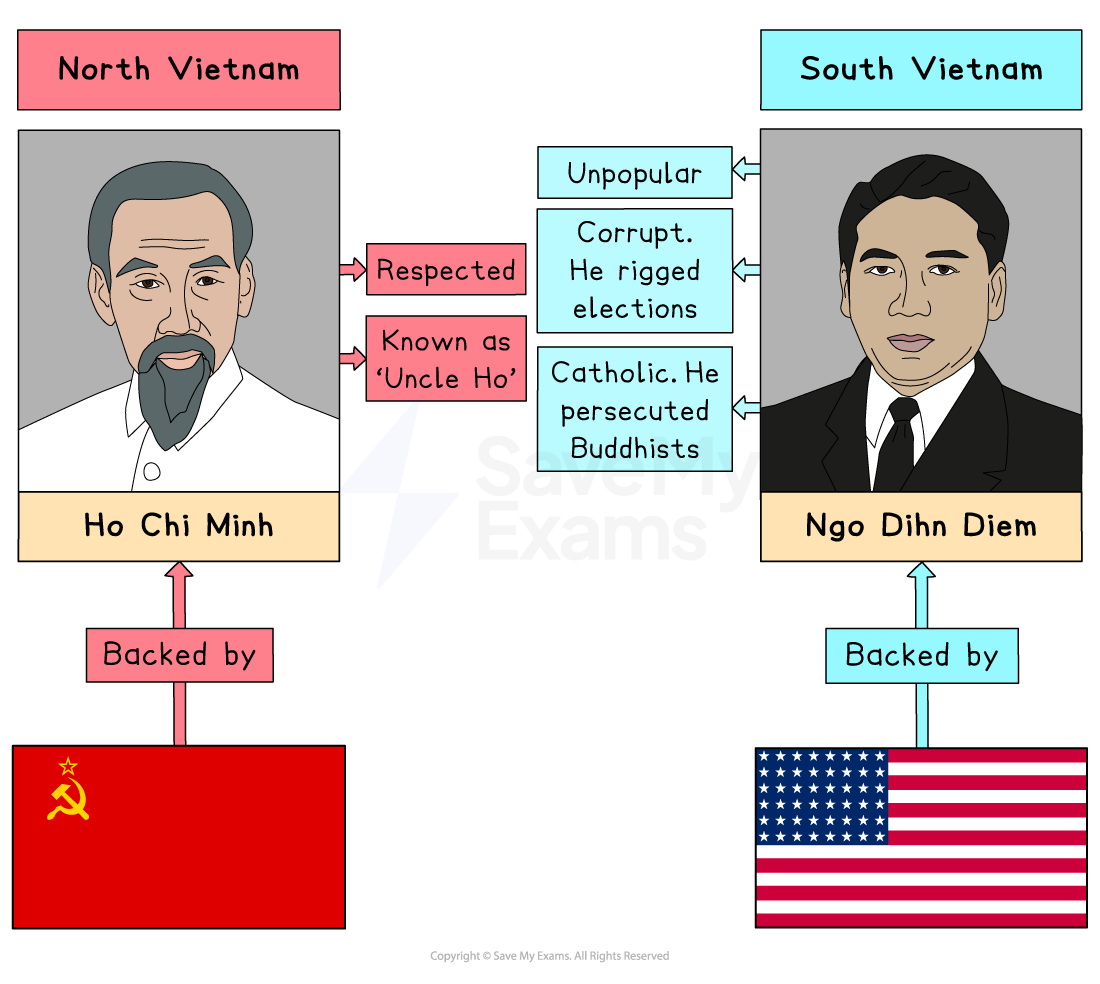
Ngo Dinh Diem was to become the leader of South Vietnam because he was strongly anti-communist
However, he was also corrupt, introduced new taxes and crushed any opposition
This made him deeply unpopular with many South Vietnamese people
Many of Diem’s opponents came together to form the National Liberation Front (NLF) to remove him from power
The NLF took direct action:
They killed hundreds of people who worked in Diem’s government
Diem used the Army of the Republic of Vietnam (ARVN) to try to crush the NLF
The NLF took to the jungle to hide and then launched their attacks from there
The ARVN leaders called the NLF “Viet Nam Cong San”, which means Vietnamese communist
They were soon being called the Vietcong for short
The Viet Cong
From 1959 onwards, the Viet Cong were supported by North Vietnam and supplied with instructions and training, as well as weapons and equipment
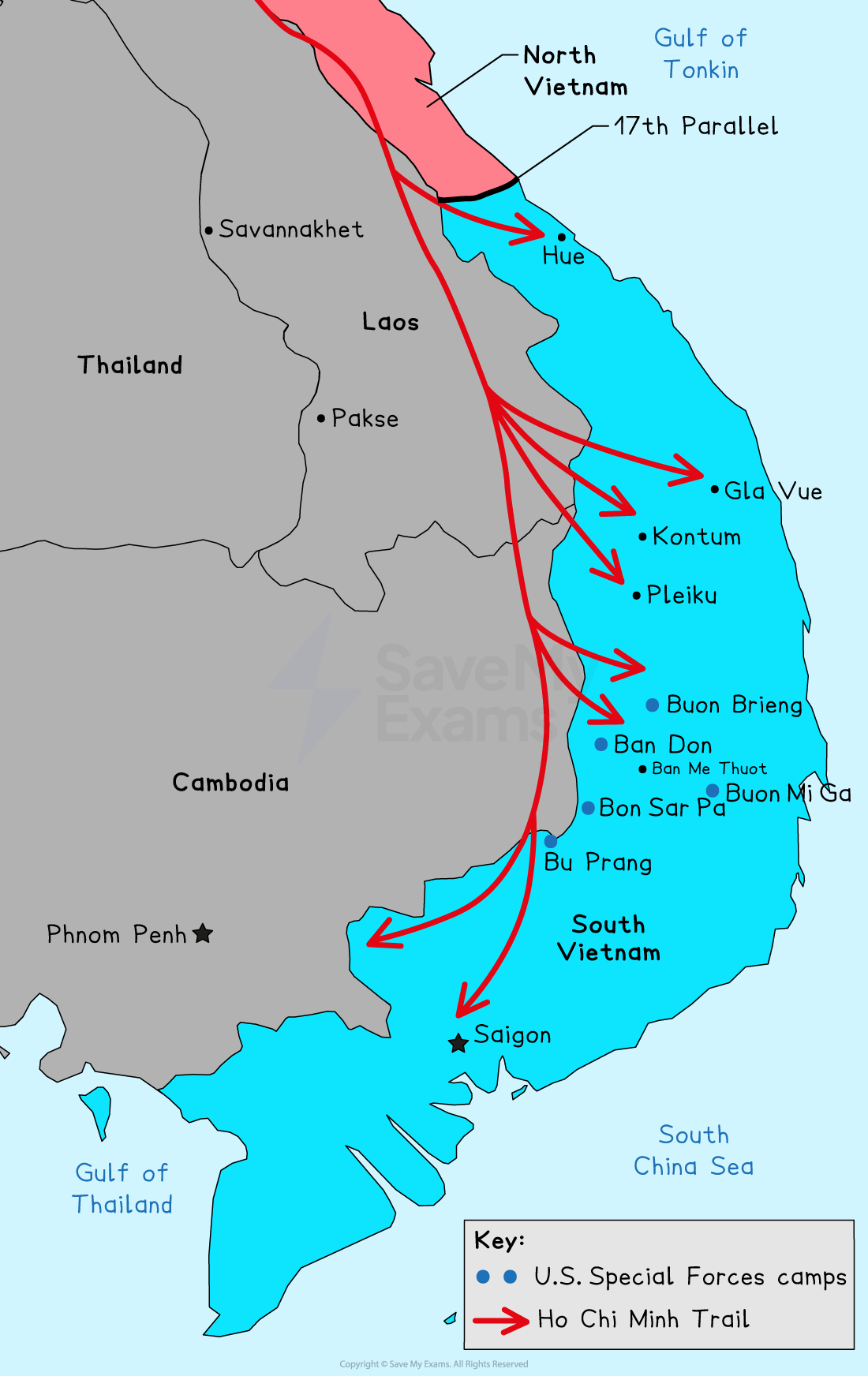
This was delivered along supply routes that became known as the Ho Chi Minh Trail
The Ho Chi Minh Trail stretched from North Vietnam, through the neighbouring countries of Laos and Cambodia, before emerging in the jungles of South Vietnam
The Gulf of Tonkin incident
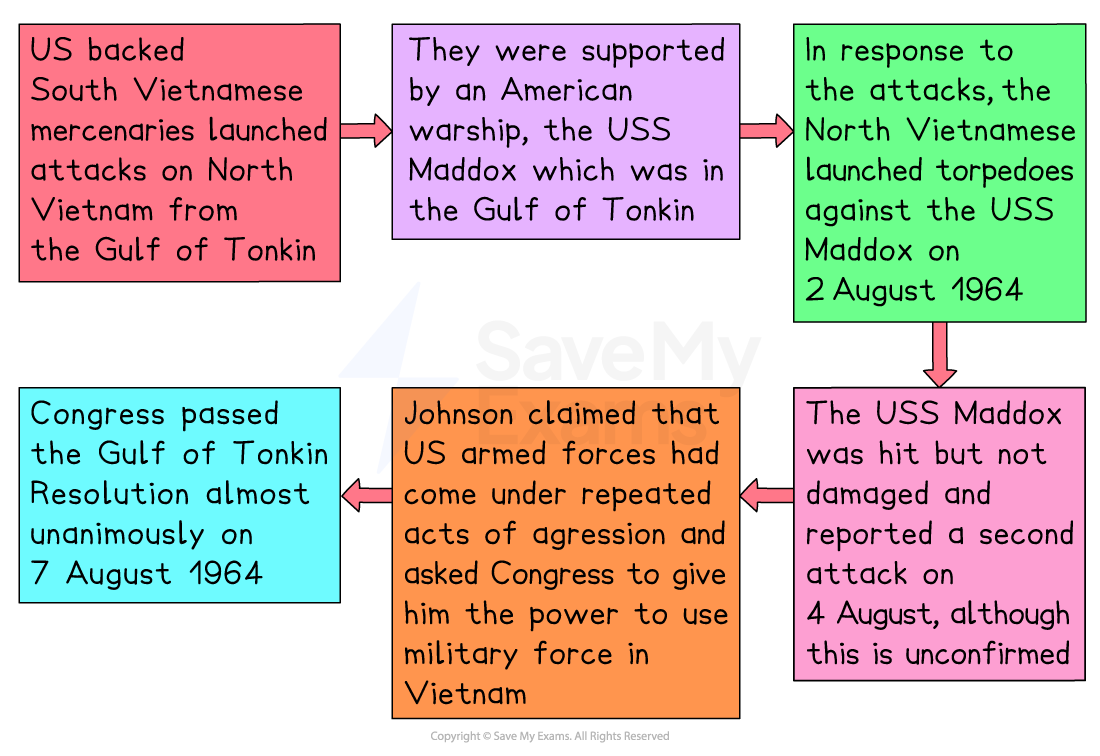
The Gulf of Tonkin Incident was the key event that led to US troops fighting in Vietnam
It occurred in August 1964, when the US president was Lyndon Baines Johnson
Like Presidents Eisenhower and Kennedy before him, Johnson believed in the Domino Theory
This was the idea that if one country became communist, its neighbouring country would soon do the same
America feared that if Vietnam turned communist, as China and North Korea had, it would lead to Laos, Cambodia, Thailand and India doing the same

Like Eisenhower and Kennedy, Johnson also seemed reluctant to send American troops to Vietnam
All that changed after the Gulf of Tonkin incident
A US warship, USS Maddox, was torpedoed while supporting attacks on North Vietnam
The warship was hit, but no major damage was done
The event was enough to persuade Congress of aggression from North Korea
The Gulf of Tonkin Resolution meant that President Johnson was free to use the US military to defend South Vietnam — and attack North Vietnam — in whichever way he chose
Operation Rolling Thunder
To cut off the Vietcong’s supplies, the US military targeted the supply routes and North Vietnam’s cities and factories with a sustained aerial bombing campaign called Operation Rolling Thunder
It began in March 1965 and continued until November 1968
During that time, nearly 900,000 tons of bombs were dropped on Vietnam
It is estimated that around 90,000 people were killed
Despite the enormous scale of the bombing, Operation Rolling Thunder was not as successful as the US had hoped
The Ho Chi Minh Trail was often just a dirt track and was easily repaired
The Vietcong built extensive underground bases and tunnel complexes that protected them from the bombing
It failed to break the resolve of the Vietcong or the North Vietnamese
Fear of bringing China directly into the conflict stopped the US from bombing North Vietnam’s ports
This meant that supplies, including jet fighters and air defence systems, continued to arrive in North Vietnam
Over 3,000 American war planes were shot down during the Vietnam War

Chemical Warfare
To prevent the Vietcong from hiding in the dense jungle, the US launched Operation Ranch Hand from 1962 until 1971
This involved spraying millions of litres of herbicide or defoliant to kill the plants
This was intended to expose Vietcong trails and bases and destroy their food
Exposure to these chemicals led to birth defects for many years after the war had ended

Search and Destroy
Like the French troops and Diem’s ARVN before them, the US soldiers struggled against the Vietcong’s guerrilla tactics
By operating in small groups and by not wearing uniforms, it was almost impossible for the Americans to tell who was a Vietcong fighter and who was a farmer
By patrolling through the jungle to find the Vietcong, US troops exposed themselves to booby traps and ambushes
US troops were being killed, but the Vietcong were not being found, let alone killed
In response, the US adopted search and destroy tactics
It built fortified bases all across South Vietnam from where it could launch search and destroy missions
Travelling by helicopter, troops would suddenly descend on villages and search for evidence of the Vietcong
If they found Vietcong fighters, they would call for backup and order airstrikes
If they found weapons or food stores, they would burn down the villages
Search and destroy tactics were not successful
US troops were still killed by booby traps and ambushes when they left their helicopters
It led to an increase in support for the Vietcong as villagers resented having their homes destroyed
The Vietcong continued to escape the searches and would disappear into the jungle or across borders to foreign countries such as Laos and Cambodia
The Vietcong usually moved back and took control of an area once the US helicopters had left

How did the War in Vietnam end?
President Richard Nixon was elected in 1968 after promising to bring about an “honourable peace” in Vietnam.
His policy of Vietnamisation required South Vietnam’s soldiers to do more of the fighting against the Vietcong rather than alongside the US troops.
However, he also resumed heavy bombing raids on North Vietnam and ordered both US aircraft and soldiers to pursue the Vietcong into the neighbouring countries of Laos and Cambodia
Many Americans believed he was expanding the war rather than ending it, and protests erupted across the country
However, in January 1973, the governments of the USA, South Vietnam and North Vietnam signed the Paris Peace Accords
Key features of the Paris Peace Accords
There would be an immediate ceasefire
Troops from both North and South Vietnam to stay in their current positions
All US troops were to leave Vietnam
All US prisoners of war were to be returned
Free and fair elections were to be held, and Vietnam was to be reunified in a peaceful and orderly manner
The US would continue to supply South Vietnam with weapons and equipment
Consequences of the Paris Peace Accords
Nixon claimed, “We believe that the agreement will bring peace with honor in Vietnam and Southeast Asia”
Other people claimed it was a humiliation and a betrayal of South Vietnam
North Vietnam still had a strong military and was determined to reunify Vietnam
Without US troops on the ground, some people believed that the defeat of South Vietnam by the communist North was inevitable
The agreed ceasefire quickly collapsed, and by March 1973, 6,000 Army of the Republic of Vietnam (ARVN) troops had been killed fighting the Vietcong
Despite this, all US troops had left Vietnam within two months of the agreement being signed in Paris
In December 1974, North Vietnam tested America’s determination to support South Vietnam by invading and capturing a South Vietnamese province
When the USA did nothing to help the ARVN troops, the invasion continued
By April 1975, the capital city of Saigon had been captured by North Vietnam’s troops
On 30 April 1975, South Vietnam surrendered
The Vietnam War was over, and Vietnam was a united country with a communist government
Examiner Tips and Tricks
Question 5 on this paper will ask you how important an issue was in a particular event. You must explain and evaluate the importance of that issue, supporting it with specific factual details. You must then identify another important issue that relates to the same event and explain and evaluate its importance. Finally, you must reach a conclusion that is well-reasoned and supported as to which is the most important factor of the two.

Unlock more, it's free!
Join the 100,000+ Students that ❤️ Save My Exams
the (exam) results speak for themselves:

Was this revision note helpful?