Impacts of the Great Depression (WJEC Eduqas GCSE History): Revision Note
Exam code: C100

Summary
Life became incredibly hard for millions of Americans during the Great Depression. With large-scale homelessness and extreme poverty affecting people in both cities and the countryside. Widespread criticism of President Hoover’s reaction to both the Great Depression and the "Bonus Marchers", combined with Roosevelt’s effective campaign, "led to Hoover’s defeat in the 1932 presidential election".
Roosevelt had promised the American people a ‘New Deal’ if he were elected. He aimed to provide relief, recovery and reform for the millions who were suffering, and he quickly set about passing government acts and setting up government agencies to achieve this. The Supreme Court banned some of these agencies (known as the Alphabet Agencies), and Roosevelt was accused of overreaching his powers. He launched the Second New Deal in 1935 and once more faced significant opposition from political opponents and the Supreme Court. Debate raged over whether the New Deal was a success, "but it was popular enough to enable Roosevelt to win the 1936 election".
Life During the Depression
There were no social security payments in the USA in the 1920s
Workers were expected to solve their own problems and not rely upon the government for help
Charities and local government organised support, like soup kitchens and people queued for hours for food
Malnutrition and even starvation became an issue because people could not afford food
By 1932, over 250,000 people could not repay their mortgages
This led to banks repossessing people’s homes
Landlords also evicted people who could not pay their rent
The result was large-scale homelessness
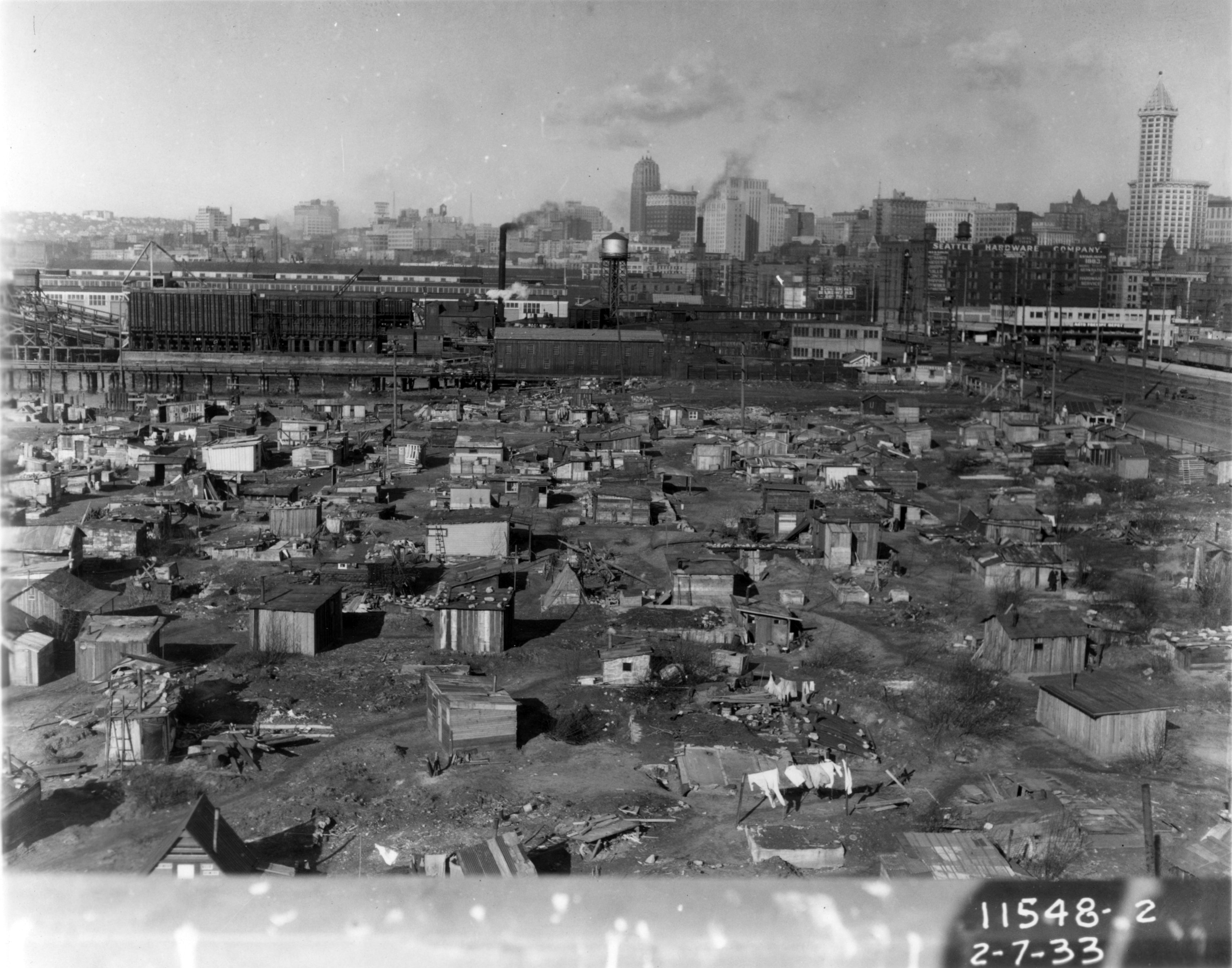
Most cities soon had temporary slum houses made from corrugated iron and cardboard, built on areas of wasteland
They became known as ‘Hoovervilles’
The name was an attack on President Hoover for his government’s failure to help people during the Depression
Life in the Countryside
The demand for food dropped as fewer people could afford to buy it
This meant many farmers were often unable to sell the food they had produced
Things became much worse for the farmers of the Midwest when drought combined with intensive farming practices to destroy the soil
Around 20 million hectares of farmland saw its topsoil blown away in an event that became known as the ‘Dust Bowl’
This led to over a million Americans leaving their homes and farms to travel west in search of work on the citrus fruit farms on the West Coast
The arrival of so many desperate people was welcomed by many West Coastcoast farmers who paid them very low wages and housed them in basic and unsanitary conditions
However, their arrival was resented by the local workers who blamed them for driving down wages and ‘stealing’ their jobs
The Bonus Marchers
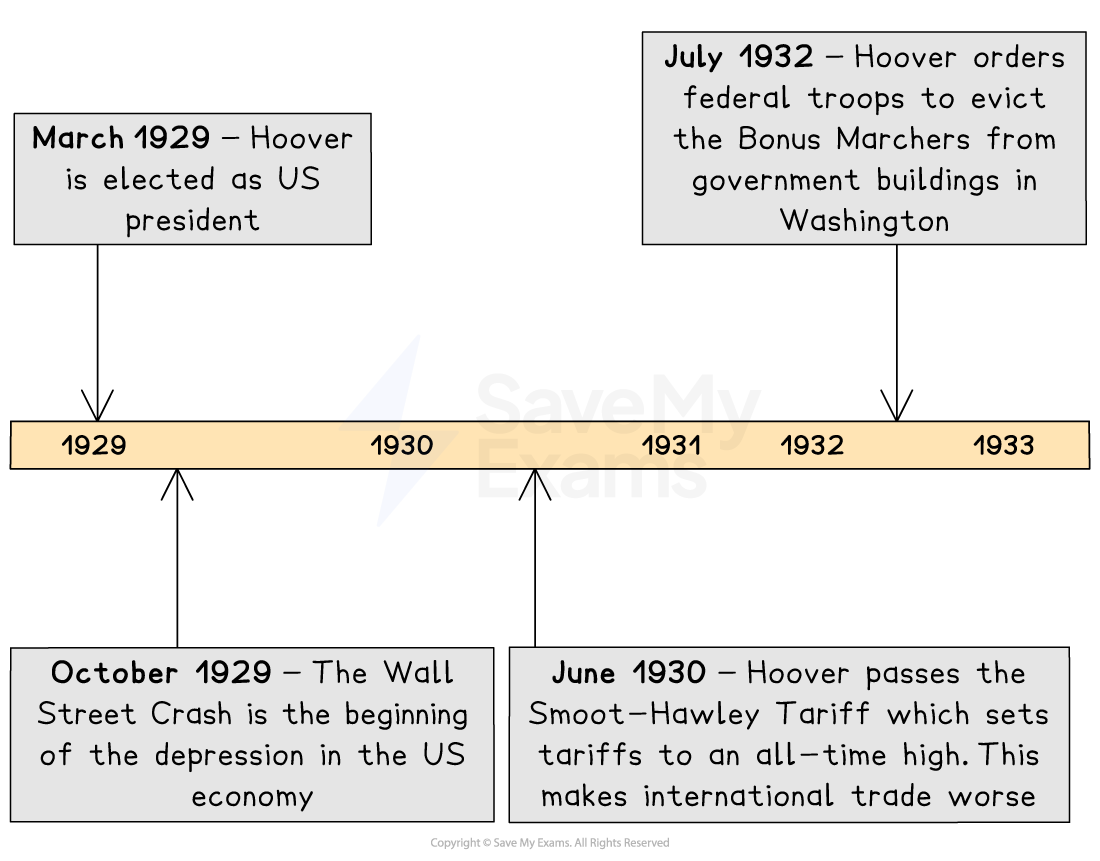
President Hoover’s actions towards the Bonus Marchers made him even more unpopular
The Bonus Army was a group of 20,000 former First World War soldiers
In March 1932, the members marched to Washington to ask for economic help to survive the Depression
The Bonus Marchers wanted the government to pay their war pension of $500 straight away, rather than in 1945
They created a Hooverville just in front of the White House
Hoover decided to remove the Bonus Army by force
Douglas MacArthur led the US troops
The Army used tear gas and tanks to move the Bonus Marchers
The US army killed two protestors and a baby
Over 1,000 people were injured
Roosevelt & the New Deal
The election took place in November 1932
Roosevelt won with eight million more votes than Hoover
It was the biggest landslide victory in US history
Hoover only won votes from six out of 48 states

American voters had rejected Hoover based on his response to the Great Depression and events such as the Bonus Marchers
They had also voted for Roosevelt because
He ran a clever election campaign
Promised the American people a ‘New Deal’
The New Deal
Roosevelt had three key aims for the New Deal:
Relief
Providing food for people in need
Implement policies that stop people from losing their homes
Recovery
Boost the economy so that there are jobs for the unemployed
Rebuilding trade and industry
Reform
Create a welfare state in the USA
Ensure that people have access to government help for unemployment, sickness, disability and old age
The Hundred Days
US Presidents are now often judged on their first hundred days in office
This is regarded as enough time for a president to implement changes
People use it to indicate how successful the presidency will be
This was the result of Roosevelt’s first ‘Hundred Days’, in which he achieved many things
Roosevelt’s Achievements in the ‘Hundred Day'
Issue | Action | Success or failure? | Explanation |
|---|---|---|---|
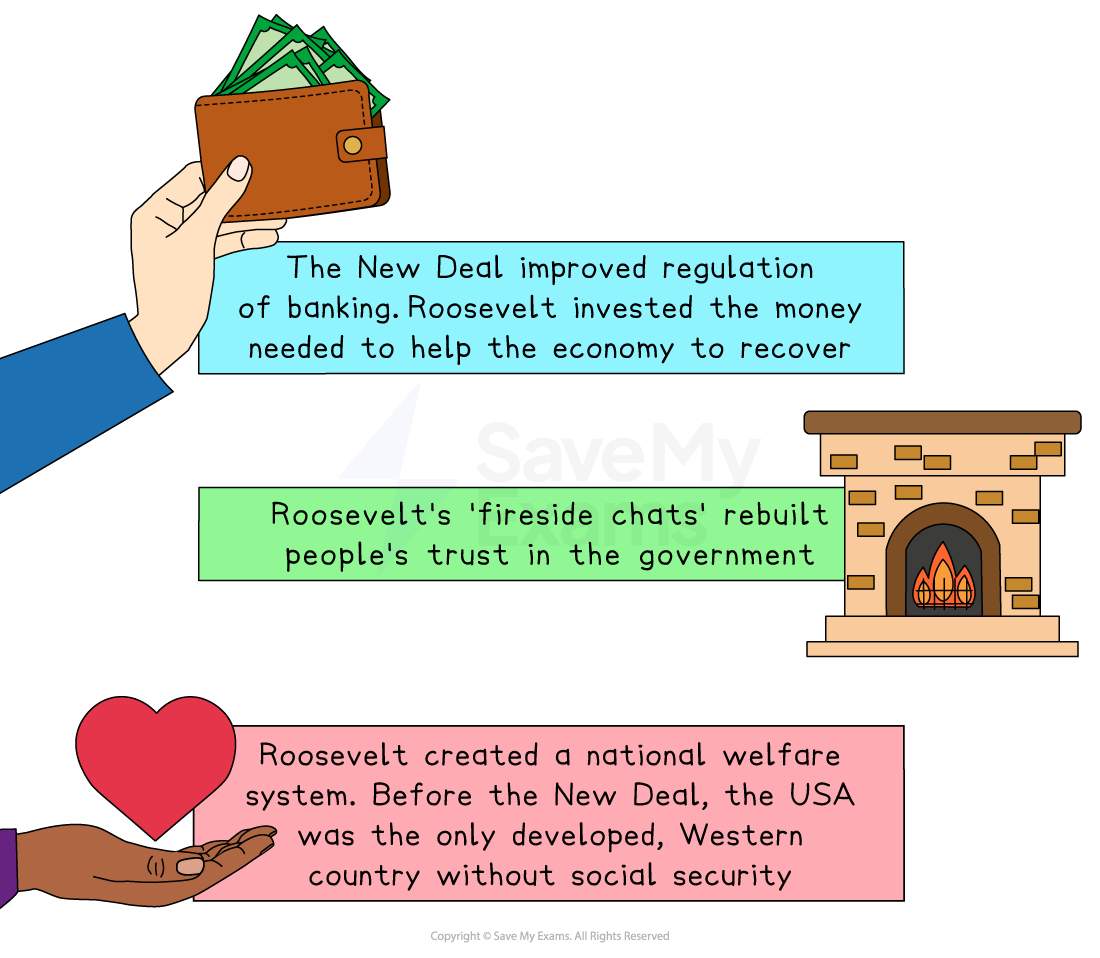
The banking crisis | The Emergency Banking Act (1933) | Success | Roosevelt closed all banks for four days for their accounts to be inspected. People had more confidence in the banking system and reopened accounts with them. This increased the money that banks had available to lend to businesses, especially as the government backed their loans |
The Prohibition | The Beer and Wine Revenue Act (1933) | Success | Many people openly broke Prohibition. It had become acceptable for people to ignore the government. This act ended the acceptability of breaking US laws. The government also earned revenue from taxing alcohol |
High government spending | The Economy Act (1933) | Both | Roosevelt cut the wages of all government employees by 15%. This negatively impacted this group of people. However, Roosevelt also took a pay cut. This action freed up $1 billion to help the unemployed |
A lack of communication between the people and the President | Fireside chats | Success | Roosevelt broadcast his policies on the radio. He spoke to the USA every Sunday. Over 60 million US citizens listened to his fireside chats. This was a revolutionary idea |
The Alphabet Agencies
Roosevelt did not have a clear plan at the beginning of his presidency on how to fix the Great Depression
Roosevelt assembled a group of talented people to advise him
This group was called the Brain Trust
Roosevelt’s government and advisors created the Alphabet Agencies
Each organisation was known by its abbreviation
Examples of Alphabet Agencies
Alphabet Agency | Who it aimed to help | Responsibilities | Impacts and reactions |
|---|---|---|---|
Agricultural Adjustment Administration (AAA) | Farmers | To stop overproduction and to pay farmers to produce less This would then increase food prices and farmers’ profits | Farmers’ revenue doubled between 1933 to 1939. Some farmers destroyed produce. People criticised this as the food could have been given to the poor |
Federal Emergency Relief Administration (FERA) | Unemployed | $500 million to create jobs for the poor for example, setting up soup kitchens | From 1933 to 1935, FERA distributed over $3.1 billion. It provided work for over 20 million people |
Civil Work Administration (CWA) | Unemployed | Create four million short-term jobs for unskilled workers before the winter of 1933 | Created pointless jobs known as boondoggles. These included hiring 100 people in Washington to scare pigeons away with balloons. This only lasted one winter. These 4 million people then became unemployed again |
Public Works Administration (PWA) | Unemployed | Attract skilled workers to build schools, hospitals, dams, aircraft carriers and airports and create 4 million long-term jobs | It helped the USA to recover by improving its infrastructure This act was not useful for the millions of unskilled workers |
Civilian Conservation Corps (CCC) | Youth | Provide temporary work to single, unemployed men aged 18 to 25 Give the men jobs such as clearing land, planting trees and making reservoirs | By 1938, over two million men had served in the CCC. Each member received free food, shelter and clothing. Men learnt skills that could be transferred to other jobs. Each project only lasted 6 months. They were only paid $1 a week |
Home Owners Loans Cooperation (HOLC) | Homeowners | Help people meet their mortgage repayments Lend homeowners money at lower interest rates | 800,000 people repaid their HOLC loans. HOLC was not available to farmers or houses worth over $20,000 |
Tennessee Valley Authority (TVA) | Those living in the Tennessee Valley. The area covered seven different states | Build dams to prevent the Tennessee River from flooding. This destroyed farms and caused soil erosion Provide cheap electricity. Only 3% of farms had electricity To create new jobs. Half of the population relied on charity | The TVA built 16 hydroelectric dams by 1944. By 1940, these were the USA’s biggest source of electricity. By 1950, 93% of farmers had an electricity supply. The TVA prevented soil erosion and flooding. This improved farming in the Tennessee Valley. Car makers, paper mills and steel makers built factories in the Tennessee Valley. African-Americans could not own a TVA model farm |
Why Did the New Deal Change?
By 1935, Roosevelt had to adapt the New Deal because:
He faced growing opposition from:
The Supreme Court banned the National Recovery Association (NRA) and the Agricultural Adjustment Administration (AAA) because Roosevelt had abused his powers as president
Businessmen who felt that the NRA was too expensive
1936 was an election year, and although Roosevelt remained popular with the people, he wanted to stop the growing opposition to his policies
Problems continued in the USA
By 1935, 11 million people were unemployed
Workers continued to strike, which impacted the coal, steel and car industries
Second New Deal
The Second New Deal started in the summer of 1935
The Second New Deal was different from the First New Deal
The First New Deal tried to support the recovery of the economy
The Second New Deal aimed to create a significant welfare programme
Government Reform | How did it improve upon the First New Deal? | Impacts and reactions |
|---|---|---|
National Labour Relations Act (1935) Also known as the Wagner Act | Replaced the NRA Encouraged workers to join a trade union Created the National Labour Relations Board (NLRB) to protect the rights of workers | The act increased union membership. By the end of the 1930s, over eight million people belonged to unions The Republican Party and businessmen opposed the act. Some employers refused to let their workers join unions |
Social Security Act (1935) | Created a national social welfare system which included: old-age pensions, disability payments and unemployment payments (dole money). It also supported widows and orphans | The USA had a welfare system. This brought the USA in line with other Western countries in looking after their citizens Pension payments were low at $85 a month. The system only covered a third of workers. The system did not support farmers or workers in private households |
Fair Labour Standards Act (1938) | Enforced a minimum wage Limited working hours Improved working conditions | Over 700,000 workers achieved higher pay. More than 1.5 million people worked fewer hours in a week than before the act |
Was the New Deal a Success?
Whether the New Deal was a success or a failure was debated at the time and continues to be debated by historians today
Benefits of the New Deal
Group | How did the New Deal Benefit this group? |
|---|---|
The unemployed and the poor | The US government gave millions of dollars in support to those facing poverty, homelessness and hunger |
The TVA created work and improved the standard of living in poorer parts of the USA | |
After 1935, many vulnerable people in society benefitted from the Social Security Act | |
Male workers | The Alphabet Agencies created millions of new jobs for workers |
The NRA improved workers’ pay and hours | |
The National Labor Relations Act encouraged trade unions. It attempted to stop employers from treating their workers unfairly | |
Women | The WPA in the Second New Deal employed women |
Roosevelt appointed Frances Perkins as the Secretary of Labour. She was the first woman in history to have a cabinet job in the US government | |
Farmers | Large-scale farmers received support |
The AAA reduced the number of farmers losing their land and improved profits | |
The TVA improved productivity in the Tennessee Valley. It helped the area to recover from the Dust Bowl | |
African-Americans | The New Deal gave jobs to African-Americans |
After 1935, African-Americans received relief cheques from the government | |
Before the Depression, many black Americans supported the Republican Party. It was the political party of Abraham Lincoln that abolished slavery. After the New Deal, more African-Americans supported the Democrats |
Failures of the New Deal
Group | How did the New Deal Disadvantage this group? |
|---|---|
The unemployed and the poor | By 1939, 9.5 million US citizens remained unemployed |
Some people became reliant on government support | |
Male workers | The New Deal benefitted skilled workers more than unskilled workers. People became annoyed at boondoggle jobs |
Some employers did not respect the New Deal and blocked workers from joining trade unions | |
Women | Agencies like the CCC only specifically helped young men |
The WPA mainly gave women unskilled jobs | |
The NRA purposefully set wages lower for women than for men | |
Farmers | Smaller farmers did not receive much benefit from the New Deal |
The AAA encouraged farmers to produce less. This forced many sharecroppers to leave farming and head for industrial cities to find work | |
Despite the TVA bringing electricity, farmers continued to have a low standard of living | |
African-Americans | Many African-Americans continued to work in low-paying jobs |
The NRA paid black workers less than white workers | |
The CCC had segregated camps for black workers | |
Support for an anti-lynching bill increased when 63 black people were lynched in the South. Roosevelt refused to pass this bill. He needed the support of southern Democrats who supported white supremacy | |
A third of all African-Americans became reliant on the government’s relief payments |
Opposition to the New Deal
There was opposition to the New Deal from a number of different areas in American society.
Conservative Opposition
Some people in the USA believed that the New Deal went too far to help people
Many conservative opponents came from the Republican Party. They believed that:
The government should be following laissez-faire and rugged individualism approaches
The New Deal cost too much money
The jobs created by the New Deal were pointless
Roosevelt had too much power and was becoming a dictator
People should not be dependent on the government
Business owners had issues with certain aspects of the New Deal
They hated government involvement in how they ran their businesses through the NRA and the National Labour Relations Act
They believed that the USA was becoming communist
Some people even compared the New Deal to Stalin’s Five-Year Plans
Opposition from Individuals
Who | Criticism | Beliefs | Outcomes |
Huey Long was the Senator for Louisiana. | Long did not believe that the New Deal helped enough people. He wanted the government to do more | Long proposed a ‘Share our Wealth’ campaign. The plan suggested that anyone with over $6-$8 million would have to give their money to the government. This money could then be shared between poorer families | Long was Roosevelt’s strongest opponent. However, he was corrupt. He got rid of opponents, rigged elections and bribed police. Long was assassinated in 1935 |
Father Charles Coughlin was a Catholic priest based near Detroit. | Coughlin was a supporter of Roosevelt. However, he believed that the New Deal did not do enough to help the poor. He even called Roosevelt an “anti-God” | In 1935, Coughlin created the National Union for Social Justice. The group wanted work and fair wages for everyone. He argued that banks should be nationalised | Coughlin’s radio show had 30 million listeners. Coughlin ran against Roosevelt in the presidential election of 1936 but was unsuccessful. His support declined after he made speeches attacking Jewish people and trade unions |
Dr Francis Townsend had been the assistant city health director in Long Beach, California. He lost his job during the Depression at age 66 | Townsend did not think that the government was doing enough for older people struggling with poverty like himself | Townsend created the Old Age Revolving Pension Plan. This campaigncampaigned askedthe government to give $200 a month to everyone over 60. Each pensioner would have to spend this money within the month. He believed retiring at 60 would free up millions of jobs for younger people | Townsend had millions of supporters. His ideas inspired parts of the Social Security Act in the Second New Deal in 1935. The government scheme was not as generous. Townsend never stopped proposing his pension scheme to the government |
Opposition from the US Supreme Court
Many members of the US Supreme Court were Republicans
They were opponents of the New Deal
The US Supreme Court used itstheir power to fight against the New Deal
The Sick Chickens case
In 1933, a poultry company in New York signed up forto the NRA
In 1935, the business began to sell diseased chicken meat
This broke one of the NRA’s policies
The NRA took the poultry company to court for this violation
The poultry company appealed, and the case went to the Supreme Court
The Supreme Court sided with the company, declaring that the NRA was an illegal organisation
The Supreme Court declared that the NRA and the AAA were illegal and unconstitutional for:
Giving too much power to the government
Imposing laws ononto state governments
By 1936, the Supreme Court had tried 16 cases against the Alphabet Agencies
They had ruled against the agencies in 11 of these cases
Examiner Tips and Tricks
Students often find it challenging to remember the number of alphabet agencies and what each one provided to people in the 1930s and 1940s. As a revision technique, you could create a character living in the USA during the Great Depression. Draw or write how each agency helped your character to improve their lives. Creating a story or adding images (dual coding) will help you remember the role of each agency.

Unlock more, it's free!
Join the 100,000+ Students that ❤️ Save My Exams
the (exam) results speak for themselves:

Was this revision note helpful?