The Wall Street Crash (WJEC Eduqas GCSE History): Revision Note
Exam code: C100

Summary
America had enjoyed an economic boom during the years after the First World War, but that ended with the Wall Street Crash in October 1929. Americans lost billions of dollars they had invested in the stock market almost overnight. This had terrible knock-on effects that led to millions of Americans becoming unemployed and homeless. The president at the time of the Wall Street Crash was the Republican Herbert Hoover. He believed that the government should stay out of people’s lives as much as possible and that it was up to individual Americans to solve their problems. Although he did try to help towards the end of his presidency, the damage was done, and he lost the 1932 election.
The Impact of the Wall Street Crash
What was the Wall Street Crash?
The stock market in the United States is often called Wall Street
It is named after the location of the building in New York where the stock market is housed
Shares are bought and sold on Wall Street
Investors spend their money on shares in the hope that they will increase in value
However, the value of shares can go down as well as up
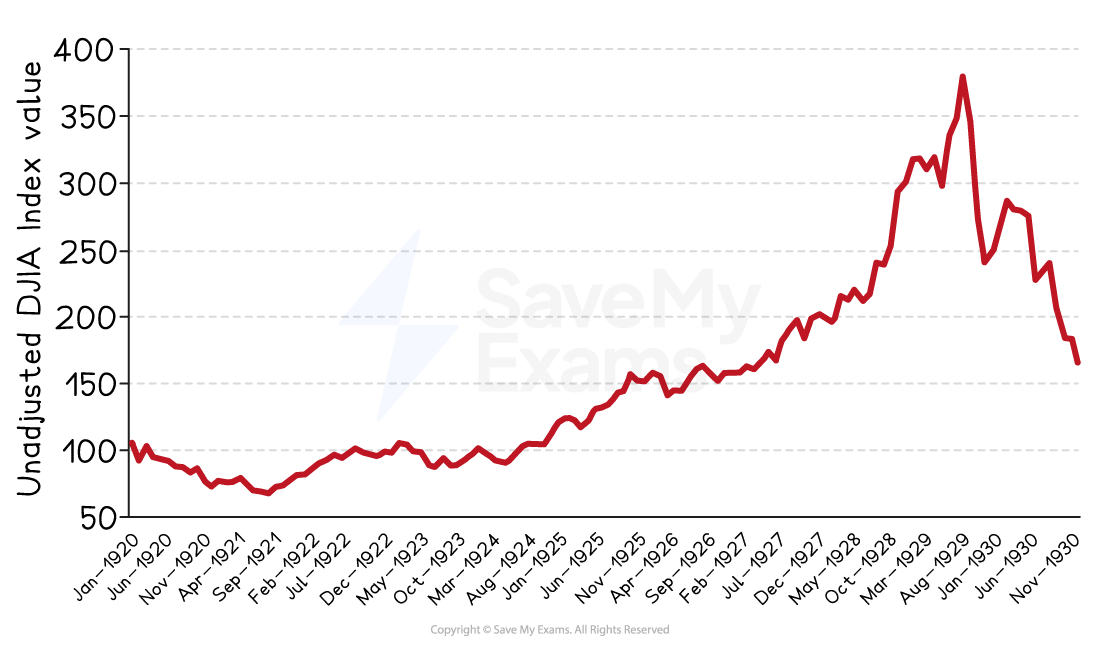
Between the 24th and 30th of October 1929, the price of shares plummeted (fell rapidly), and the USA’s economy collapsed
People sold 13 million shares
Shares that were worth $20,000 on the morning of 24 October 1929 were worth $1,000 by the end of the day
By 30 October 1929, over $4 billion of investors money had been wiped out
The Trigger for the Great Depression
Although it was only investors in the stock market who initially lost their money, the impact of the Wall Street Crash was soon felt at all levels of American society
Demand for products fell as so many people had lost money
This caused many businesses to cut production
By 1932, industrial production had fallen by 45%
Car production fell by 80%
Over 100,000 businesses went bankrupt
Most businesses that didn’t close still made people redundant and reduced wages
The closure of so many businesses caused unemployment to rocket, and in 1933, 25% (14 million) US citizens became unemployed
Nearly all industries suffered, but coal miners suffered particularly badly as their pits closed due to a lack of demand
Black Americans and immigrants were also statistically worse hit by unemployment
Republican Attempts to Deal with the Crisis
The president at the time of the Wall Street Crash and the start of the Great Depression was the Republican Herbert Hoover
Hoover had very strong ideas about how America and the economy should be governed
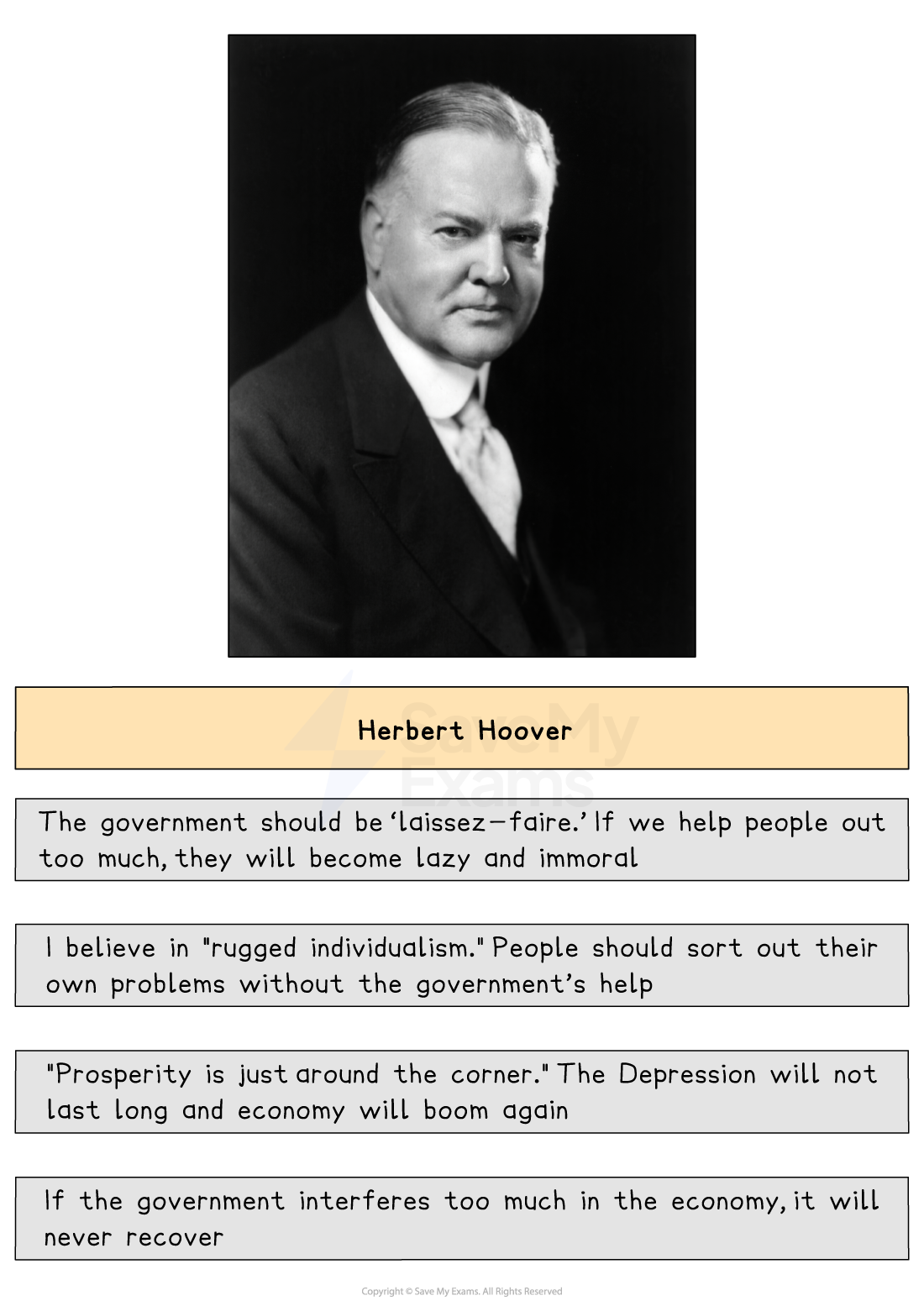
Hoover’s laissez-faire beliefs meant that for many years, he did nothing to help the American people or the economy
Some people believe his actions and policies actually made things worse
For example, he blocked the passing of the Garner-Wagner Relief Bill in 1932, which would have used government money to create public jobs
However, others believe he did try to improve things for the American people
He passed the Hawley-Smoot Tariff Act in 1930, which placed import duties on foreign goods to encourage Americans to buy US goods and produce
He passed the Agricultural Marketing Act in 1930, which lent money to farmers
He cut taxes by $130 million
He spent $1.8 billion on the construction and repair of new roads and dams to provide jobs
He established the Reconstruction Finance Corporation in 1932, which gave $2 billion to banks and insurance companies
He passed the Emergency Relief Act in 1932, which gave $300 million to state governments to help the unemployed
Did Hoover’s Policies Work?
America remained in the Great Depression, and unemployment continued to rise
His failure to act in the weeks and months following the Wall Street Crash damaged his reputation beyond repair
Many of his policies were continued by his successor, Franklin D. Roosevelt
Worked Example
Describe the policies of Herbert Hoover in relation to the Great Depression.
[5 marks]
Answer:
The policies of Herbert Hoover changed as the Great Depression developed. As a Republican, Hoover was reluctant to allow the state to become too involved in the everyday lives of the American people. He believed in a laissez-faire approach to the economy and believed that the hard work and resilience of ordinary Americans would be enough to drag America out of the Great Depression.
However, as America sank deeper and deeper into economic depression, Hoover passed a number of acts designed to both help Americans and improve the performance of the economy. These included the Emergency Relief Act in 1932 which gave $300 million to state governments to help the unemployed and spending $1.8 billion on the construction and repair of new roads and dams to provide jobs.
Hoover’s actions were not enough to drag America out of the Depression and he was voted out of office in the 1932 election. However, many of his policies were continued by Franklin D. Roosevelt when he became president.
Examiner Tips and Tricks
When answering the ‘describe’ question, try to include the most important words of the question in the first line of your answer. This immediately lets the examiner know that you understand the thrust of the question

Unlock more, it's free!
Join the 100,000+ Students that ❤️ Save My Exams
the (exam) results speak for themselves:

Was this revision note helpful?