Changes in the USA Economy (WJEC Eduqas GCSE History): Revision Note
Exam code: C100

Summary
The Second World War had a dramatic and positive impact on the American economy. The demand for weapons and vehicles meant America’s factories suddenly started employing millions more Americans. This, combined with conscription of millions more into the military, meant that unemployment all but disappeared in America.
After the war, the boom continued. Widespread employment and disposable income meant there was a high demand for consumer goods - creating even more jobs. American goods were in demand by many foreign nations thatwho had seen their factories destroyed in the fighting. Also, the Cold War, which began as soon as the Second World War World War 2 ended, meant that the government continued to spend enormous amounts on its military and created hundreds of thousands of jobs.
The widespread wealth led to shopping and spending becoming a leisure activity and led to the birth of consumerism. At the same time, millions of Americans spent their new wealth on new houses built in the suburbs of cities and drove to work in their new cars.
Not all Americans benefited from the economic boom triggered by the Second World War. Many black Americans and people in the Southern States remained in poverty.
Industrial Output
The Japanese attack on the American Navy at Pearl Harbor on 7 December 1941 led directly to the USA joining the Second World War
This led to a dramatic improvement in the American economy
By September 1945, the USA had the biggest economy in the world
In January 1942, the US government created the War Production Board
The War Production Board adapted US industries to war production, including:
The Ford Motor Company converted to making B-24 bombers
The Lionel toy train factory manufactured items for warships
Unlike, its Allies’, American industry was out of range of attack from either Nazi Germany or Japan
As a result, the USA produced weapons, ammunition and vehicles, not only for its own military, but also for Britain, the USSR and Latin America
By 1944, half of all the weapons being produced in the world were being produced in America
A quarter of Britain’s military equipment was American-made
The End of Unemployment
Around 16 million Americans served in the armed forces, with many being conscripted
The need to produce armaments led to American factories employing millions more people
In 1939 there were 9.5 million unemployed Americans
By 1944, there were just 670,000
Post-War Affluence
During the war, the American public had purchased millions of war bonds to help the war effort
Once the fighting had stopped, they cashed them in, which injected around $200 billion into the bank accounts of ordinary Americans
They spent much of this money on consumer goods
The number of new cars sold in America in 1945 was 69,500
This had increased to 6.7 million by 1950
There was also demand for American goods all over the world, particularly in Europe, where much of its industry lay in ruins
Peace meant that American goods could easily be put on ships and sailed around the world
At the same time that spending on consumer goods was rocketing, the US government continued to spend on its military
The Cold War meant that around $50 billion was spent on defence every year by the American Government
The result was widespread employment and increasing wages
The average weekly pay of an American factory worker went from $55 in 1950 to $80 in 1959
Consumerism and Suburbanisation
Large amounts of disposable income meant that shopping became a leisure activity in America
Shopping malls and supermarkets spread throughout the US
Transistor electronics brought about a new era of products and gadgets
America became a consumerist society
By 1960, 90 per cent of American homes had a television set
The standard of living of the average American was three times higher than the average British person
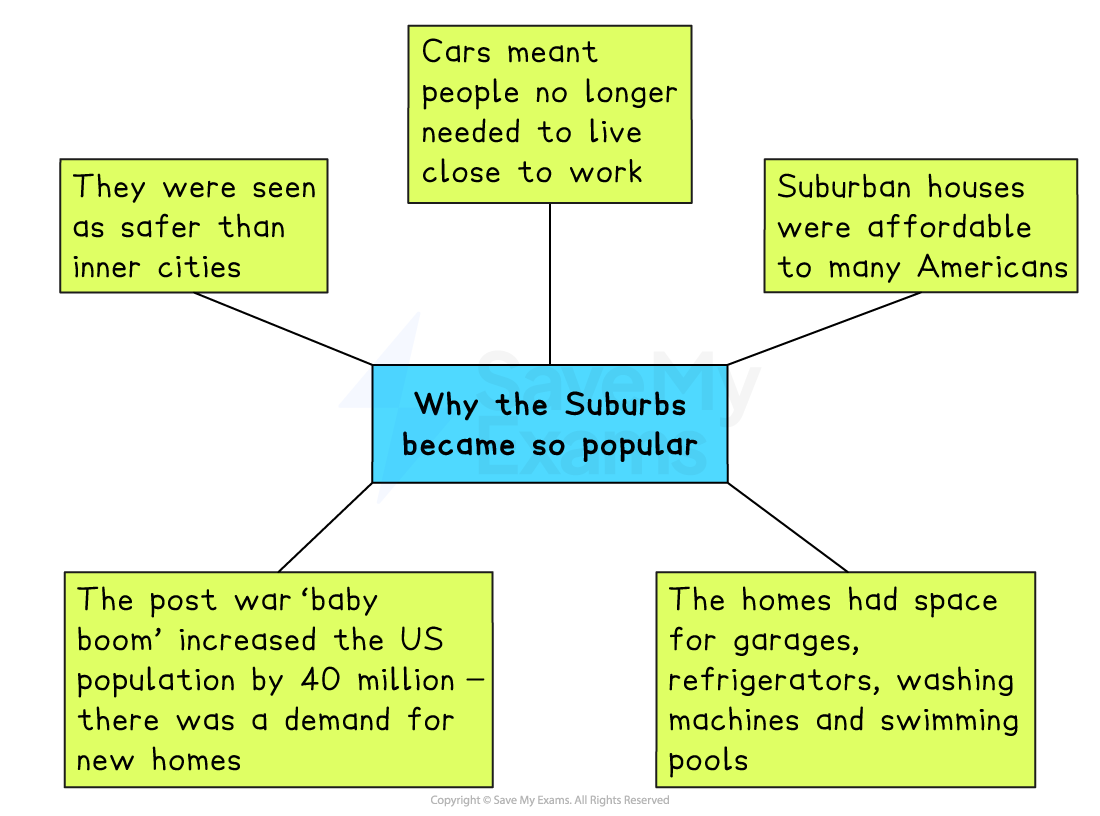
The widespread ownership of cars also led to the development of suburbanisation
During the late 1940s and 1950s, large numbers of Americans moved out of city centres to new housing developments located on the edges of towns
One in five American families lived in houses that had been built in the 1950s by the year 1960
A new life in the suburbs appealed to many Americans for several reasons
‘Poverty Amidst Plenty’
A new life in the new suburbs was not an option for all Americans
Despite the economic boom, 29 per cent of Americans remained below the poverty line in 1959
The new wealth was not shared equally around the United States, and many southern states did not benefit in the way the northern and western states did
Black Americans did not benefit as much from the boom as white Americans
Many of the builders of the new suburbs also refused to sell homes to ethnic groups such as blackAfrican Americans
Unlike many European countries, such as Britain, America did not set up a free at the point of use national health service
This meant many Americans were forced into poverty by medical bills if they or their family members fell sick
Worked Example
Describe the impact of the Second World War on the American Economy.
[5 marks]
Answer:
The Second World War brought about a dramatic change to the American economy and finally ended the Great Depression. There was suddenly an enormous demand for guns, planes, tanks, ammunition, etc, and America’s factories that had previously produced things such as cars began to make them.
It was not just America’s armed forces that were being supplied by American factories, either. Britain and the USSR were buying or leasing enormous amounts of goods. The result was that over half of all the weapons being made in the world in 1944 were made in America.
The result of this increase in manufacturing was an enormous increase in employment by those factories. This, combined with the millions of Americans who were conscripted to join the armed forces, meant that unemployment in America basically ceased to exist in the 1940s.
Examiner Tips and Tricks
Question 4 on this paper is known as the ‘Explain why’ question. Explaining is when you give reasons for something happening, and to score highly on this question, you need to provide a range of reasons why an event occurred. Beginning your paragraphs with “One reason why…” and “Another reason why…” will help you remain focused on explaining the reasons and avoid just talking generally about a topic.

Unlock more, it's free!
Join the 100,000+ Students that ❤️ Save My Exams
the (exam) results speak for themselves:

Was this revision note helpful?