Martin Luther King & the Civil Rights Movement (WJEC Eduqas GCSE History): Revision Note
Exam code: C100

Summary
Martin Luther King became a leading figure in the civil rights movement during the Montgomery Bus Boycott. He was a well-educated Baptist minister whose powerful speeches and calm leadership inspired many people to join the struggle for equality. King strongly believed in non-violent protest and helped establish the Southern Christian Leadership Conference, which aimed to challenge racism through peaceful action. During the early 1960s, he became involved in major campaigns that exposed the brutal reality of segregation in the United States. His leadership in Birmingham and his famous speech at the March on Washington brought national attention to the movement and increased pressure on the government to act. King became a symbol of hope and determination until his assassination in 1968.
Who was Dr. Martin Luther King Jr?
Martin Luther King emerged as an important figure and leader of the civil rights movement during the Montgomery Bus Boycott
He had a middle-class upbringing and was the son of a Baptist minister from Atlanta, Georgia
After completing a PhD at Boston University, he was appointed minister at the Dexter Avenue Baptist Church in Montgomery, Alabama, in 1955
His skills as an orator and organiser, as well as his energy and enthusiasm, inspired others during the bus boycott
This led to him being chosen as the leader of the Montgomery Improvement Association (MIA), which helped coordinate the boycott
Despite suffering threats, intimidation and having his house firebombed, victory in desegregating Montgomery’s buses was only the start of King’s involvement in the civil rights struggle
He helped create the Southern Christian Leadership Conference (SCLC) in 1957, which was determined to challenge racism through non-violent means
The SCLC emerged from the black church, and its motto was ‘not one hair of one head of one White person shall be harmed’
Campaign ‘C’ in Birmingham, Alabama
The next focus of Martin Luther King’s protests was Birmingham, Alabama
In 1963, every aspect of life in Birmingham, Alabama, remained segregated
It had a population of around 350,000
Of that population, 150,000 people were black
Black churches, businesses and homes in Birmingham were frequently targeted with firebombs
It began to be known as ‘Bombingham’
The man in charge of keeping law and order in Birmingham was Police Chief ‘Bull’ Connor
He was known to be a supporter of the KKK
When Birmingham closed its swimming pools, parks and playgrounds rather than desegregate them, the SCLC decided to confront them
They called this confrontation ‘Campaign C’, and it involved direct action protests such as:
Sit-ins
Boycotts of shops and businesses
Marches
It was hoped that the peaceful confrontation of Campaign C would provoke the police into violence and attract media attention
That is exactly what happened when thousands of peaceful demonstrators marched through Birmingham on 3 May 1963
Many women and children took part in the demonstration
‘Bull’ Connor ordered his officers to:
Set dogs on the demonstrators
Blast them with fire hoses
Arrest the protestors regardless of age
Almost 2,000 demonstrators were jailed, and around 1,300 children were arrested
TV news crews filmed the shocking scenes, and they were broadcast all over the world
The images were very powerful, and President Kennedy claimed that the events had ‘damaged America’
Campaign C had succeeded in provoking ‘Bull’ Connor, who was removed from his job
Kennedy sent 3,000 federal troops to Birmingham to maintain order
Birmingham began to desegregate
The March on Washington, 1963
1963 marked the 100th anniversary (centenary) of the end of slavery in the United States
To mark the event, a march on the nation’s capital, Washington, D.C.
This was suggested by Phillip Randolph, the leader of the Brotherhood of Sleeping Car Porters
Randolph argued that a large protest in front of key government buildings, in the capital city, would attract enormous publicity
The major civil rights campaigning groups all agreed to take part, including:
The National Association for the Advancement of Colored People (NAACP)
Congress of Racial Equality (CORE)
The Student Nonviolent Coordinating Committee (SNCC)
SCLC
The protest was to be non-violent and demand that the government pass a new civil rights bill
On 28 August 1963, around 250,000 demonstrators assembled in central Washington, D.C.
Their numbers were far higher than the organisers had expected
Many had travelled from all across the USA
Protest singers, including Bob Dylan, sang to the enormous crowd before several speeches were given
Martin Luther King was the final speaker of the day, and the words he spoke have gone down in history as the ‘I Have a Dream’ speech
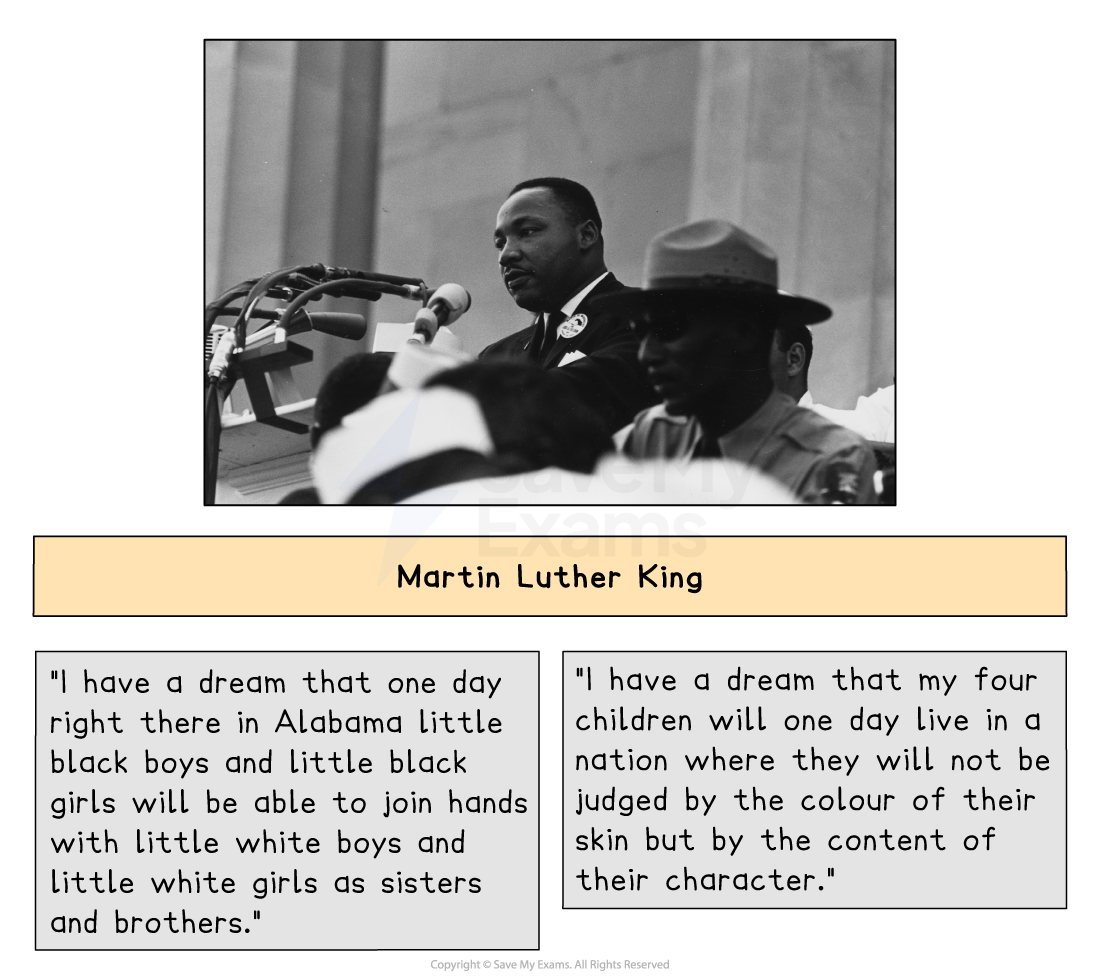
Impacts of the March on Washington
Crowd size. The sight of 250,000 people, of whom 40,000 were White, gathered at the nation’s seat of government was powerful and awe-inspiring. It demonstrated both the amount of support and the strength of feeling of the protestors
Media attention. A gathering of that size, accompanied by celebrities such as Bob Dylan and campaigners such as Martin Luther King, ensured the eyes of the world were on the protest
‘I Have a Dream’ Speech. King’s skill at public speaking and his references to the Bible and the American Declaration of Independence ensured it was both memorable and appealed to a large section of American society
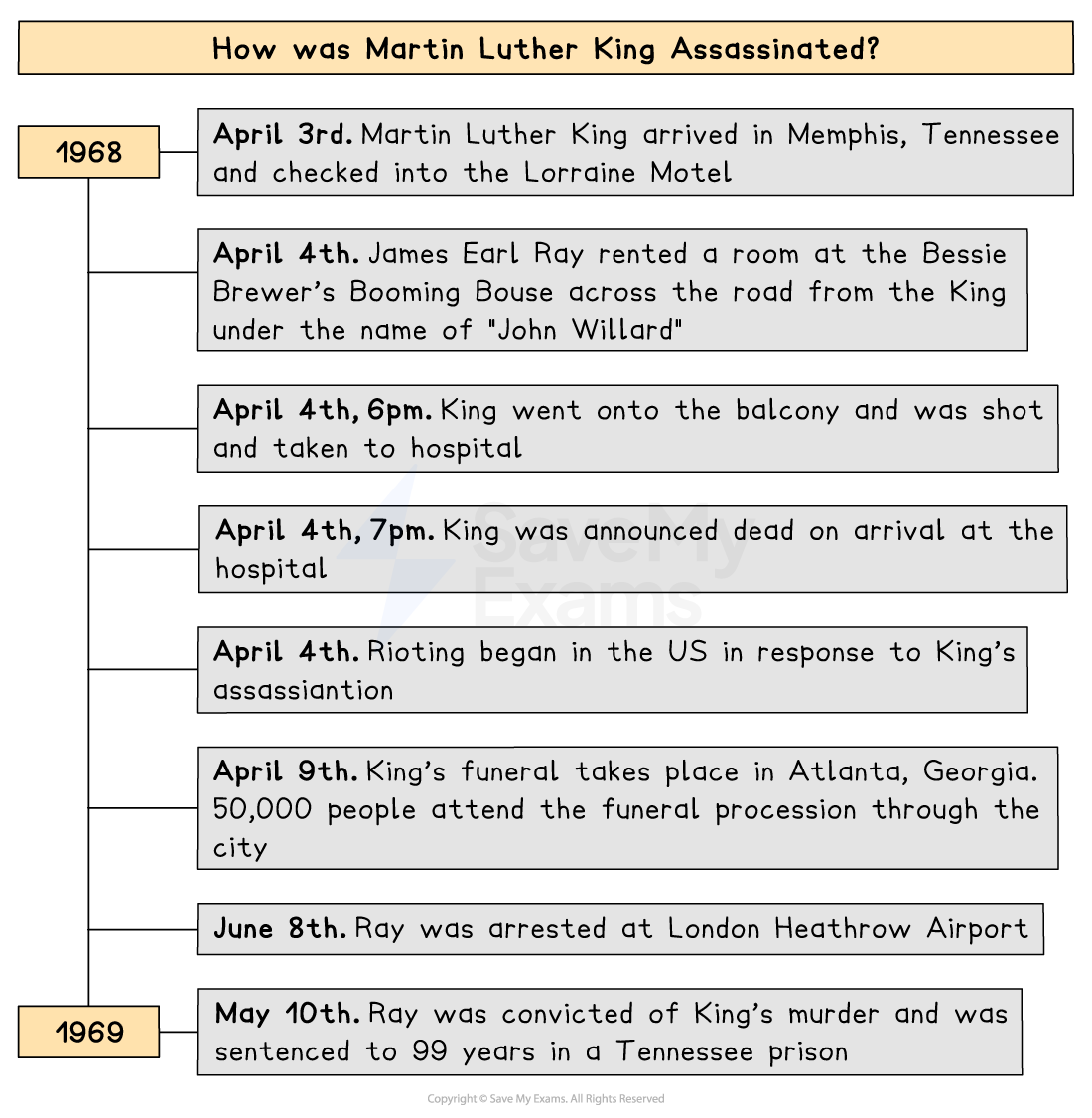
The Assassination of Martin Luther King
Martin Luther King’s role as a figurehead of the civil rights movement came to a tragic end when he was assassinated on 4th April 1968
Examiner Tips and Tricks
Martin Luther King is also known as MLK or Doctor King. Any version is acceptable in your exam answers. Whilst there are many abbreviations in this course, it may help in your exam answers to shorten King’s name. When writing an answer, write “Martin Luther King (MLK)” once. This will allow you to write “MLK” throughout the rest of your answer.

Unlock more, it's free!
Join the 100,000+ Students that ❤️ Save My Exams
the (exam) results speak for themselves:

Was this revision note helpful?