Détente & Attempts to Limit Arms (WJEC Eduqas GCSE History): Revision Note
Exam code: C100

Timeline & Summary

Détente is the French word for “relaxation”. In the context of the Cold War, it refers to the period when the USA and the USSR attempted to ease tensions and reduce the risk of nuclear conflict.
After the Cuban Missile Crisis, both superpowers recognised the dangers of continued confrontation. The creation of a ‘hotline’ between Washington and Moscow symbolised their desire to avoid another near-nuclear disaster. The USA hoped détente would help end the Vietnam War, while the Soviet Union wanted access to American technology and trade. Both sides also understood that the arms race placed huge financial pressure on their economies.
Attempts to limit nuclear weapons formed a key part of détente. The SALT agreements—SALT I in 1972 and SALT II in 1979 aimed to slow the nuclear arms race by restricting missiles and preventing the development of new technologies. Although SALT I showed clear cooperation, neither agreement fully stopped the production of advanced weapons, and SALT II was never ratified.
The Helsinki Accords of 1975 further demonstrated the desire for stability. Thirty-five nations agreed to political, economic and human rights commitments, strengthening East-West communication. However, despite these achievements, détente was fragile and Cold War tensions returned by the late 1970s.
Détente
The improvement in relations between the USA and USSR in the years after the Cuban Missile Crisis became known as détente
Détente happened because:
The Cuban Missile Crisis showed that Cold War tensions should not increase to that deadly level again
The White House and the Kremlin had a hotline created to improve communications
Both the USSR and the USA were willing to discuss the reduction in arms
The USA wanted to end the Vietnam War
President Nixon hoped that a reduction in arms and improved trade links would make the Soviet Leader, Brezhnev, end the war
Brezhnev did want China to develop a relationship with the USA
He wanted to have access to US technology and grain sales
The Soviet invasion of Czechoslovakia in 1968 and the Brezhnev Doctrine concerned the USA
As the Soviets showed that they were willing to use force to ensure Soviet control in the Union
Attempts to Limit Arms
The SALT agreements
SALT, or the Strategic Arms Limitation Treaty, attempted to reduce the amount and types of nuclear weapons available to the USA and the Soviet Union
The agreement was a result of years of negotiation between the USA and the Soviet Union
The talks began in November 1969, and the USA and the Soviet Union signed SALT 1 on 26 May 1972
SALT I
SALT 1 contained agreements between the USA and the Soviet Union on three key areas of weapons limitation:
The Anti-Ballistic Missile Treaty
This agreed to the restriction of Anti-Ballistic Missiles (ABMs)
The treaty allowed the USA and the Soviet Union to have 100 ABMs across two sites
The Interim Treaty
This placed limitations on how many ICBMs and Submarine-Launched Ballistic Missiles (SLBMs) the USA and the Soviet Union could have
The treaty allowed the USA to have around 1,000 ICBMs and 740 SLBMs
As the USA possessed more strategic bombers, the Soviet Union could have over 1,600 ICBMs and 740 SLBMs
The Basic Principles Agreement
Ensured that the USA and the Soviet Union developed actions to avoid nuclear warfare
This treaty also set out 'rules' if future conflict occurred, for example, neither country could place nuclear warheads under the sea
Examiner Tips and Tricks
SALT is the approved abbreviation for the Strategic Arms Limitation Treaty. Examiners will accept students using 'SALT' throughout their exam answers, rather than 'the Strategic Arms Limitation Treaty.'
Strengths and Weaknesses of SALT I
Strengths of SALT I
The first genuine attempt from both countries to slow down the nuclear arms race
It showed the world that the USA and the Soviet Union could cooperate
Publicly, the two countries could agree on key international issues
Weakness of SALT I
It was unrealistic to expect both countries to follow the Basic Principles Agreement if nuclear war occurred in the future
SALT 1 did not restrict new technology like Multiple Independently Targeted Re-Entry Vehicles (MIRVs)
These were singular missiles that carried multiple nuclear warheads at once
SALT II
The success of SALT 1 encouraged further cooperation between the USA and the Soviet Union
In 1973, Nixon and Brezhnev visited each other's countries
In 1974, negotiations began for SALT 2
SALT 2 aimed to resolve the issues not covered or agreed upon by SALT 1
The terms of SALT 2 were:
To continue the USA and the Soviet Union's commitment to reduce nuclear weapons until 1985
To ban the further development of new nuclear technology, such as MIRVs
To ensure the USA and the Soviet Union had equal limits on strategic bombers and missile launchers
President Carter and Brezhnev signed SALT 2 on 18th June 1979
Carter became the President of the United States in 1977
Strengths of SALT II
SALT 2 was a complex treaty that covered the latest nuclear technology
This showed an attempt to improve upon SALT 1
Weaknesses of SALT II
SALT 2 never received ratification from the US Senate
As a result, the treaty was never upheld by either the USA or the Soviet Union
The Helsinki Agreements, 1975
In 1973, 33 representatives of the Warsaw Pact and NATO nations began discussions
The nations wanted to continue the success of détente shown at SALT 1
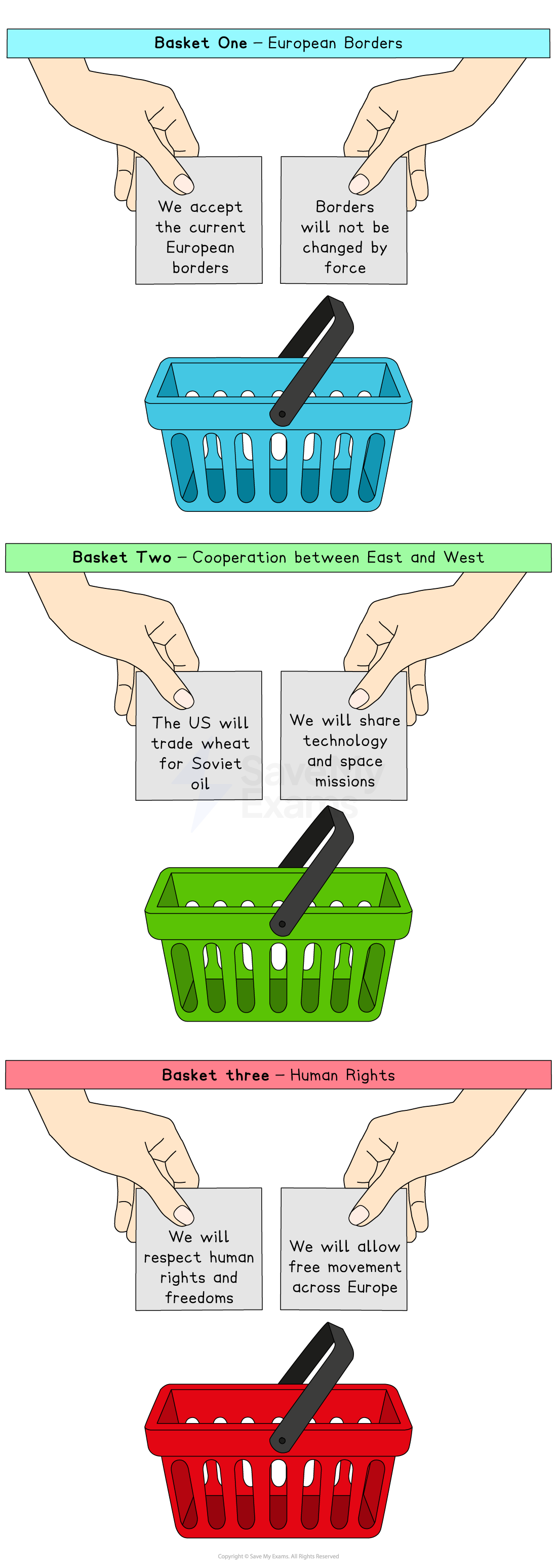
In August 1975, the nations met in Helsinki, Finland and signed up to a wide-reaching set of political, social and economic agreements
The organisers arranged these agreements into three topics, which they referred to as 'baskets'
Examiner Tips and Tricks
The term 'basket' allows a visual way for you to remember the political, social and economic agreements in the Helsinki Accords. Adding images, or dual coding, to your revision is an effective method to help memorise events.

Unlock more, it's free!
Join the 100,000+ Students that ❤️ Save My Exams
the (exam) results speak for themselves:

Was this revision note helpful?
