Law & Order in the 16th Century (WJEC Eduqas GCSE History): Revision Note
Exam code: C100

How Much Did Law and Order Change During the 16th Century? - Summary
Law and order in the 16th century remained largely the same as in the medieval period, with communities still playing a key role in catching criminals and maintaining peace. Systems such as the hue and cry and posse comitatus continued, relying on ordinary people to catch criminals. Parish constables and town watchmen enforced local laws, while able-bodied men were expected to help when crime occurred.
The main development was the increased importance of justices of the peace (JPs)-wealthy local gentry who oversaw law enforcement and punishment in their areas. Although unpaid, the role gave them significant power. Despite growing urban populations putting pressure on these systems, policing remained local and community-based. It was not until the 19th century that law enforcement saw a major change with the creation of organised, professional police forces.
Growth of Civic & Parish Responsibilities
Maintaining law and order in the 16th century was very similar to that of the medieval era
The following were still largely responsible for keeping the peace:
Town watchmen
Parish constables
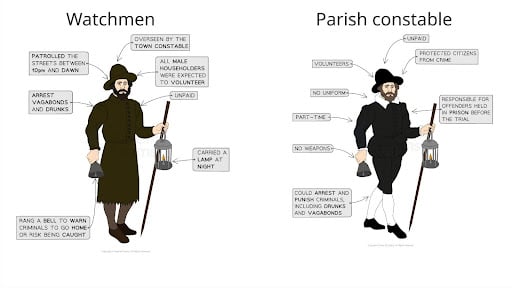
The community still played a vital role in the capture of criminals
Parish constables still used ‘hue and cry’ as people did in the medieval era
Able-bodied men were expected to search for criminals
This search could go beyond the parish
Parish constables could also use posse comitatus
Which ordered every male over the age of 15 to catch a criminal or stop a riot
Members of the gentry had more civil responsibility in the Tudor period as they became JPs
They were responsible for enforcing the new laws enacted by Parliament
JPs attended quarter sessions four times a year
They met with other JPs across England to judge more serious crimes
They had the power to give criminals the death sentence
Judged manor court cases
These continued to handle local, minor crimes (like drunkenness and selling underweight bread)
This was an unpaid position, but it gave them considerable power in their local area
However, urbanisation and the increase in the population put a considerable strain on
JPs
Watchmen
Parish constables
Examiner Tips and Tricks
Question 3 is a describe style question; you may be asked to describe how law and order were enforced. You must always mention specific roles, such as watchmen, not just “the police,” which didn’t exist yet.

Unlock more, it's free!
Join the 100,000+ Students that ❤️ Save My Exams
the (exam) results speak for themselves:

Was this revision note helpful?
