Law & Order in the 19th Century (WJEC Eduqas GCSE History): Revision Note
Exam code: C100

Timeline
Why Did Policing Change in the 19th Century? - Summary
By the 19th century, England and Wales had experienced significant changes. The population had risen from around 2.5 million in 1500 to 10 million by 1800, with many people now living in growing industrial towns and cities. This rapid urbanisation made it difficult to maintain law and order using traditional community methods such as parish constables and watchmen.
In small medieval villages, these systems had worked well because everyone knew one another, but in large cities like London, crime increased faster than it could be controlled. In Wales, the town of Merthyr Tydfil had a population of over 30,000 people, yet it was still only policed by two justices of the peace (JPs). Watchmen and constables were unpaid, poorly trained, and often corrupt, and they could not deal with the rising levels of theft, violence, and disorder. As a result, there was growing public pressure for change. The 19th century saw the creation of organised, professional police forces to meet the demands of an industrial and urban society.
The Concept of State Police
Before the development of a formal police force in England and Wales, other forms of policing were used, such as
Thief-takers
Captured criminals and claimed the reward money
They acted as unlawful law officers
They were often corrupt
Jonathan Wild was known as the ‘Thief-taker General of Great Britain and Ireland’ who ran his own empire of crime in Cripplegate, London. He would take items from thieves and claim the reward. Wild was arrested and found guilty, and hanged for his crimes in 1825.
The Bow Street Runners
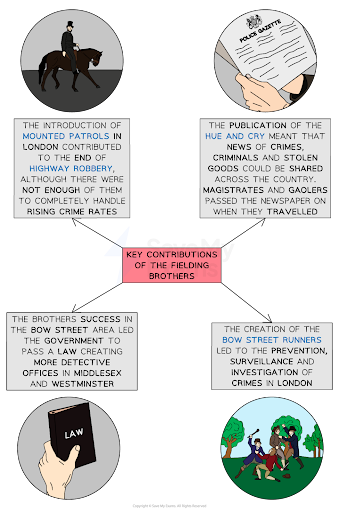
Two brothers, Henry and John Fielding, created their own small police force of paid law officers in London
They were initially volunteers who then charged fees and collected rewards for their work
They were able to pay law officers to patrol the streets in London
They had some success in reducing crime as they found criminals and returned stolen property
Eventually, the government decided to pay them directly
The creation of a formal police force developed over time and was influenced by different local policing systems across England and Wales, including
Created in 1829 by Sir Robert Peel
It divided London into 17 divisions with 3,300 paid police officers
The Rural Police Act of 1839
Allowed JPs to create a police force in their counties
Why Was There Opposition to the Creation of a Formal Police Force?
Many people opposed a formal police force in England and Wales because they believed
A police force would be used by the government to remove political opposition
In places like France, the police were used as spies
A police force was an invasion of privacy
People would not be able to criticise the government
It was not the role of the government to prevent crimes
People believed they could do it themselves
A police force was too expensive
They did not want taxes to rise
The best way to reduce crime was to make punishments more severe
Through the Bloody Code
Criminals were not afraid of constables, and therefore, they would not fear a police force
The Creation of a Formal Police Force
As time went on, opposition towards a formal police force decreased due to
Fear of a revolution in the UK
The war with Revolutionary and Napoleonic France between 1793 and 1815 caused both the landowners and government to fear a revolution in Britain
The violent protests of this time made the idea of a British revolution possible. Events such as the Luddite protests of 1812-1813, the Chartists of 1838-1850, and the Swing Riots of 1830-1831
An increase in crime
Most people believed that violent crime was on the rise
An ineffective policing system
The reliance on JPs, constables, and watchmen was ineffective
Growing towns
Government reforms
The British government was no longer laissez-faire
The government raised taxes to improve local services and public health
Changing attitudes
People saw the benefits of a police force
The presence of police on the streets reduced crime
In 1856, the Police Act created a professional police force
The police were responsible for
Patrolling the streets
Keep law and order
Prevent crime
To investigate criminals and criminal activity
To arrest criminals
This police force was funded by the government and expected to employ officials to inspect the police forces regularly
Examiner Tips and Tricks
In Question 4, you might be asked to ‘Explain why law enforcement changed in the 19th century.’ The most significant development was the gradual shift from informal, local systems to professional policing. The Metropolitan Police Act (1829) introduced full-time, uniformed officers to patrol and prevent crime, but traditional roles like justices of the peace (JPs) and local constables continued alongside the new forces for many years.

Unlock more, it's free!
Join the 100,000+ Students that ❤️ Save My Exams
the (exam) results speak for themselves:

Was this revision note helpful?
