Law & Order in the 20th & 21st Century (WJEC Eduqas GCSE History): Revision Note
Exam code: C100

How Much Has Policing Really Changed in the 20th and 21st Centuries? -Summary
Although policing has developed through modern technology, specialist units, and improved training, its core purpose and powers have largely remained the same. Police officers still work to prevent and investigate crime, maintain public order, and protect communities, just as they did in earlier centuries. They continue to use key powers such as arrest, search, detention, and issuing fines, and deal with both minor and serious offences.
The structure of policing has become more organised and professional, and technology such as radios, DNA evidence, and CCTV has improved efficiency. However, the principles of law enforcement, public safety, and community cooperation remain. Despite changes in recruitment, transport, and diversity, modern policing continues to reflect its traditional purpose: to uphold the law and preserve peace in an ever-changing society.
The Changing Nature of Policing
There have been some considerable changes to policing in the 20th and 21st Centuries, including:
The structure
Prevention of crimes
Police recruitment
Use of technology
Specialisation
Community policing
Structure
In 1900, there were 234 separate forces
The Police Act of 1946 merged smaller town police forces, reducing the number to 117
In 1964, this was reduced again to 47
Today, there are 43 police forces in England and Wales
A Chief Constable is the head of each police force
They work alongside the Association of Chief Police Officers to coordinate their forces
All police forces use the National Police Computer
Created in 2016
Prevention of crimes
When police were first introduced, their role was to deter and catch criminals by
Patrolling the streets
Investigating crimes
Arresting suspects
Modern police have a similar role, but they also increasingly focus on crime prevention by
Conducting risk and threat assessments
Police attempt to predict where crimes might happen
Criminal profiles help to identify criminals
Offering advice
Crime Prevention Officers (CPOs) advise people on crime prevention and security
Advising on locks and alarms to prevent burglary
Dealing with issues that lead to crime
Police attend events that might result in crime
Anti-social behaviour, such as drunkenness, especially in large crowds at sporting events
Building relationships with communities
Police maintain links with neighbourhood watch members
Working with schools
Educating young people on how to avoid crime and the risk factors
Police Recruitment
To attract and retain more police officers, the government provided
Pay increases
Pensions
A reasonable retirement age of between 55 and 60
In 1947, a National Police College was created to train police officers
All recruits attend 14 weeks of basic training
Transport
In 1900, police officers completed their duties on foot
They walked on average up to 20 miles a day
Since the Second World War, the police have used more modern forms of transport, such as
Motorbikes
Cars
In 1970, the Metropolitan police created its own Police Helicopter Unit
There have been many criticisms of the increase in police transport
Many believe that they have taken the police off the streets and out of the community
Use of Techonlogy
Advancements in science and technology have changed and improved policing by
Communication
Two-way radios provide instant communication between police officers
The emergency 999 number has allowed the public to report a crime
Pepper spray and CS gas
Allows the police to have greater control over violent suspects and rioters
Tools used to manage driving offences
Automatic number plate recognition (ANPR)
Breathalysers
Speed cameras
Equipment to identify and convict suspects
Fingerprints
Blood samples
DNA samples
CCTV cameras
Specialisation
Modern Britain has seen an increased emphasis on police training
Before serving as officers, recruits receive
Around 18-22 weeks of classroom training
Practical training
Every police force now has its own special branch
These branches respond to national terror and security threats
Officers in these branches receive specialised training in
Using tasers and firearms
Riding police horses or motorbikes
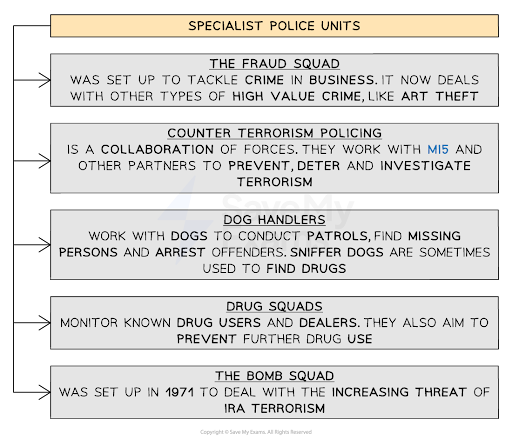
There are several other specialist police units or squads
Community Policing
Modern Britain has seen a return to community law enforcement
Unlike in the Anglo-Saxon era, community law enforcement is now voluntary
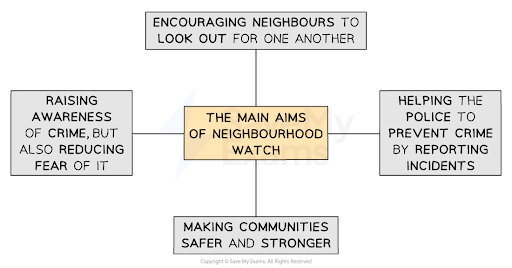
Neighbourhood Watch
This organisation was set up at a time when crime was increasing
Based on a similar scheme in the USA
It is now Britain’s largest voluntary crime-prevention movement
Around 2.3 million households in England and Wales are involved
Attitudes Towards the Police
Attitudes towards the police have fluctuated over time because
The police have enforced unpopular laws
Such as making the use of mobile phones while driving illegal
Some see the police as too powerful
The police are sometimes accused of corruption, prejudice, racism, sexism, and homophobia towards victims and criminals
In 2025, the Metropolitan Police scandal showed that there is still discrimination in the police force
Examiner Tips and Tricks
Question 5 often asks you to ‘explain how law enforcement has changed over time,’ but many students lose marks by only writing about change. To reach the higher levels, you must also show continuity by outlining what stayed the same.
Although new technology transformed policing in the 20th and 21st centuries, the core aims of the police to prevent crime, protect the public, and maintain order remained the same.

Unlock more, it's free!
Join the 100,000+ Students that ❤️ Save My Exams
the (exam) results speak for themselves:

Was this revision note helpful?
