Law & Order in the Medieval Era (WJEC Eduqas GCSE History): Revision Note
Exam code: C100

How did the structure and beliefs of Anglo-Saxon and Norman society influence law and order in medieval England? - Summary
Anglo-Saxon England was a deeply religious and tightly structured society. The king sat at the top of the social hierarchy and was responsible for keeping “the King’s Peace” across the land. Most people lived in small villages or hamlets where everyone knew one another. This created a strong sense of community responsibility as people were expected to prevent and report crime, as well as to help enforce justice through systems such as the tithing and hue and cry.
Religion also shaped law and order. The Church played a vital role in guiding moral behaviour, offering spiritual justice through church courts and influencing attitudes to punishment and forgiveness. After 1066, the Normans strengthened royal authority while keeping many Anglo-Saxon traditions. Local courts, manorial courts, and church courts worked together to maintain order, showing how both community and faith were at the heart of medieval justice.
Communal & Family Responsibility
In the Medieval era, policing was mainly carried out by the community
Men were grouped into tens known as tithings
If one of them broke the law, the others brought him to court
The ‘hue and cry’ was a system used to capture criminals
If a victim raised the ‘hue and cry’, it was everyone's responsibility to catch the criminal
If the criminal were not found, the local sheriff or agent of the king would track them down using their posse
Chief constables were appointed to supervise law and order in their areas
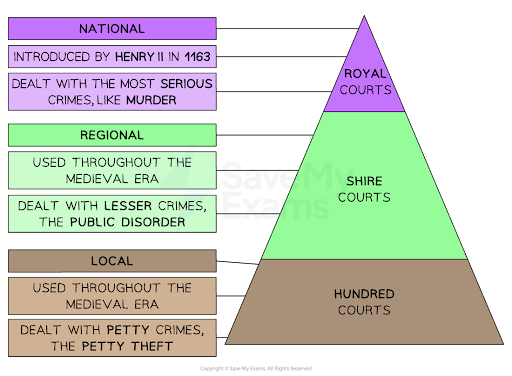
A system of courts was created to control the country by the Anglo-Saxon kings
Royal courts
The king would decide the outcome of the cases
Shire courts
The local lords would decide the outcome of the cases
Hundred courts
Dealt with cases brought forward by the tithings and less serious crimes
The Role of the Manorial, Church & Royal Courts
By the late medieval period, there were several court systems
This was the result of the king, lords, and the Church attempting to control crime
Manor courts
Replaced local courts
Dealt with petty crimes in the local area
Including land disputes and theft
The local lord ran the manor court
By 1500, manor courts were being replaced by Justices of the Peace (JPs)
Borough courts
In towns, but they were the same as manor courts
Controlled by freemen
Church courts
For clergy who broke laws or committed moral offences
Such as drunkenness or adultery
A local bishop would be responsible for these courts
If someone claimed sanctuary, a member of the clergy would pass judgment
Royal courts
Heard the most serious crimes, such as murder
Juries were from the same area as the criminal
In 1293, King Edward I ordered royal judges to visit each county two or three times a year to try cases of serious crimes in that area
This ended in 1971
Examiner Tips and Tricks
Students often lose marks by mixing up how criminals were caught with how they were punished. Law enforcement means finding and arresting offenders; however, punishment is what happens after they have been found guilty. Keep these ideas separate in your answers.

Unlock more, it's free!
Join the 100,000+ Students that ❤️ Save My Exams
the (exam) results speak for themselves:

Was this revision note helpful?
