Combatting Crime in the 19th Century (WJEC Eduqas GCSE History): Revision Note
Exam code: C100

Timeline
Why was the 19th Century a Time of Major Change in Combatting Crime? - Summary
In the 19th century, there were significant changes in how crime was tackled. Before this period, law enforcement relied on local unpaid volunteers as towns and cities grew; this was no longer effective. The work of the Bow Street Runners, set up by Henry and John Fielding, was the first major step towards a more organised and professional police force. They introduced new ideas such as regular patrols and record-keeping to help prevent crime.
Building on their success, Sir Robert Peel established the Metropolitan Police in 1829, giving London its first official police force with paid, full-time officers. Over time, the system expanded across England and Wales through new laws, creating a national network of police forces. This marked the beginning of modern policing, replacing community responsibility with professional law enforcement.
The Establishment of the Bow Street Runners
Thomas de Veil, in 1729, was appointed as a justice of the peace for the City of Westminster
His office was in Bow Street
Criminal activity in this area was high
De Veil investigated crimes and arrested criminals
His work in this area inspired others, such as the Fielding brothers
Henry and John Fielding: The Bow Street Runners
Henry and John Fielding were appointed magistrates
Henry was a magistrate in the Bow Street area
He was concerned about the high crime rates in the area and wanted to reduce crime
In 1751, Henry Fielding published a book entitled An Enquiry into the Late Increase of Robbers 1751
This book analysed crime and found that
There was corruption in the government
People would rather choose a life of crime than work
Only six out of the 80 constables in London were effective
Henry also
Kept records of crimes
Placed adverts
Asking locals for help solving crimes
Established a magazine called The Covent-Garden Journal in 1752
This published information about local crimes
Sent inventory lists of stolen property to pawnbrokers and innkeepers
Established a policing force of ‘runners’ and ‘thief-takers’ to catch criminals; they were
Paid a guinea a week
Trained by Henry
Effective in catching criminals
Initially known as ‘Mr Fielding’s People’. Then later, as the ‘Bow Street Runners’
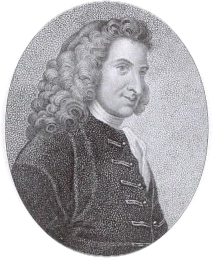
Due to Henry’s poor health, John Fielding, his half-brother, was appointed as a magistrate to help him
John ran the Bow Street Runners in 1754
John followed many of the same strategies as Henry
He published a newspaper called The Quarterly Pursuit in 1772
Providing information on crimes and criminals
In 1786, this became a weekly publication under the name of The Public Hue and Cry
John made a series of suggestions to the government on how to improve the policing in London, including proposals to
Divide London into six areas
Paid JPs would manage these areas and their police stations
The government rejected this proposal, but they did grant £600 to create a Bow Street horse patrol
Provide John with information about crimes from JPs across the country to be published
The government gave John £400 to set up the newspaper The Hue and Cry
In 1800, this became known as the Police Gazette
Force all chief constables within 100 miles of London to live on the main road going into London so they can catch criminals
This plan was rejected as high constables refused to do it
John Fielding was knighted for his role in the Bow Street Runners in 1761
Sir John Fielding died in 1780
Other magistrates continued to run the Bow Street organisation. Bow Street continued to be effective as
The government in 1792 funded seven other magistrates to have six full-time constables in London
Two magistrates associated with Bow Street, John Harriot and Patrick Colquhoun, helped ship owners by establishing the Thames River Police
Ship owners funded the force
They recovered £1220,000 worth of stolen goods in the first year
By 1800, the government funded the River Police
Bow Street Runners increased to 68
In 1805, there were 54 armed horse patrol officers
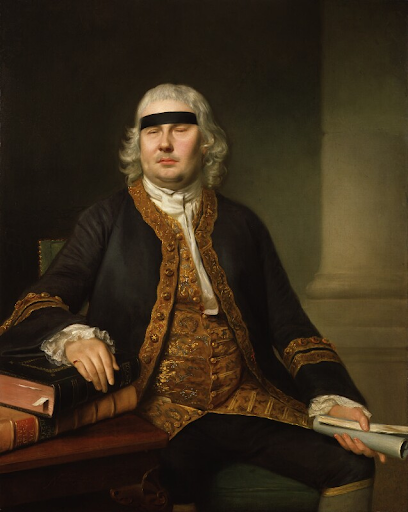
How Effective were the Bow Street Runners?
Despite people's opposition to a formalised police force, Bow Street was seen as successful because it
Reduced crime
Introduced the idea of preventing crime
Rather than responding to crimes that have already happened
Used an already established system
They used JPs and law officers already in positions
Peel & the Metropolitan Police
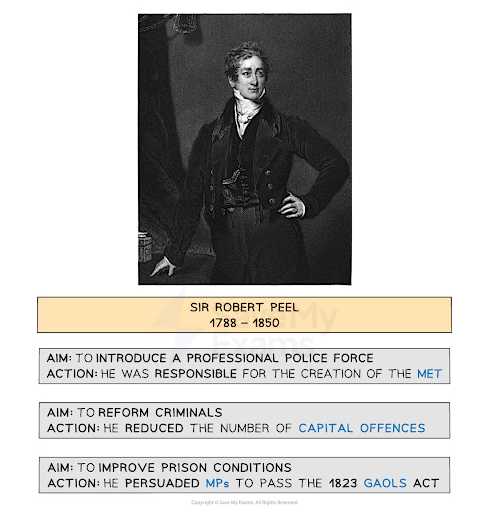
Who was Robert Peel?
Sir Robert Peel was a 19th-century politician
He was initially Home Secretary (for two separate terms)
He later became Prime Minister (also for two separate terms)
Peel took many actions to achieve his aims of reducing crime and reforming the penal code
The Creation of the Metropolitan Police, 1829
Peel wanted an ethical police force
His Peelian principles still provide the foundation for modern policing in Britain today:
Centralisation of policing standards across London
An impartial and objective approach
Lawful behaviour
A positive relationship and cooperation with the public
To only use physical force as a last resort
Differentiation from the army
Non-military uniform
No firearms
In 1829, the Metropolitan Police Force Act came into effect
The new Metropolitan Police Force had its headquarters at Scotland Yard, and also
Divided London into 17 divisions
Each division had 144 constables and a superintendent
Constables patrolled their own beat in their area
Paid their police officers a wage of one guinea a week
Approximately £1.05
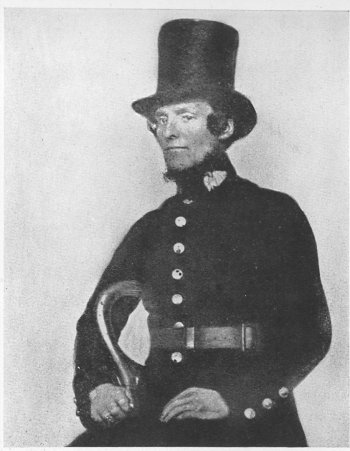
Supplied police officers with a
Blue uniform
Wooden truncheon and rattle. Which was later replaced by a whistle in 1884
Top hats
The Metropolitan Police Act of 1839
Extended the area from a seven-mile area to a 15-mile radius from Charing Cross
This ended the Bow Street Runners and the Thames River Police as they were brought into the Metropolitan Police
After 1839, the Metropolitan Police force grew
By 1900, there were approximately 16,000 police men and 21 divisions
Examiner Tips and Tricks
For questions that are related to change and continuity or development, examiners will expect you to refer to key individuals who influenced policing and crime prevention. You should not just name them, but explain why they did and their impact.
Creating key individual profiles or flashcards for figures like Sir Robert Peel, Henry Fielding, and John Fielding will help you revise what they achieved and their long-term impact on policing.
The Extension of Police Forces
As the Metropolitan Police force was a success, the government passed a series of laws establishing a similar police force across England and Wales
The Municipal Corporations Act, 1835
Reformed some rotten boroughs
Allowed for police forces to be created
It was unpopular by 1837, and only 93 out of 171 boroughs created a police force
The Rural Police Act, 1839
Allowed justices of the peace to create a police force
This was not compulsory
This was unpopular, as by 1856, only 55 counties had created a police force
The County and Borough Police Act, 1856
This act was compulsory
Any county or borough that did not have a police force had to create one
The Home Secretary appointed Inspectors of Constabulary to inspect each police force
Special police units were later developed in response to the ever-changing nature of crime, including
The Detective Branch, 1842
Created in response to the limits of uniformed police officers
Plain-clothed uniformed officers
Included six sergeants and constables
Criminal Records Office, 1869
Created at Scotland Yard, London
Contains records of criminals and crimes
Criminal Investigation Department (CID), 1878
Replaced the Detective Branch
Special Irish Branch, 1883
Created in response to the threat of Irish terrorism
A specialised unit branched off the CID
From 1888, it became known as the Special Branch

Unlock more, it's free!
Join the 100,000+ Students that ❤️ Save My Exams
the (exam) results speak for themselves:

Was this revision note helpful?
