Common Crimes in the 16th & 17th Century (WJEC Eduqas GCSE History): Revision Note
Exam code: C100

How did Economic and Religious Changes in the 16th and 17th Centuries Affect Crime in England and Wales? -Summary
The 16th and 17th centuries were a period of significant change in England and Wales. This was caused by the continuous change in religious beliefs and growing economic hardships. The Tudor monarchs’ repeated changes between Catholicism and Protestantism created many social and religious problems. Crimes such as heresy, the refusal to follow the monarch’s religion, and treason, opposing or plotting against the crown, became common.
At the same time, rapid population growth, inflation, enclosure of land, and unemployment caused widespread poverty. Many people were forced to travel in search of work, leading to the crime ofvagrancy. These religious and economic pressures created social tension and uncertainty, shaping both the causes and nature of crime during this period.
Vagrancy
Vagrancy became more of a problem in the sixteenth century, during the reign of Elizabeth I, due to an increase in
Unemployment
Economic hardships
Between the 1560s and 1570s, London’s Bridewell Prison held approximately 200 vagrants each year
By 1600, this had increased to over 550
Vagrancy became a crime as a result of pressure the general population put on the government
Vagabonds often wandered in search of work
This made them strangers to the community
Many relied on begging and charity to survive
The settled population hated, feared, and resented them
In the reign of Elizabeth I, the law split vagabonds into two categories:
‘Deserving’
Elderly
Disabled
‘Undeserving’
Able-bodied
Fit for work
Vagrants were categorised into different categories, which was illustrated in the book A Caveat or Warning for Common Cursitors, vulgarly called vagabond, by William Harman in 1566
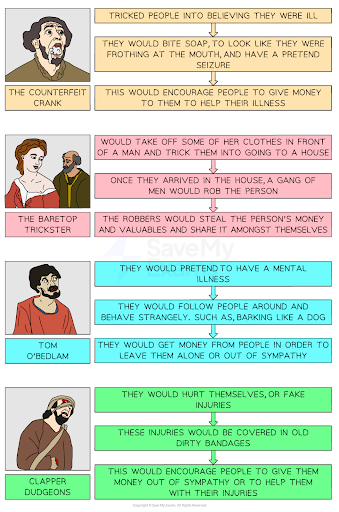
Harman stated that there were 23 different types of vagabonds, such as:
The Counterfeit crank
The Baretop Trickster
Tom O’Bedlam
The Clapper Dudgeons
Heresy
During the 16th and 17th centuries, freedom of religion did not exist
People had to follow the religion of their monarch
If they did not follow the monarch's chosen religion, they were accused of heresy
Those people accused of heresy would be put on trial
They had the opportunity to recant
If they did, they would receive a prison sentence
If they did not recant, they were sentenced to death
During the reign of Mary I, people refused to recant their Protestant faith
Approximately 280 people were burned to death in England and Wales
Rawlins White, a fisherman from Cardiff, was burned at the stake in 1555
The bishops Hugh Latimer and Nicholas Ridley were burned at the stake in 1555
Although Elizabeth I adopted a ‘middle way’ in her religious settlement, there were still heretics
Including Richard Gwyn, a schoolteacher from Llanidloes, who was executed for spreading Catholic ideas in 1584
Examiner Tips and Tricks
In Question 4, examiners want to see how changes in religion directly created new crimes. Under Mary I, heresy meant refusing to follow Catholicism, while under Elizabeth I, refusing Protestantism could also lead to execution.
Treason
Treason during this period was often linked to heresy
When people did not agree with the chosen religion, they attempted to rebel or overthrow the monarch
During the reign of Elizabeth I, many Catholics plotted against her
The Babington Plot of 1586 involved Mary, Queen of Scots, and Anthony Babington. Babington failed to kill Elizabeth I and replace her with Mary
Both Babington and Mary were placed on trial and found guilty of treason and executed

Unlock more, it's free!
Join the 100,000+ Students that ❤️ Save My Exams
the (exam) results speak for themselves:

Was this revision note helpful?
