Common Crimes in the 18th Century (WJEC Eduqas GCSE History): Revision Note
Exam code: C100

Why did crimes such as highway robbery and smuggling increase during the 18th century?- Summary
Crimes such as highway robbery and smuggling were not new in the 18th century, but they became more common due to major social and economic changes. The Industrial Revolution led to a rising population, improved roads, and increased trade, which created new opportunities for crime. More people were travelling between towns and cities, often carrying goods or money, making travellers easy targets for highwaymen on unpoliced roads.
At the same time, heavy taxes on imported goods encouraged many to turn to smuggling, as it provided a way to make money by selling tea, tobacco, and alcohol illegally. Poverty and unemployment also drove people to join smuggling gangs. Both crimes reflected how industrial growth and expanding trade created wealth for some but desperation and temptation for others.
Smuggling
There was a growth in smuggling during the 18th century due to the following:
War
The government increased taxes on goods to pay for costly wars
Excise duty
This tax was placed on goods such as chocolate, tea, and spirits
Customs duties
Tax on imported and exported goods kept on rising
By the middle of the 18th century, the tax on tea had increased by 70%
The black market
People disliked paying taxes and duties on goods, so they brought goods on the black market to avoid paying these costs
Demand for smuggled goods
People did not want to pay taxes and duties on goods, so the demand for goods increased
Policing
There were not enough police to patrol the whole British coastline
It was easy to smuggle goods into Britain
Investors
Investors were willing to fund smugglers' ventures as they profited from them
Employment
Smuggling paid well
This was attractive to poor people who could earn up to seven times their daily wage in one night
There were approximately 20,000 active smugglers in Britain in the mid-18th century
Public perception
Smuggling was seen as a ‘social crime’
It was rarely reported by the public
The government saw smuggling as a serious crime because it was
Disruptive to trade
A drain on tax revenue
Around 1.4 tonnes of tea were smuggled into Britain each year, tax-free
Despite this, authorities struggled to stop smuggling
Smuggling Gangs
Smuggling gangs caused big problems for the government
They could be as large as 50-100 well-armed men
They fought with customs officers
The Hawkhurst Gang was one such example
They smuggled goods along the south coast
They seized back their confiscated goods
The authorities sentenced the leaders to death by hanging
Smuggling gangs were well organised
They often included
The venturer
A wealthy individual
They paid for the venture
They paid the smugglers from the profits
The sportsman
A local person
Knew the local land and people, and used this knowledge to prevent smugglers from being caught
The lander
Organised the small boats and any transport needed by the smugglers
The tubman
Lifted and carried the smuggled goods
The batsmen
Protected the tubmen from customs officials
How did the Government reduce smuggling in the 18th Century?
Smuggling eventually declined as a result of:
New laws
Revenue men
Reduction of high duties
Threat of French invasion
The government introduced new laws
The Hovering Act, 1718, made it illegal for vessels smaller than 50 tons to wait within six miles off the shoreline. This held the punishment of transportation
The Act of Indemnity, 1736, introduced the death penalty for anyone injuring an officer. Those caught bribing an officer were fined, and any smugglers who provided information were pardoned
The introduction of the Revenue Men of the Customers and Excise Service
They patrolled the coastline of England and Wales
33 areas were created and staffed with officers to prevent smuggling
Reduction of high duties in the 1780s
In 1784, the government reduced duties on goods, including tea. This was reduced from 119% to 12.5%The threat of a French invasion during the Revolutionary and Napoleonic Wars
The government created Martello towers along the coast
The Royal Navy patrolled the English Channel
The Royal Navy blockaded French ports
Conviction of smugglers and the coastguard
However, convicting smugglers was difficult as
Magistrates were afraid to anger powerful gangs
Locals did not report smugglers to the authorities
By the 1820s, the government introduced the Coast Guard, which helped to prevent smuggling
Examiner Tips and Tricks
Use specific historical keywords in your answers. Avoid vague phrases such as “they sent criminals away.” Instead, use accurate keywords like ‘transportation’, ‘deterrence’, or ‘retribution’ to show strong subject knowledge and meet the higher bands for accuracy.
Highway Robbery
Across the 18th and early 19th centuries, highway robbery dramatically increased
Travellers became very fearful of highwaymen
There were two types of highway robbers
The footpad
They did not have horses
They stole from pedestrian travellers
The highwayman
Used horses
Attacked stage coaches and people on horseback
Targeted rich travellers
Most robberies took place on roads leading to and from London
Dick Turpin was a notorious highwayman from the time period
His story was romanticised in nineteenth-century novels
Dick Turpin was born in 1706 and became a highwayman alongside Tom King, attacking travellers on the Cambridge Road
Both Turpin and King were wanted criminals with a £100 reward for their capture
They lived in a cave in Epping Forest
King was shot and killed in 1737 during an attack
Turpin managed to escape the attack and moved to Yorkshire
Turpin changed his name and created a business selling horses
In February 1739, Turpin was found guilty of stealing horses and hanged in York
Why did Highway Robbery Increase in the 18th Century?
Highway robbery increased due to
Turnpike roads
Roads had improved, allowing for more people to travel by coach
These roads were often quiet and isolated, making it easier for highwaymen to ambush travellers
Unpoliced roads
There were very few members of law enforcement patrolling the roads
Increased travel
Due to the increase in wealth among the nobility, gentry, and businessmen, there was a desire to travel
As it was the start of the Industrial Revolution, more people were moving from the countryside to the cities and towns for work
The creation of coaching inns
With improved roads and more travelling, people needed places to stay on the roads
Highway robbers watched the coaching inns, looking for people to rob from
The unemployed
As unemployment was high, especially with demobilised soldiers, they turned to highway robbery
The availability of firearms
Handguns became easier for highwaymen to obtain
Handguns were easier to load and fire, making highway robbery easier
Availability of horses
Horses became cheaper to purchase, making highway robbery easier
The lack of banks
There were not many banks; therefore, people were carrying more money around with them
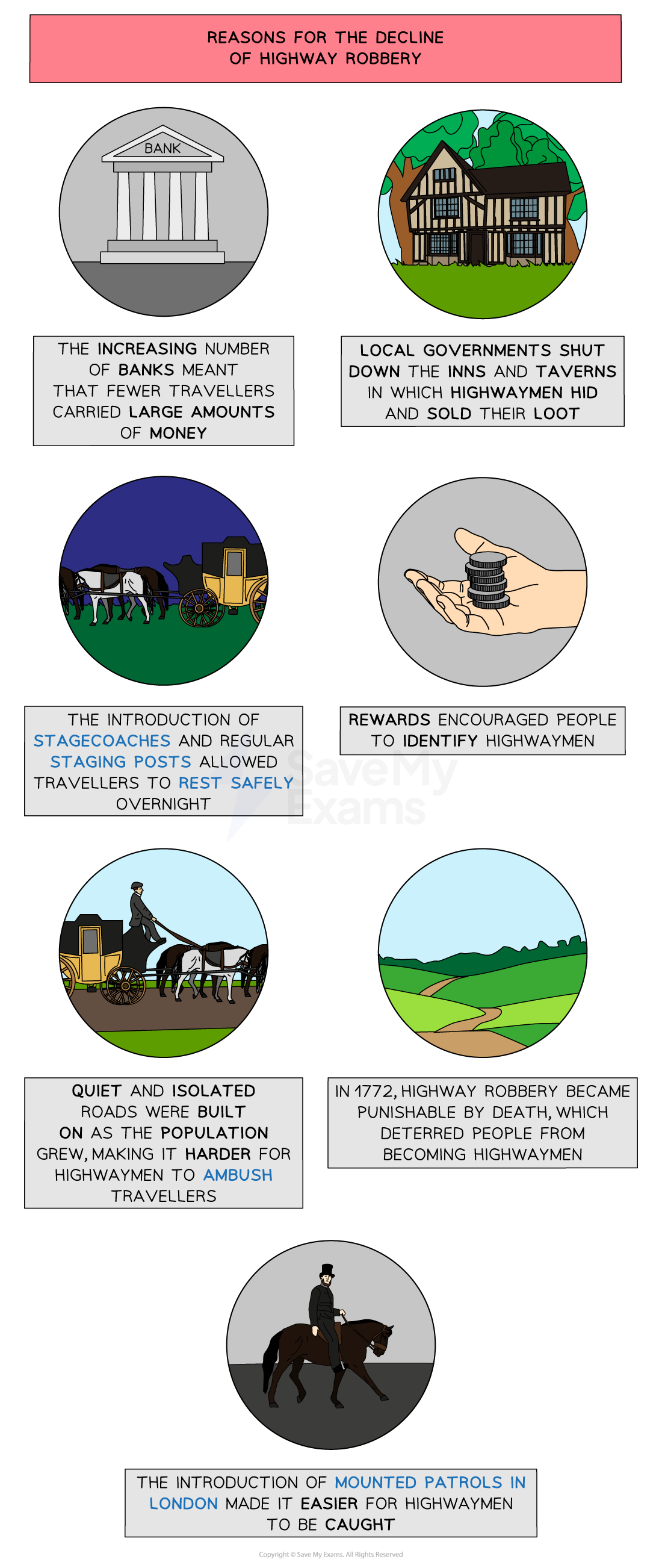
Why was there a decline in Highway Robbery?
The government saw highwaymen as a major disruption to trade
This was especially the case on roads around London
Authorities started to make more efforts to reduce highway robbery
In the early 19th century, highway robbery started to decrease
It eventually stopped altogether due to
The increase in banks
Closing of coaching inns
Rewards for highwaymen
Introduction of stagecoaches and staging posts
Towns and villages are being built around the previously isolated roads
Highway robbery was made a crime punishable by death in 1772
Mounted patrols on roads in London
Examiner Tips and Tricks
In the 18th century, new crimes such as smuggling and highway robbery became more common. However, many older crimes like theft and murder continued. For top marks in “change over time” questions, you must include both elements.

Unlock more, it's free!
Join the 100,000+ Students that ❤️ Save My Exams
the (exam) results speak for themselves:

Was this revision note helpful?
