Common Crimes in the 20th & 21st Centuries (WJEC Eduqas GCSE History): Revision Note
Exam code: C100

How did technology and transport change the nature of crime in the 20th and 21st centuries? - Summary
While many crimes, such as theft and fraud, have existed for centuries, the 20th and 21st centuries saw major changes in how these crimes were committed. Developments in technology and transport created new opportunities for crime. The mass production of cars led to new offences such as speeding, drink driving, and vehicle theft, while the rise of computers and the internet introduced cybercrime, including hacking, online fraud, and identity theft.
These changes also meant that crime was no longer linked only to poverty or the lower classes. Increasingly, middle-class offenders use technology and business networks to commit crimes such as fraud or online scams. Advances in communication and global trade have made it easier for criminals to act anonymously and across borders. In modern Britain, crime has adapted to the pace of technological and social change, reflecting how society itself has evolved.
Technology & Crime
Vehicle Crimes
Cars first appeared on the roads in the UK in 1894
Laws were introduced to ensure the safety of drivers and the public; they included
The Locomotive Acts in the late 19th century, which
Set speed limits
Enforced safety procedures for self-propelled cars
In 1865 alaw was introduced forcing drivers to have someone walk in front of the car with a red flag or lantern
The law also set maximum speeds of
4 MPH in the country
2 MPH in the towns and cities
In 1896, the speed limit increased to 14 MPH, and removed the need for someone to talk in front of a car with a flag or lantern
Before the 1920s, only wealthy people owned cars
However, once mass production methods were introduced in the UK, cars were more affordable, and middle-class people were able to afford them
From 1924 to 1936, car prices fell by 50%
The affordability of cars increased crime
Which saw more crimes being committed by the middle classes, such as speeding and drink driving
Between 1933 and 1934, there were 7,000 fatal car accidents, which resulted in the Ministry of Transport introducing
Speed limits
Tests for new drivers
Pedestrian crossings
As more crimes were happening, the owners of cars were responsible for
Passing a driver's test and having a valid driver's license
Vehicle tax and insurance
MOT certificate when a car is three years old or older
Following the rules of the highway code, road signs, and speed limits
From the mid-20th century to the present day, there has been a dramatic increase in the number of cars on the road
This has increased car-related crime, including:
Drink driving
Breathalysers were introduced in 1967
Men aged 17-29 are more likely to drink and drive
Approximately 3,000 people are killed or seriously injured every year due to drink driving
In 2004, drink driving crimes decreased as the maximum prison sentence was increased to 14 years
Drug driving
In 2011, 22% of those killed in road traffic accidents had drugs in their blood
Drug driving is common among 20 -24-year-olds
Theft of vehicles
One of the biggest categories of crime in the UK
Initially, poor security made it easy for cars to be stolen; however, car manufacturers improved their security
Car thieves break into homes to steal car keys
Some gangs hire trailers for cars that have been stolen to order, and within 24 hours, the car has been shipped abroad
Car-jacking
Criminals have staged fake crashes to steal someone else's car after they have left their car to help them
Criminals have waited for a red light and forced drivers out of the driver's seats, and stolen their cars
Carjackers can sometimes work in gangs
Joy-riding
Young men aged 17-25 are most likely to commit this crime
There are 10,000 cases a year in the UK
Speeding
This is the most common car crime
In 1934, a 30 MPH speed limit was introduced in built-up areas to reduce car accidents
In the 1990s, speed cameras were introduced
The punishment for speeding is either a fine and penalty points or the option to attend a speed awareness course

Computer Crimes
Most computer crimes are new versions of old crimes:
Theft
The internet has made it easier for people to illegally download films and music
Governments, security services, and corporations are vulnerable to hacking
Fraud
The internet has made it easier for criminals to hide their identity
This makes it more likely that people will fall for scams
Phishing scams trick people into giving them personal information
Extortion
The internet contains a lot of personal information that is easy to access
Extortionists may threaten to expose this information unless their demands are met
The scale at which these crimes can be committed is new
Thousands can be targeted at once
Perpetrators can be overseas
This causes new problems in law enforcement
New crimes have also been developed, including:
Computer viruses
Individuals deliberately place a computer virus to damage or destroy information
Hacking
Criminals gain unauthorised access to private records to blackmail or extort the owners of the stolen information
Cyberterroism
Attacking the government via its computer network for political reasons
Cyberbullying
Computers, phones, and social media are used to intimidate or hurt people by repeatedly threatening or harassing themSexual crimes
Chatrooms and social media are used to groom children
Making and sharing illegal images of children
Sharing of sexual content of adults without consent
Examiner Tips and Tricks
While new crimes appeared, old ones such as theft and violence continued. Always mention what has changed and what has stayed the same. For example, although cybercrime is new, theft is a constant feature of crime throughout history.
Hooliganism
The late 20th century saw a rise in violent and anti-social behaviour
One example of this is hooliganism
Hooliganism is often related to sport, especially football
This often includes
Rioting
Violence
Fighting
Excessive drinking
Drugs
Destruction of property
Hooliganism reached its peak in the 1970s and 1980s, with rival football gangs fighting each other
For example, Soul Crew is a football hooligan firm associated with Cardiff City Football Club
Soul Crew was known as one of the most violent football firms in Britain
Football hooligans are often arrested for public order offences
However, the police have attempted to deal with such criminal activity by
Segregating fans before a match
Increased police presence during games, and especially during rival matches
Increased CCTV
The creation of a specialised police unit dedicated to football hooliganism
Terrorism
In the past, terrorism mostly targeted authorities
The Gunpowder Plot is an early modern example of this type of terrorism
Nowadays, governments and ordinary people are vulnerable to terrorism
Extremism often influences terrorists
Modern terrorist attacks have included:
Assassinations
Bombings
Hijackings
Use of chemical weapons
Cyber attacks
Hostage taking
Suicide bombings and attacks
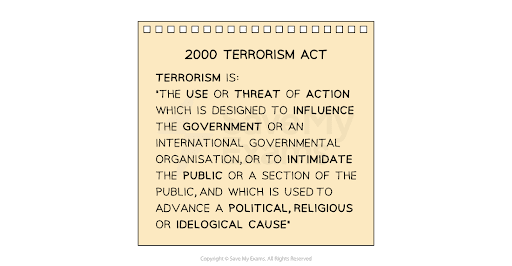
Examples of terrorism in modern Britain include the following:
The Irish Republican Army (IRA)
Active between the 1970s and 1990s
Loyalist and republican paramilitary groups carried out bomb attacks across Britain, including the 1979 assassination of Earl Mountbatten and the 1984 October attempt to bomb the Grand Hotel in Brighton, where Prime Minister Margaret Thatcher was staying
The 1998 Good Friday Agreement ended most of the conflict in Northern Ireland
There have been fatal attacks and violence since then
Terrorist groups linked to Northern Ireland remain a threat
Islamic terrorist attacks
On the 7th July 2005, during the morning rush hour, 4 Islamist suicide bombers targeted commuters in central London. 52 people were killed, and around 770 were injured
In May 2013, outside Woolwich Barracks, two Islamist extremists attacked and killed an off-duty soldier
In 2017, the Manchester Arena was bombed by an Islamist terrorist
Terrorist groups linked to Islamic extremism remain a threat
Far-right attacks
In April 1999, David Copeland planted nail bombs targeting black Bangladeshi and gay people in London. The attack killed three people, and 100 people were injured
In June 2016, Thomas Mair shouted ‘Britain First’ as he shot, stabbedand killed MP Jo Cox during the EU Referendum campaign
In June 2017, Darren Osborn drove into a crowd of people outside a mosque in Finsbury Park. Killing one man and injuring others. In his car were far-right books.
Far-right extremists remain a terrorist threat in the UK

Unlock more, it's free!
Join the 100,000+ Students that ❤️ Save My Exams
the (exam) results speak for themselves:

Was this revision note helpful?
