Symbols as a Form of Expression in Catholic Christianity (AQA GCSE Religious Studies B): Revision Note
Exam code: 8063

The significance of Christian symbols
A symbol is a simple design that represents something more complex
Symbols are commonly used in Christianity to express complex beliefs
They are found in church art and design and may be worn on priests’ vestments
Christian symbols are often monograms, images made up of letters
Three key Christian symbols are the Ichthus (fish), Alpha and Omega and Chi-Rho
Ichthus (fish)
AWAITING IMAGE
Ichthus symbol
The Greek word “ichus” means fish
Christians used the word “ichthus” as a type of acronym, with each letter of the word representing the first letter of a different belief about Jesus
I is Iesous = Jesus
CH is Christus = Christ
TH is Theos = God
U is (H)Uios = Son
S is Soter = Saviour
Taken as a whole, this statement reads: “Jesus Christ, God’s son, Saviour”
In the early days of the Christian Church, this was a common symbol among believers for two reasons
The fish outline was easy to draw and erase, so it was used to indicate that a person was a Christian or that a Christian meeting was taking place
It was only recognisable by fellow believers who knew the symbolism, and therefore, using it avoided the danger of persecution
The fish was a useful symbol because:
Jesus called fishermen to become his apostles, telling them he would make them “fishers of men”
Fish feature in several of Jesus’s miracles, such as the feeding of the 5,000
Alpha and Omega
Attribution:
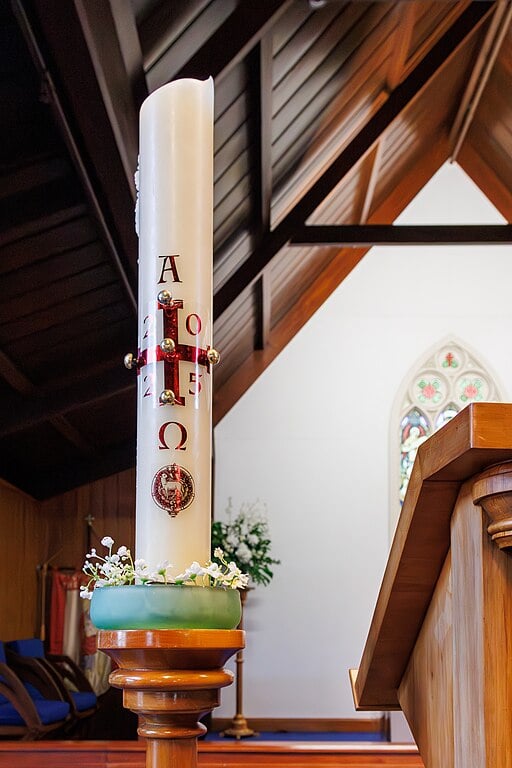
A paschal candle in St John the Baptist Anglican Church, Northcote, Auckland. Bjankuloski06, CC BY 4.0
Alpha (A) is the first letter of the Greek alphabet; Omega (Ω) is the last letter
This symbol is used to indicate that God is at the beginning and the end of everything; God is eternal
In Revelation 1:8, Jesus called himself “the Alpha and the Omega”, showing that he is God — the symbol is used to refer to both God and Jesus
In churches, the Alpha and Omega symbols are widely used in artwork and on priests’ vestments
These symbols are used primarily on the Paschal candle, the large candle lit at Easter to symbolise the risen Christ
Chi-Rho
Attribution:
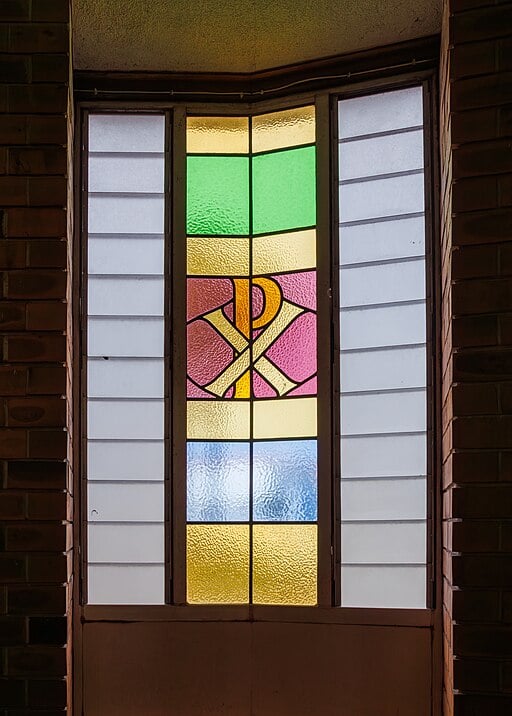
A Chi-Rho christogram on a stained-glass window in St Mary's Cath bolic Church, Northcote, Auckland. Bjankuloski06, CC BY 4.0
The Chi-Rho symbol is the first two letters of the title Christ in Greek (when written in capitals)
Chi = X
Rho = P
Christ is the Greek word for Messiah, the redeemer of the world
Christians use the Chi-Rho symbol to remind them that Jesus redeemed the world through his death
It is often worn as an alternative to a cross or crucifix by Christians to express their faith
The influence of the incarnation on Catholic views about religious art
Some religions, such as Islam and Judaism, consider it disrespectful to portray God in art in any form
Some Christians, such as Baptists and Methodists, agree with this. Their places of worship may be very simple and plain
Reasons why believers avoid showing God in religious art include:
God is infinite and therefore cannot be shown using finite forms, such as art and statues
The second of the Ten Commandments states: “You shall not make for yourself an idol” (Exodus 20:4), and this is sometimes interpreted as a command not to make images or statues to represent God
Art can be misleading and give people wrong ideas about God’s nature
When people pray in front of a statue or work of art, this can mislead others into thinking that the artwork itself is being worshipped
Catholic Christianity does not have the same attitude and sees religious art as acceptable
Because God showed himself in human form on Earth in the incarnation, it is acceptable to use human images to depict God
Jesus was fully human and, therefore, can be pictured as a human being. These representations can help give Christians a greater understanding of his human nature
Jesus came to save all of humanity and, therefore, can be depicted as a member of any ethnicity
The Catholic Church considers religious art to be useful because it:
Inspires people
Helps people learn more about aspects of God
Gives people something to focus on in prayer
Christians who use religious art to focus on in prayer do not worship the artwork. Only God is worshipped, but the images are respected for what they portray
The meaning and significance of one sculpture of Jesus
Catholic religious art allows the use of three-dimensional images such as statues and sculptures
Two common statues used in Catholic Churches are the crucifix and the Sacred Heart
The crucifix
A crucifix is a representation of Christ on the cross
Crucifixes are used as a reminder of Jesus’s sacrifice on the cross and the love of God that was shown through this sacrifice
The Sacred Heart
Attribution:
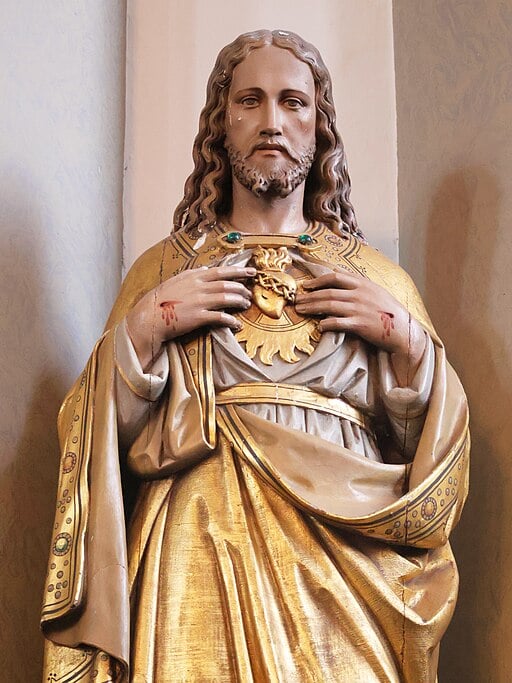
Close-up of the statue of the Sacred Heart of Jesus
Image by ReneeWrites (opens in a new tab) via Wikimedia Commons, CC-BY-4.0 (opens in a new tab)
The Sacred Heart of Jesus statue is a statue of Jesus that reminds Catholics of Jesus’s love for all humanity
Just as the heart is a common symbol for love, the Sacred Heart portrays the total, self-sacrificing love of Jesus for all humanity
Common features of a Sacred Heart statue may include:
A peaceful and loving expression on Jesus’s face
Marks on the hands showing where Jesus was nailed to the cross
Jesus’s hands pointing towards his heart to draw attention to it
Flames coming from the heart to show the intensity of Jesus’s love
A crown of thorns to represent the crown the soldiers placed on Jesus’s head to mock him at the crucifixion
A piercing mark on the heart to represent the hole the soldiers pierced in Jesus’s side on the cross after he had died
There are many reminders of Jesus’s crucifixion on this statue because Jesus accepting crucifixion and death to save humanity was the most complete demonstration of his love
Different Christian views about sculptures or statues of Jesus
Some Christians, including Catholics, accept the use of sculptures or statues of Jesus because they help people to focus on important truths and aspects of Jesus’s teachings
Some Christians believe that it is wrong to portray Jesus in art in this way because:
It goes against the second commandment
It focuses more on Jesus’s humanity and not enough on his divine nature
It is never accurate because there is no evidence of what Jesus actually looked like
Some Christians oppose the use of the crucifix because Christ is risen from the dead, so it is wrong to portray him as still on the cross. They only use an empty cross to symbolise these events
However, Catholics say that it is respectful to remember the great sacrifice Jesus made, just as they still read the gospel accounts of the crucifixion
Some Christians oppose the use of the Sacred Heart of Jesus statue because these statues can be quite violent, with evidence of Jesus’s wounds
However, Catholics say that it is a reminder of the total love of Jesus and the sacrifices he made for all people
Worked Example
Which one of the following symbols was used by persecuted Christians to show other believers that they were Christians?
[1 mark]
A. Chi-Rho
B. Crucifix
C. Ichthus
D. Alpha and Omega
Answer:
C. Ichthus
Early Christians would draw the simple fish symbol to show they were Christians. Non-Christians would not understand it to be a Christian symbol.
Examiner Tips and Tricks
Because the exam board specification doesn’t state one specific statue for this topic, the images and examples on this page are samples. You may have studied different works of art or statues in your course, and any valid example will be accepted by the examiner.
Make sure that whichever sculpture or statue you choose, you can explain its meaning and significance for Catholics.

Unlock more, it's free!
Join the 100,000+ Students that ❤️ Save My Exams
the (exam) results speak for themselves:

Was this revision note helpful?
