Catholic Practices & Redemption (AQA GCSE Religious Studies B): Revision Note
Exam code: 8063

Redemption and the Mass
For Catholics, the Mass is both a re-enactment and a celebration of the redemption brought through Jesus’s death
Catholics believe that when they participate in Mass, they:
Accept Christ’s redemption
Have their sins forgiven
Come closer to Christ and have their relationship with God restored
Are given the power and grace to resist the temptation to sin in the future
The Mass has two key parts
The liturgy of the word
The liturgy of the Eucharist
Liturgy of the Word
This is the part of Mass that contains readings from the Bible
There are at least two readings, with one taken from the gospels
The readings remind Catholics that God has guided his people through the ages
The gospel readings remind Catholics of how Jesus showed God’s love through his words and actions
Liturgy of the Eucharist
This is the part of the Mass that contains the blessing of the bread and wine in the Eucharistic prayer
Catholics believe that the bread and wine become the Real Presence of Christ’s body and blood when they are consecrated
Believers share in this offering when they eat and drink the bread and wine in Holy Communion
During the Eucharistic prayer, the priest reads out the words of Jesus at the Last Supper
“Take this all of you and eat it. This is my body … this is the blood of the new and everlasting covenant which will be poured out for you and all people so that sins may be forgiven. Do this in remembrance of me” (Eucharistic prayer)
Catholics carry out Jesus’s command to eat and drink in remembrance of him to:
Join in with Jesus’s offering of himself on the cross
Be part of the “new covenant”, the new relationship between God and humanity created by Jesus’s redeeming work
Unlike an Old Testament covenant, which involved repeated sacrifices, Jesus’s sacrifice was a one-time event that brought everlasting salvation
Join in with the celebratory meal that binds them to God through Jesus
This reminds them that the Last Supper was a celebration of the Passover. Just as the Jews were freed from slavery in Egypt, so they are saved from slavery to sin
When Catholics receive the consecrated bread and wine in Holy Communion, they believe they are receiving the body and blood of Jesus Christ
They are given power and God’s grace to help them live a good life and follow Jesus’s teachings
They are brought as close to Christ as possible. Jesus taught that he would live in them, and they would have eternal life
“Those who eat my flesh and drink my blood have eternal life, and I will raise them up on the last day … Those who eat my flesh and drink my blood abide in me, and I in them” (John 6:54,56)
At the end of the Mass, Catholics receive a blessing from the priest and a call to share the presence of Christ in the Eucharist with everyone they meet
Different Christian understandings of the Eucharist
Catholic understanding of the Eucharist
For Catholics, the Mass is the source and the summit of Christian life (Catechism of the Catholic Church, 1324)
It is the source of Christian life because:
It is a life-giving event. Receiving the Body and Blood of Jesus in Holy Communion gives life to the believer’s soul
Christian spirituality all flows from the Eucharist (it is the source of it)
“Not to go to Communion is like someone dying of thirst beside a spring” (Saint John Vianney)
It is the summit of Christian life because:
It is the highest form of prayer, re-enacting the offering of Christ on the cross
It celebrates the most important event in Christian history
All Christian action should be directed towards it
Every other sacrament is linked to the Eucharist
Orthodox understanding of the Eucharist
Orthodox Christians have a very similar understanding of the Eucharist to Catholics
The Eucharist is central to their liturgy
Orthodox Christians believe in the Real Presence of Jesus in the Eucharist
Differences from the Catholic Church:
Eucharist is called the Liturgy
There is more symbolism and ritual
The consecration takes place behind the iconostasis (Holy Doors), which symbolise the gateway between heaven and earth. What happens is considered too holy for the congregation to see (and a privilege for the consecrated priest). Christ is offered on the “heaven” side but received by believers on the “earth” side
Anglican understanding of the Eucharist
Some Anglicans (Church of England) share the Catholic belief in the Real Presence
Other Anglicans believe that the bread and wine become holy, but only represent Christ being received (consubstantiation). It is the spirit of Christ that is received in Holy Communion
Christ is present in the hearts of the believers
Protestant understanding of the Eucharist
Different denominations have different views about the Eucharist
Many nonconformist Christians believe the Eucharist is a memorial of the Last Supper and see it as symbolic only
They see Christ as being present in the Bible readings, which are the Word of God
Quakers and the Salvation Army do not celebrate the Eucharist. They see the whole of life as a sacrament and so do not celebrate any sacraments
They believe that Christ is present in the Spirit amongst the people gathered
Prayers in the Mass and Adoration
For Catholics, the Mass reflects their belief that the bread and wine truly become the body and blood of Jesus Christ
Christ is truly present in the consecrated bread and wine (the Real Presence), and so they are referred to as the Blessed Sacrament
The Youth Catechism explains that Christ is present in the Eucharist using these words
“Christ is mysteriously but really present in the Sacrament of the Eucharist”
(Youcat, 216)
The Words of Institution and Agnus Dei
The Words of Institution are the words the priest says to consecrate the bread and wine
They are the same words Jesus said at the Last Supper
“Take this, all of you, and eat of it, for this is my body, which will be given up for you.
Take this, all of you, and drink from it, for this is the chalice of my blood, the blood of the new and eternal covenant, which will be poured out for you and for many for the forgiveness of sins. Do this in memory of me” (Eucharistic prayer II)
Although the bread and wine still look the same, Catholics believe they are transformed when these words are said
The words “this is my body” rather than “this symbolises my body” mean that Catholics believe in the Real Presence, not in a symbolic one
Agnus Dei means "Lamb of God” in Latin
The Agnus Dei prayer is said just before Holy Communion
“Lamb of God, you take away the sins of the world, have mercy on us.
Lamb of God, you take away the sins of the world, have mercy on us.
Lamb of God, you take away the sins of the world, grant us peace”
The prayer is a reference to the Passover, when God commanded the Jews to mark the door of their houses with lamb’s blood so the Angel of Death would “pass over” it and nobody would be killed
The sacrifice of a lamb saved the Jews
Jesus is the new Lamb of God, whose sacrifice saved everyone by destroying sin and death
Eucharistic Adoration and Benediction
Catholic belief in the Real Presence of Jesus in the bread and wine means that they treat it with great reverence and respect
Some Catholics only receive communion on the tongue as a sign of respect
At the end of Mass, any consecrated hosts not received as communion are placed in the tabernacle. They are known as the “reserved sacrament” and are a focus for the prayer known as Eucharistic Adoration
Catholic churches also have Benediction. Benediction means blessing
This is a service when a consecrated host is displayed in a large holder called a monstrance
People can see and worship the Real Presence of Christ
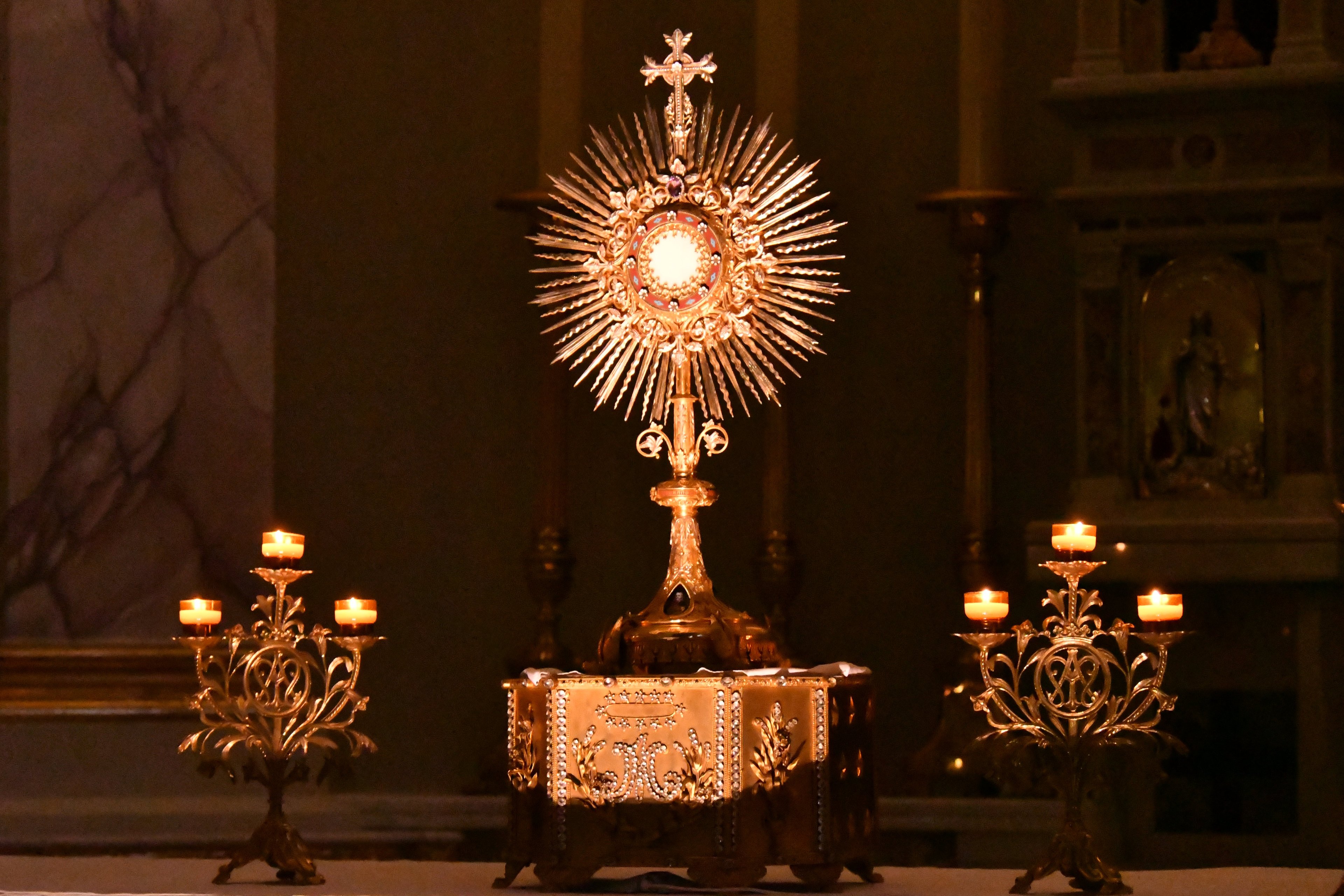
Attribution: Willuconquer, CC BY-SA 4.0
Worked Example
Which of these Christian denominations does not celebrate the Eucharist?
Nonconformist Christians
Catholics
Quakers
Anglicans
Answer:
C. Quakers
Quakers do not celebrate the Eucharist. All of the other listed denominations do.
Examiner Tips and Tricks
Catholic belief in the Eucharist as the “source and summit” of the Christian life is a key belief, expressed in the Catechism of the Catholic Church.
You may be asked about this belief as part of a 5-mark question:
Explain two reasons why the Mass is called the “source and summit” of Christian life.
Refer to scripture or another source of Christian belief and teaching in your answer.[5 marks]
To answer this question successfully, give two developed (explained) reasons why the Catechism states this belief. You can gain a mark for a religious source by quoting the Catechism, Saint John Vianney or one of the Eucharistic prayers — it does not need to be from the Bible.
You may also get a 12-mark question asking you to analyse the belief:
The Eucharist is important to all Christians because it is the “source and summit” of Christian life. Evaluate this statement. [12 marks]
Note the use of “all Christians”, which is the key phrase in this question. Because this statement is not true of “all Christians”, you can easily come up with some reasons against it. Draw up a list of possible statements you might make for both sides.

Unlock more, it's free!
Join the 100,000+ Students that ❤️ Save My Exams
the (exam) results speak for themselves:

Was this revision note helpful?
