Beliefs & Teachings about the Kingdom of God (AQA GCSE Religious Studies B): Revision Note
Exam code: 8063
The significance of the Kingdom of God in the Lord’s Prayer
The Kingdom of God
The Kingdom of God is not a geographical place but the idea of God’s rule in believers’ lives. Therefore, it is also known as the Reign of God
The idea of the Kingdom of God is central to Jesus’s teaching, with almost every parable describing what it is like
The importance of the Kingdom of God is summed up in Jesus’s very first teaching in Mark’s gospel
“The time is fulfilled, and the kingdom of God has come near; repent, and believe in the good news.” (Mark 1:15)
The Kingdom of God:
Began when Jesus was born
Was established through Jesus’s resurrection
Came to believers through the gift of the Holy Spirit at Pentecost
Is continued by Christians who spread the Kingdom of God on earth
Is represented by the Church, the Kingdom of God present on earth
Will be completed at the end of time when God comes back in power and people can share the eternal happiness of heaven
The Lord’s Prayer
Jesus taught his disciples the Lord’s Prayer, or the Our Father, to show them how to talk to God
The prayer contains several beliefs about the Kingdom of God
“Our Father, who art in heaven,
hallowed be thy name;
thy kingdom come; thy will be done
on earth as it is in heaven.
Give us this day our daily bread;
and forgive us our trespasses,
as we forgive those who trespass against us;
and lead us not into temptation,
but deliver us from evil. Amen” (The Lord’s Prayer)
“Our Father” shows that Jesus wants people to be able to call God “Father” and, therefore, have a close relationship with him
“Hallowed be thy name” is a prayer for God’s name to be accepted as holy
Believers must accept God as the most important thing in their lives so they can become members of the Kingdom of God
“Thy kingdom come” is a prayer for people to accept God’s will in their hearts
This allows God’s kingdom to be present on earth through each person who believes
“Thy will be done on earth as it is in heaven” is a call for everyone to do God’s will on earth
This enables the Kingdom of God to be fully established
“Give us this day our daily bread” is a call for everyone in the world to have enough to survive
This means that everyone is equal, which is an important element of the Kingdom of God. It also means that people can focus more on God
“Forgive us our trespasses” means that sins are forgiven, allowing people to be closer to God
Their sins will no longer separate them from God
“As we forgive those who trespass against us”: To spread the Kingdom of God, believers must be prepared to forgive others
Forgiveness removes barriers to relationships and makes the Kingdom of God more fully present
“Deliver us from evil” shows that humans need help to resist temptation and avoid sin
With God’s grace, this can be achieved, and therefore, the peace and justice of God’s Kingdom can spread
Catholic teaching on justice, peace and reconciliation
The signs of the Kingdom of God are justice, peace and reconciliation
Christians must contribute to justice, peace and reconciliation to help the Kingdom of God grow on earth
Justice
Christians should remember that all people are God’s creation and are equal in God’s eyes
Justice involves living in a way that respects others’ rights and dignity
It also involves challenging unjust and unfair situations and systems
This is known as social justice and involves ensuring that everyone has access to basic human rights
The Catechism of the Catholic Church says that “goods created by God for everyone should in fact reach everyone” (CCC, 2459)
Peace
Peace means unity and a lack of conflict
True peace requires justice; there cannot be true peace where there is injustice
Working for peace is a duty of all Christians so that the peace of God’s kingdom is present in everyone’s lives
Jesus taught that “Blessed are the peacemakers” (Matthew 5:9)
Catholics must support all agencies working for peace and justice in the world
Reconciliation
Reconciliation involves bringing together people who have separated because of conflict
It involves a state of peace being established between people or groups
It breaks down the barriers of division, allowing God’s justice and peace to spread and making the Kingdom of God present on earth
Hierarchy of the Church and the Second Vatican Council
Hierarchy of the Catholic Church
The Catholic Church has a hierarchy, indicating different levels of authority and responsibility
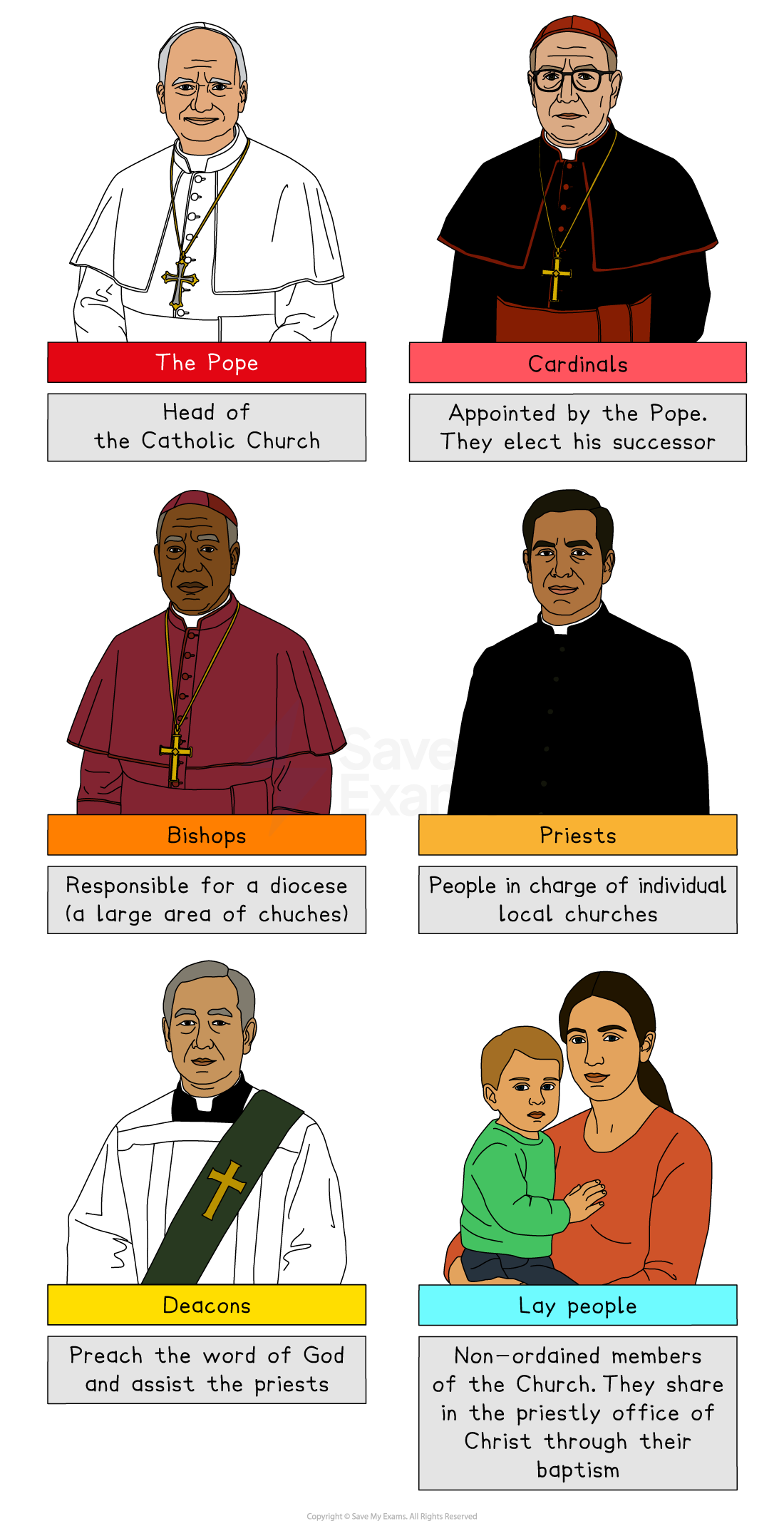
The hierarchy of the Catholic Church
The Pope is the head of the Catholic Church and the successor to Saint Peter, the leader of the apostles
This is because of what Jesus said to Peter:
“You are Peter, and on this rock I will build my church … I will give you the keys to the kingdom of heaven, and whatever you bind on earth will be bound in heaven, and whatever you loose on earth will be loosed in heaven” (Matthew 16:18–19)
The Pope is at the top of the Catholic Church’s hierarchy
The rest of the hierarchy consists of:
Cardinals, who have the task of electing a new Pope when the previous Pope dies or retires
Bishops, who are the successors to the apostles. They are the heads of the local churches and oversee areas of the Church called dioceses
Senior bishops, known as archbishops, have more responsibilities
Priests, who are ordained to administer the sacraments and preach the word of God
Most priests oversee small areas of the Church called parishes
Deacons, who assist the priests and preach the word of God
Lay people, who are non-ordained members of the Catholic Church
The Pope has the ultimate authority in the Church
However, he consults others within the hierarchy to make decisions in the interest of the whole Church
A formal gathering of the Pope and bishops to discuss Church issues is known as a Council, and its decisions carry great authority
“The college or body of bishops has no authority unless it is understood together with the Roman Pontiff, the successor of Peter, as its head” (Lumen Gentium, 22)
The Second Vatican Council
The most recent Catholic Church Council was the Second Vatican Council, 1962–65
Pope John XXIII started the Council, and Pope Paul VI completed it
This Council focused on how to make the Catholic Church more relevant and open to the modern world
It produced four key documents
Dei Verbum (The Word of God)
Lumen Gentium (Light of the Nations)
Sacrosanctum Concilium (On the Sacred Liturgy)
Gaudium et Spes (Joy and Hope)
Dei Verbum (The Word of God)
Dealt with the understanding of the Bible
Agreed that the Bible is authoritative as the Word of God but that it should not be read literally
Stressed the importance of Magisterial Teaching and guidance
Stressed the need for an understanding of Church tradition
Lumen Gentium (Light of the Nations)
Looked at the Church’s structure
Agreed that the Church should be seen as “the Body of Christ”
Stressed that as parts of one body, all roles are important
Emphasised the laity’s importance and their active involvement in parish work and leadership
Sacrosanctum Concilium (On the Sacred Liturgy)
Looked at the liturgy and church services
Agreed that the Mass no longer had to be in Latin but could now be said in the language of those attending
Accepted the inclusion of contemporary music
Encouraged the laity’s greater participation in the Mass
Gaudium et Spes (Joy and Hope)
Looked at the Church in the modern world
Emphasised that the Church should be involved with the world, not separate from it
Stressed the Church’s importance in guiding people on how to live in the modern world, addressing matters such as family life, political and economic affairs and peace between nations
Encouraged peace and tolerance across all world faiths and promoted greater inter-faith dialogue and work
Agreed that God speaks to all people through their conscience
Worked Example
Give two positions in the Catholic Church’s hierarchy
[2 marks]
Answer:
The Pope, as head of the Church, is at the top of the Catholic Church’s hierarchy. [1 mark]
Priests are also in the Church’s hierarchy. [1 mark]
Examiner Tips and Tricks
Try to learn some of the key points made in each of the Second Vatican Council’s major documents and consider their influence on the Church’s role in the modern world.
Then, think about how you would respond to this 4-mark question:
Explain two ways in which the Second Vatican Council has influenced the Catholic Church.

Unlock more, it's free!
Join the 100,000+ Students that ❤️ Save My Exams
the (exam) results speak for themselves:

Was this revision note helpful?
