Drama As a Form of Expression in Catholic Christianity (AQA GCSE Religious Studies B): Revision Note
Exam code: 8063

Dramatised prayer and Catholic beliefs
A pilgrimage is a journey with a spiritual purpose, in which the destination is a spiritual place
Catholics see their whole lives as a journey towards God, with meeting God in heaven after death as their destination
Therefore, Catholics view themselves as a pilgrim people
The Church document Gaudium et Spes calls this journey through life a pilgrimage towards the heavenly city:
“Christians, on pilgrimage towards the heavenly city, should seek and think of these things which are above” (Gaudium et Spes 57)
Living life as if on a pilgrimage towards God makes Christians more aware of their actions and attitudes in daily life
It means they are more likely to pray and act in a way that shows their lives are guided by God’s teachings
One way that Catholics reflect the idea of pilgrimage is by taking part in a form of dramatised prayer called the Stations of the Cross
Dramatised prayer uses both words and actions to convey meaning
Stations of the Cross
The Stations of the Cross are a form of dramatised prayer
They are a series of fourteen images (some versions have fifteen images) showing the key events during Jesus’s last journey, when he carried the cross to his crucifixion
The fourteen Stations of the Cross are:
1. Jesus is condemned to death
2. Jesus takes up his cross
3. Jesus falls for the first time
4. Jesus meets his mother
5. Simon of Cyrene helps Jesus carry the cross
6. Veronica wipes the face of Jesus
7. Jesus falls for the second time
8. Jesus meets the women of Jerusalem
9. Jesus falls for the third time
10. Jesus is stripped of his garments
11. Jesus is nailed to the cross
12. Jesus dies on the cross
13. Jesus is taken down from the cross
14. Jesus is laid in the tomb
Collectively, these events are known as the Stations of the Cross
The pictures are placed at intervals around the walls of the church
People move between each of the images in the church in order
They stop at each one, reflecting on the event that is shown and saying a prayer
They may do this individually or in groups
Making the Stations of the Cross is a common form of Catholic worship during Lent
The Stations of the Cross allow Catholics:
To accompany Jesus on his final journey to the cross
To feel involved and share in Jesus’s sufferings and show they are grateful for his sacrifice
To remain focused on prayer
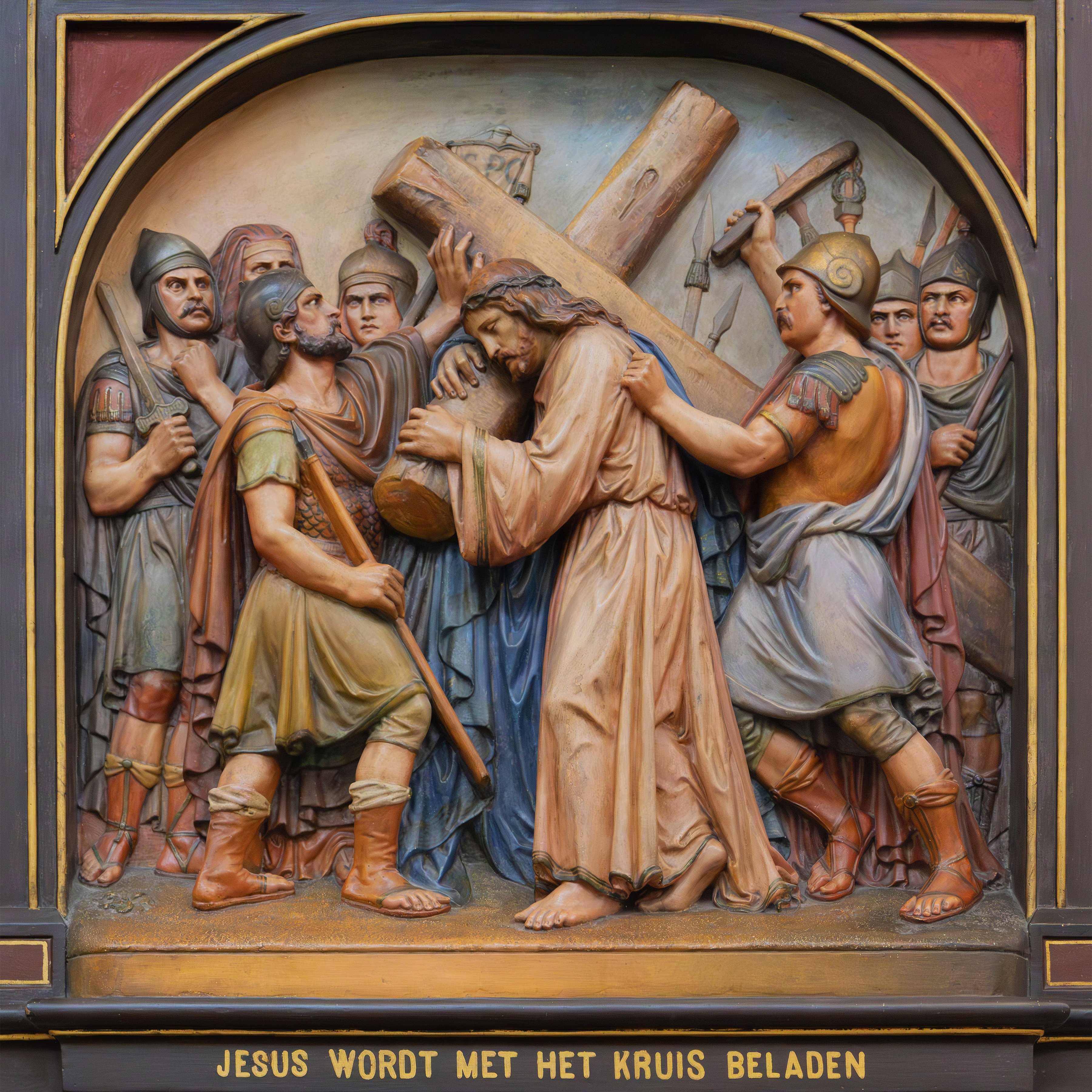
Image by ReneeWrites (opens in a new tab) via Wikimedia Commons, CC-BY-4.0 (opens in a new tab)
Worked Example
Give two reasons why some Catholics like to make the Stations of the Cross.
[2 marks]
Answer:
One reason is that it is a way to accompany Jesus on his last journey. [1 mark]
It is a way to share in Jesus’s suffering and give thanks for his sacrifice. [1 mark]
Examiner Tips and Tricks
Try to learn several examples of the Stations of the Cross. Make sure you can explain how the Stations of the Cross help Christians feel closer to Jesus and that they are seen as a form of pilgrimage in prayer.

Unlock more, it's free!
Join the 100,000+ Students that ❤️ Save My Exams
the (exam) results speak for themselves:

Was this revision note helpful?
