Racial Prejudice & Discrimination (WJEC Eduqas GCSE Religious Studies): Revision Note
Exam code: C120

What is racism?
Racism or racial discrimination means discrimination against someone because of their ethnic group or nationality
Racism is based on the prejudiced belief that some races are inferior to others
Often, racism is linked to skin colour
In the UK, Acts of Parliament have been passed to make racism illegal, including the 1976 Race Relations Act and the Equality Act in 2010
These laws make it an offence to speak or behave in a racist way
However, racism in society still exists
There are many campaigns and education programmes aiming to educate people against racism and explain what they should do if they see racist actions
One example is football’s “Show Racism the Red Card” campaign, which uses high-profile footballers to present an anti-racist message and educate people against racism
Christian attitudes to racism
Most Christians oppose racism in all forms
Racism views some people as “lesser” than others, which goes against the Christian ideals of love and respect for all
The Bible teaches about the equality of all humans
All humans are created by God and in God’s image
Therefore, each person is important and special
Although people are different, this does not mean that they are not equal in God’s eyes, as Paul wrote
“There is neither Jew nor Gentile, neither slave nor free, nor is there male and female, for you are all one in Christ Jesus.” (Galatians 3:28)
Paul also wrote to the Romans that “God does not show favouritism” (Romans 2:11), and James wrote, “My brothers and sisters, believers in our glorious Lord Jesus Christ must not show favouritism” (James 2:1)
Christians must follow this advice and treat each other with respect
Jesus’s teaching to “love your neighbour” and the Golden Rule, “Do to others what you would have them do to you” (Matthew 7:12), make it impossible for Christians to show racism
Instead, they need to show the love, respect and kindness to others that they wish to receive for themselves
Christians are encouraged to treat everyone as equals
Christianity is a worldwide religion, and believers of many races are united by their faith in a global community
Historically, the Church has not always opposed racism consistently. For example, the Dutch Reformed Church did support the apartheid system in South Africa in the twentieth century
Apartheid kept black and white people separate
White people had all the privileges, including the ability to vote
Black people did not have fair access to education, housing, employment and other public services
Other Christians campaigned against the apartheid system
Archbishop Desmond Tutu was one of the Christian leaders who headed a peaceful campaign for equal civil rights and the abolition of apartheid
Apartheid eventually ended in 1994
Many other Christian individuals and groups have campaigned against racism
In 1998, major UK churches issued a joint “Churches Together” statement saying that racism contradicts the Christian gospel and damages the whole of society
The Church of England’s Committee for Minority Ethnic Anglican Concerns (CMEAC) and the Catholic Association for Racial Justice (CARJ) work today to promote equality, support minority groups and challenge racism within the church and society
Martin Luther King
Dr Martin Luther King Jr was a Christian Baptist minister who campaigned for equal rights for black people in the USA in the 1950s and 1960s
King fought against racism in a peaceful and non-violent way
This response to injustice was strongly influenced by Jesus’s teachings to “turn the other cheek” and “love your enemies”
After a black woman called Rosa Parks was arrested for refusing to give up her seat to a white man on a bus, King organised the Montgomery bus boycott
Black people refused to use buses for 382 days, causing the bus companies to lose thousands of pounds
The Supreme Court took notice and changed the law so Black people no longer had to give up their seats on the bus for White people
King led the Civil Rights movement, organising campaigns and protest marches to achieve equality, always using peaceful methods
King received many death threats and attacks for his campaigning
He was awarded the Nobel Peace Prize in 1964 but was assassinated in 1968
Martin Luther King Jr believed in equal human rights for all
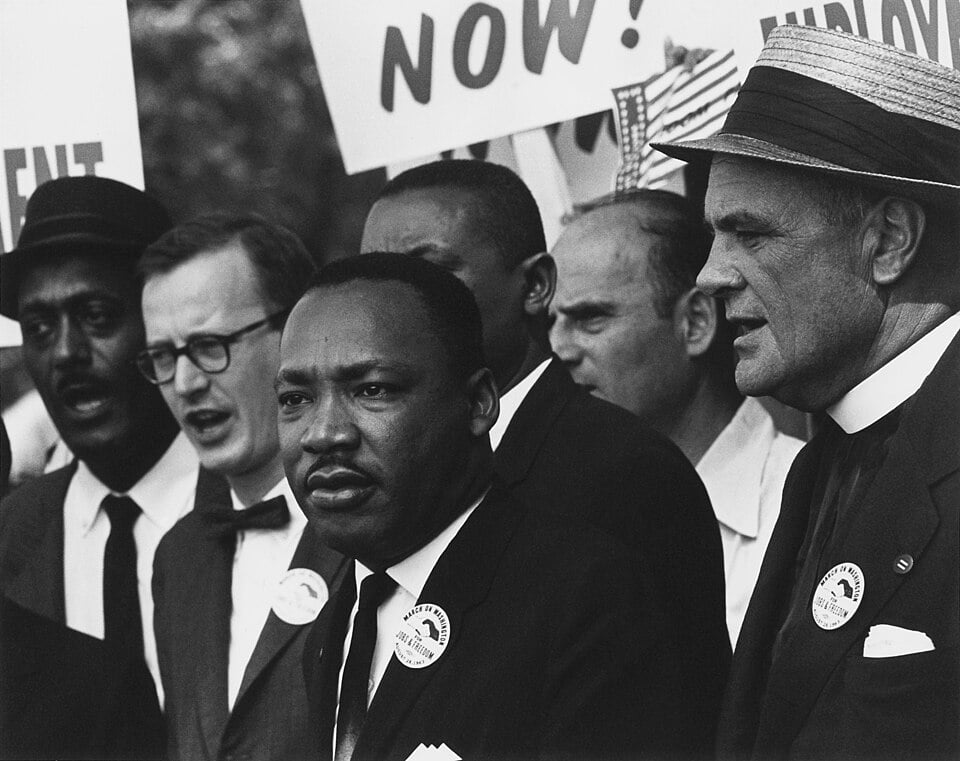
In his famous “I Have a Dream” speech during the 1963 Civil Rights March in Washington, DC, King spoke of his vision
“I have a dream that my four little children will one day live in a nation where they will not be judged by the colour of their skin but by the content of their character.”
Attribution:
Civil Rights March in Washington, DC [Dr Martin Luther King, Jr and Mathew Ahmann in a crowd.] is licenced under CC0 1.0
Civil Rights March on Washington, D.C. [Dr. Martin Luther King, Jr. and Mathew Ahmann in a crowd.] is licensed under CC0 1.0
Muslim attitudes to racism
Muslims do not support racism
The Qur’an consistently teaches people not to be racist
Although there are different races and tribes, humans have been created from the same single man and woman and are equal
Instead of building walls based on stereotypes and prejudices, people should get to know one another
“People, We created you all from a single man and a single woman, and made you into races and tribes so that you should get to know one another. In God’s eyes, the most honoured of you are the ones most mindful of Him: God is all knowing, all aware” (Qur’an 49:13)
Allah looks past the differences that cause inequalities between humans, such as colour or ethnicity
“And among His signs is the creation of the heavens and the earth, and the difference of your languages and colours” (Qur’an 30:22)
The Hadith teaches about the equality of all people
“People are equal like the teeth of a comb” (Hadith)
Muslims should follow the teaching and example of the Prophet Muhammad (pbuh)
The Prophet chose Bilal ibn Rabah, a former black slave, as the first muezzin (caller to prayer). This showed that a person’s race does not affect their worth in Islam
The Prophet is believed to have said in his final sermon, “An Arab is not better than a non-Arab … a White person is not better than a Black person except by piety and good actions”
Islam is made up of the ummah, a worldwide community, and no distinction is made between people of different races
This is demonstrated on the Hajj pilgrimage, where everyone wears the same white garments (ihram) to show equality in the eyes of Allah
Although it goes against all teachings of Islam, some Muslims have been prejudiced against “Westerners” and those of different religions
Usually, this has more to do with disapproval or disagreement with the way they live their lives or their lack of religious belief than racism
Many Muslims believe they have a duty to challenge racism, following the example of Muslims such as Farid Esack, a university teacher who campaigned against apartheid in South Africa at great personal risk
Today, Muslims continue to work for racial harmony through interfaith organisations such as the Christian Muslim Forum. This UK-based group brings Muslims and Christians together to:
Build relationships
Organise joint community projects
Support victims of hate crimes
Promote understanding across racial and religious divides
Worked Example
What is meant by “racial discrimination”?
[2 marks]
Answer:
Racial discrimination is acting unfairly towards someone because of their race or ethnic background.
Examiner Tips and Tricks
Although many teachings in both Christianity and Islam support the idea of equality, the exam board expects to see the following examples in your answers on this topic:
Christianity:
“There is neither Jew nor Gentile, neither slave nor free, nor is there male and female, for you are all one in Christ Jesus” (Galatians 3:28)
Islam:
“People, We created you all from a single man and a single woman and made you into races and tribes so that you should get to know one another. In God’s eyes, the most honoured of you are the ones most mindful of Him: God is all knowing, all aware.” (Qur’an 49:13)
“Do not let hatred of others lead you away from justice. Be just, that is nearer to righteousness.” (Qur’an 5:8)
Make sure you are familiar with these and can explain how believers interpret them. They are equally applicable to any topic in the Issues of Human Rights section.

Unlock more, it's free!
Join the 100,000+ Students that ❤️ Save My Exams
the (exam) results speak for themselves:

Was this revision note helpful?
