Model Answer: Article (Cambridge (CIE) IGCSE English Language): Revision Note
Syllabus Edition
First teaching 2025
First exams 2027
Exam code: 0500 & 0990

Assignment 1 requires you to select and evaluate facts, opinions and arguments from a text or texts.
You are also required to write in a highly effective and technically accurate style, adapting your form and language to suit your audience and purpose.
The following guide will demonstrate how to approach this task in the format of an article.
While the task itself is taken from a past exam paper, it is important to note that in your coursework portfolio you are not permitted to use texts or tasks from exam papers. However, we have included this example in order to demonstrate the skills required in order to achieve a top-mark piece of work.
Addressing the reading assessment objectives
Up to 15 marks are available in this task for your ability to evaluate both the explicit and implied ideas, opinions and attitudes expressed in one or two texts, and assimilate them to write a developed and sophisticated response.
Let’s take a look at how you do this, using the following two texts:
Text A: My best friendships happen online but that doesn't make them any less valid
The following text is about online friendships.
We blame the internet for all human sins. It has grown popular to berate the internet for its role in our ever-growing loneliness epidemic.
Scientists regularly release studies that suggest a correlation between social media use and loneliness, low self-esteem and social isolation. But even they have to admit we do not know what came first: the loneliness or the social media.
I'd like to defend the internet. I've just spent a year researching friendship for my book, which is about precisely this: the intersection between loneliness and friendship.
I've spoken to countless people, both my own friends and strangers from the internet, who would simply not have access to the same social life without social media. I know a woman who met all three of her bridesmaids — the women she cherishes most in the world — online. She says she feels like her most authentic self when she's online.
This is perhaps exactly the point: we can no longer quite so easily distinguish between our online selves and our 'real' selves. We are becoming confident enough to merge our online and offline selves as we realise that social media is an important platform for friendship.
My best friends in the world live in Melbourne, New York, Los Angeles and New Orleans. I am, at any time, a minimum of 5,000 kilometres away from them. Catch-ups over lunch are not possible for us. Our group chat has become a glorious mishmash of the trivial and the meaningful — home to career advice, dog pictures, memes and moral support. I am indignant and distressed by anyone who would suggest our largely online friendship is in any way less valid than people who have the luxury of sharing oxygen in the same physical space.
Besides, befriending apps are popping up all over. Some alleviate the loneliness for new mums or help you find new friends when you move to a new city. The clever thing about so many of these apps is they use the very thing we blame for our disconnection from others — technology — to bring us back together. They take away the difficulty of usual social interaction and reduce the chance of rejection. Think how many people this technology might particularly help: introverts, people with disabilities that make it difficult to leave the house or even speak, deaf people, people with mental health problems, people who just find social interaction terrifying.
The internet could be just the thing to help us revive friendship.
Text B: The limits of friendship
The following text is about the changing nature of friendship.
Robin Dunbar, an anthropologist working with primates some years ago, was researching why primates spend so much time in groups. He moved from there to humans and claimed that the average person could have up to 150 people in their social group. Anything beyond that is unmanageable. Since then, Dunbar has been exploring whether our ever-expanding social networks have done anything to change it.
Within the group of 150 only 5 will be your closest support group. Dunbar found that while the group sizes are stable, their composition is fluid. Your five today may not be your five next week.
As constant use of social media has become normal, people have challenged the relevance of Dunbar's number. Isn't it easier to have more friends when we have social media to help us to cultivate and maintain them? Our real-world friends tend to know each other but online we can expand our networks. Yet, 150 has remained constant, despite the ease of online connections compared with face-to-face ones.
However, social media is changing the nature of human interaction. It allows you to keep track of people who would otherwise disappear. What keeps face-to-face friendships strong is the nature of shared experience. The social media equivalent — sharing, liking, knowing that your friends have looked at the same cat video — lacks the synchronicity of shared experience. We've seen the same movie, but we cannot bond over it in the same way.
With social media, we can easily keep up with the lives of far more people. But without investing the face-to-face time, we lack deeper connections with them, and the time we invest in superficial relationships comes at the expense of more profound ones. We may widen our network to 400 people that we see as friends, but keeping up an actual friendship requires time. Putting in the effort to 'like', comment and interact with an ever-widening network means we have less time and capacity left for our closer friends — the ones that really matter.
To begin with, you should read the texts and highlight the ideas and opinions that could inform your writing. Your response might use the following ideas from these texts:
Text A:
The internet is blamed for everything without reason
Loneliness, low self-confidence and social isolation are linked to social media, but it is not really known in what way
The internet can make people less lonely, not more
People can build meaningful connections over the internet
Social media can help people find friends and develop a social life
You can be yourself on the internet as well as in person — our online and real-life personas are being merged
Online friendships can be made across vast distances
Talking and friendships online can be just as rich and as valid as in-person ones
Befriending apps are now increasingly available
Some people will find it easier to make friends online
Text B:
Research shows how important real friendship is to people
We are genetically wired to make a small number of close friends even in larger social groups
Even though we now have the internet to help us maintain friendships across expanding distances, we don’t actually have more friends with social media
The nature of friendship is changing
Shared experience in real life is essential for strong friendships
Deeper connections take more effort than being online
Assignment 1 article model answer
Worked Example
Question
Write a magazine article for young people about modern friendship.
Base your article on what you have read in both texts.
[30]
Answer
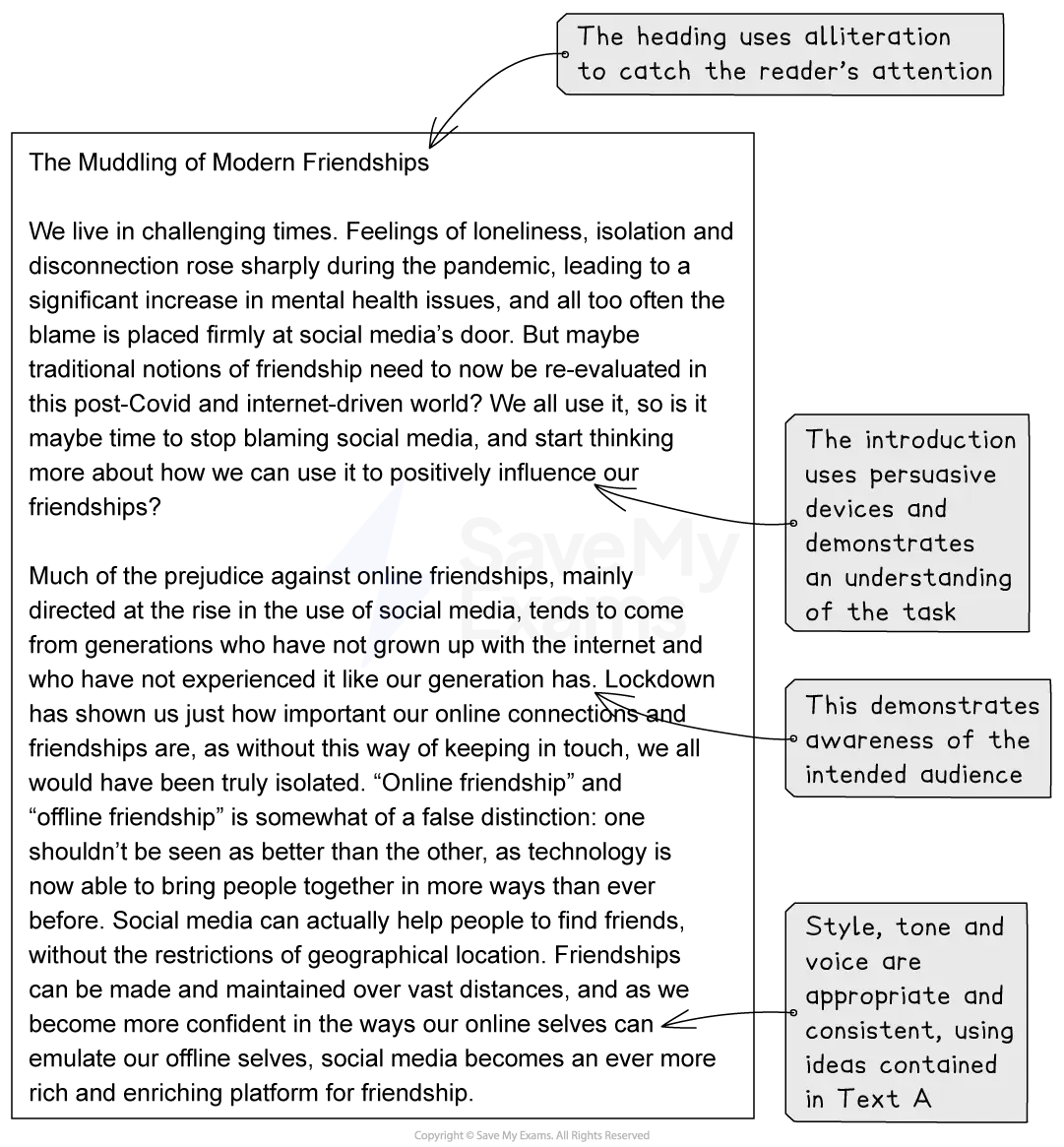
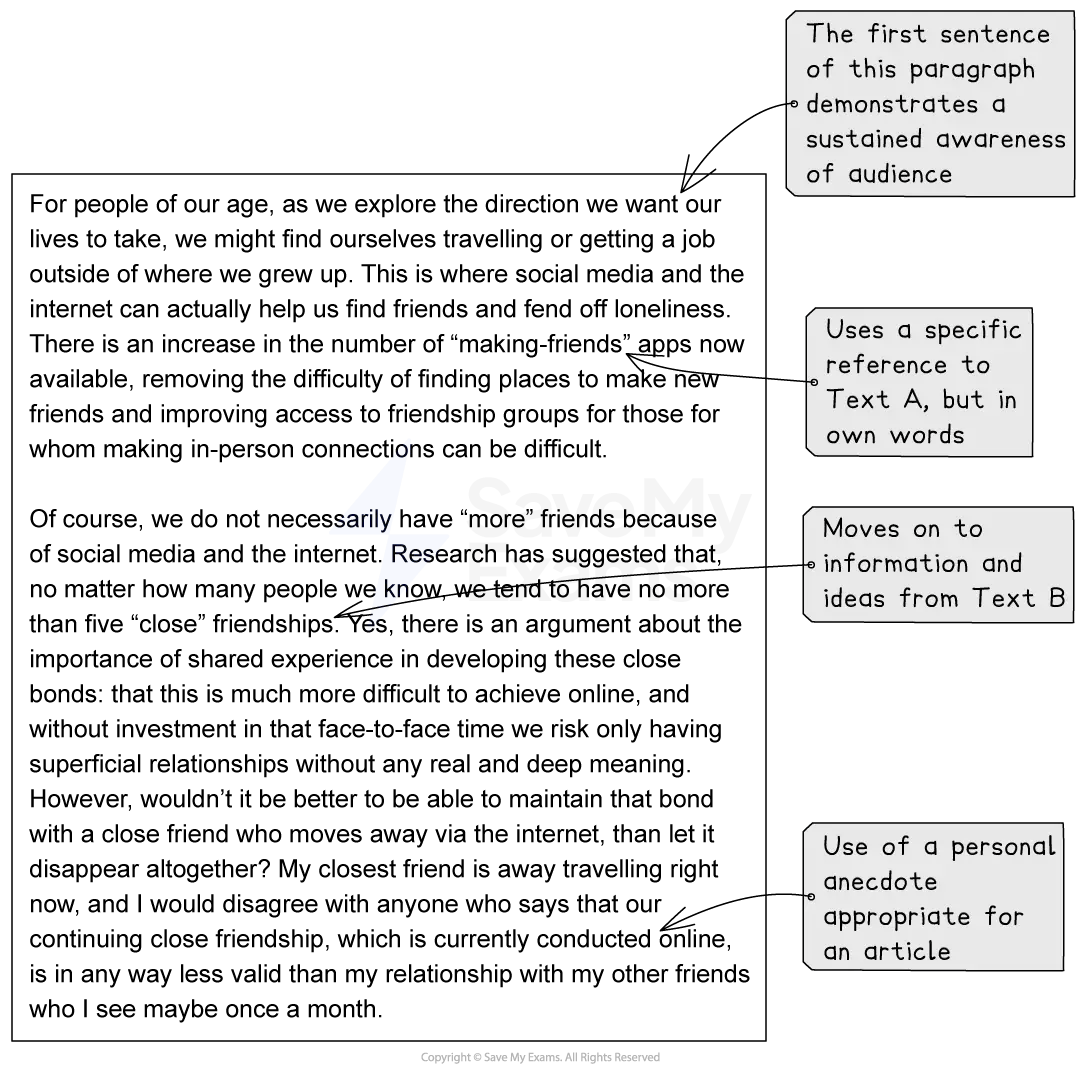
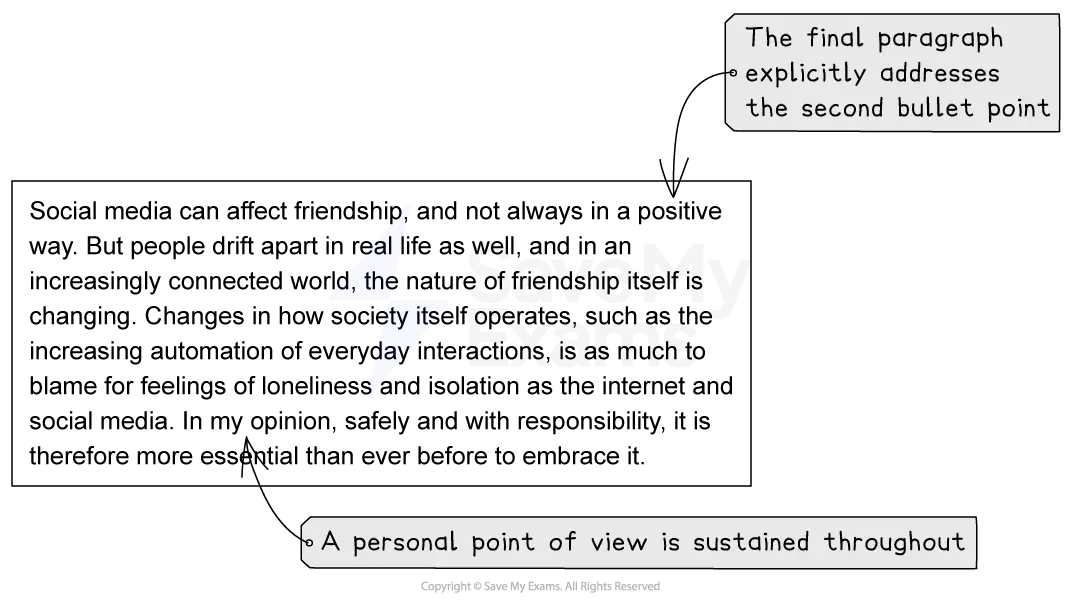
[30]
Commentary
The heading uses alliteration to catch the reader’s attention
The introduction uses persuasive devices and demonstrates an understanding of the task
The answer demonstrates awareness of the intended audience, which is sustained throughout
Style, tone and voice are appropriate and consistent, using ideas contained in Text A and Text B
Any specific references to ideas or opinions in the text are put in the candidate’s own words
The use of a personal anecdote is appropriate for an article
A personal point of view is sustained throughout
Spelling, grammar and punctuation are accurate throughout

Unlock more, it's free!
Join the 100,000+ Students that ❤️ Save My Exams
the (exam) results speak for themselves:

Was this revision note helpful?