Model Answer: Letter (Cambridge (CIE) IGCSE English Language): Revision Note
Syllabus Edition
First teaching 2025
First exams 2027
Exam code: 0500 & 0990

Assignment 1 requires you to select and evaluate facts, opinions and arguments from a text or texts.
You are also required to write in a highly effective and technically accurate style, adapting your form and language to suit your audience and purpose.
The following guide will demonstrate how to approach this task in the format of a letter.
While the task itself is taken from a past exam paper, it is important to note that in your coursework portfolio you are not permitted to use texts or tasks from exam papers. However, we have included this example in order to demonstrate the skills required in order to achieve a top-mark piece of work.
Addressing the reading assessment objectives
Up to 15 marks are available in this task for your ability to evaluate both the explicit and implied ideas, opinions and attitudes expressed in one or two texts, and assimilate them to write a developed and sophisticated response.
Let’s take a look at how you do this, using the following two texts:
Text A
The following text, written by a parent, is about being able to speak more than one language.
Everyone knows that it's intriguing to watch your children change over the years. But to hear them alter their language, over the course of a few weeks, is almost surreal. Until we moved to their mother's country, Italy, my children had always lived in England and their English was what you would expect: fluent and full of pre-teen playground slang.
What's breath-taking since we moved isn't just their language acquisition, it's the way their personalities subtly shift. Our eldest daughter, abrupt at the best of times, is strangely sweet in Italian; the middle child, our funny girl in English, is precise and serious; and the youngest is even more boisterous in Italian.
I, too, feel altered. If you're a writer, and words are your currency, hopefully you're eloquent. But when you live in a language not your own, however, fluent you are, your accent is ever obvious and you lack the nuances. Humour is hard. In a language as melodious as Italian, you will always be blunt. The children, though, will hopefully become what I can never be: truly bilingual.
Until recently, bilingualism was considered damaging to a child's development. If, for example, immigrants maintained a mother tongue at home, it would impede integration at school and probably lead to academic regression. These ideas changed with growing research on the brains and behaviour of bilingual children leading some to believe that bilingualism may offer some advantages.
Research also suggests that being bilingual increases your ability to empathise, to see a situation from another's perspective and there's some evidence that bilingual people develop dementia later than monolinguals. A flexibility of mind makes multi-tasking less problematic for bilinguals, apparently.
It would be very easy to become smug, but there are clear drawbacks as well as advantages. The verbal aptitude of bilinguals in each language is generally less than that of monolingual speakers; the vocabulary size is smaller and there is a slower response time for understanding and producing words.
It's as if some bilinguals can speak, say, 95 per cent of two languages, rather than 100 per cent of one. If children are to be articulate and sophisticated language users, that missing 5 per cent is a major hole, especially if you want them fully to appreciate the culture of both. And people lose old languages, or don't gain new ones, for reasons that have nothing to do with a careful measurement of potential benefits.
In another language, you don't just learn new words, or sounds, but new notions. It's like putting on different spectacles and seeing the world with different eyes. You gain a different perspective and sometimes, if you're lucky, you become more, rather than less, eloquent.
Text B
The following text is about being bilingual.
Being able to switch between two or more languages in conversation is pretty cool. This week, a study from the University of Washington found that bilingual babies will have developed 'better' brains before they even utter a first word. But it's not all brain development and top grades.
It's true people will find you cultured, worldly and intelligent, even though you probably didn't have a choice about learning an extra language. You either picked it up as a baby or you were forced to learn it when you moved to another country. But bilingual people are rarely equally proficient in both languages and it's easy to make mistakes in one language or the other. It takes real effort to keep both if you don't use them equally. Many people lose one of their languages over time.
An extra language makes you more marketable for employers since the 21st century world is a globalised economy. If employees can speak another language they can interact with more of the world, provided they have the range of vocabulary and fluency for a professional setting. Some bilinguals have been educated in a language they don't speak outside of school or college. They might be fluent there but not so much in the big, wide world.
Your first language can keep you in touch with your roots wherever you go, through books or through music. Although I moved to the UK when I was 10 and absorbed much of the surrounding culture, I'll never forget where I'm from since my mother frequently likes to remind me of proverbs that really don't make much sense in English.
Apparently, those who speak different languages can experience personality changes when switching from one to another. That explains why my friends say I sound angry when I'm on the phone to my parents!
To begin with, you should read the texts and highlight the ideas and opinions that could inform your writing. Your response might use the following ideas from these texts:
Text A:
“Pre-teens” pick up a new language quickly
New languages can change young people’s personalities
Picking up on nuance and being able to express humour in a new language is hard
Arguably, true bilingualism is not possible
Accents are always obvious
Attitudes to bilingualism have changed with research
Bilingualism can help with empathy and help people to see different perspectives
There is some evidence that bilingualism could protect against dementia and makes our minds more flexible
But it can make people less articulate/developed in both languages
Bilingualism can be very enriching and help you to become more eloquent
Text B:
Gaining a second language is not always a choice
It can make you a more interesting person
Bilingual people are rarely equally proficient in both languages and it is easy to make mistakes
Languages can be lost without effort
Being able to speak an extra language can make you more employable
It is not always possible to be fluent in more than one context
Retaining your first language helps you keep your link to your culture
Switching from one language to another can lead to personality changes
Assignment 1 letter model answer
Worked Example
Question
A relative is considering moving to another country where they and their teenage children will have to learn another language.
Write a letter to your relative giving your views about whether or not this is a good idea, based on what you have read.
[30]
Answer
[30]
Commentary
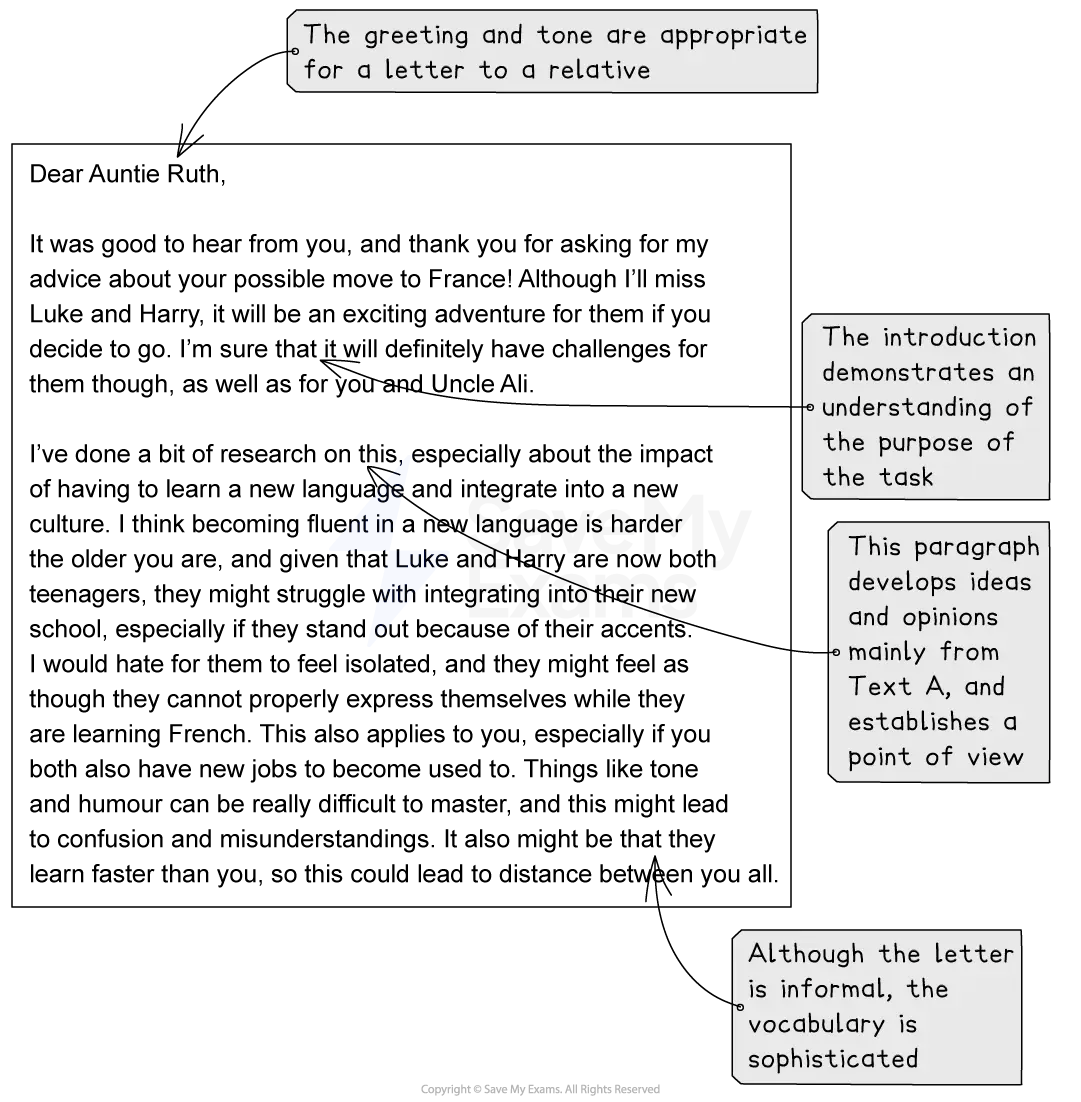
The greeting and tone are appropriate for a letter to a relative
The introduction demonstrates an understanding of the purpose of the task
The second paragraph develops ideas and opinions mainly from Text A, and establishes a point of view
Although the letter is informal, the vocabulary is sophisticated
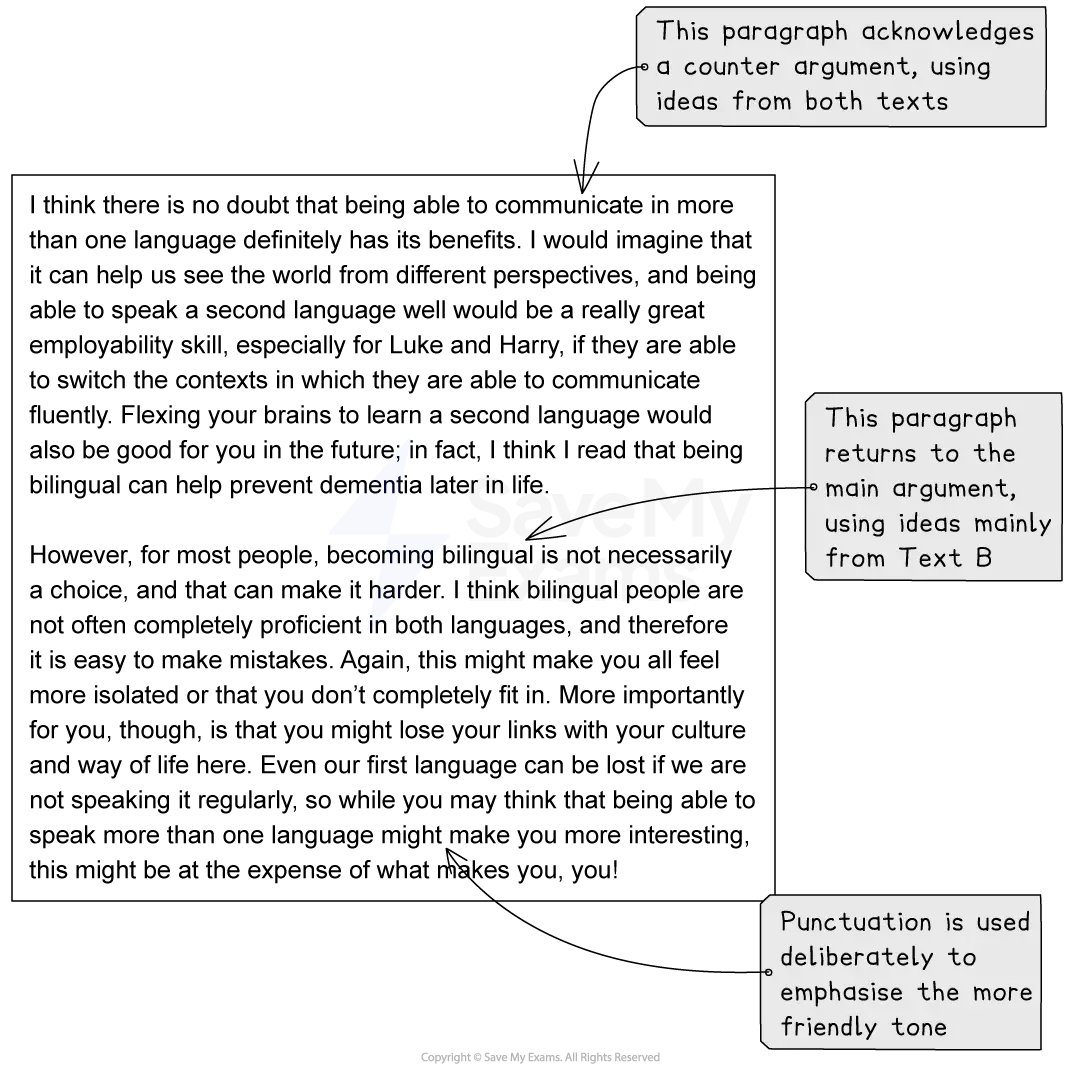
The third paragraph acknowledges a counter-argument, using ideas from both texts
The fourth paragraph returns to the main argument, using ideas mainly from Text B
Punctuation is used deliberately to emphasise the more friendly tone
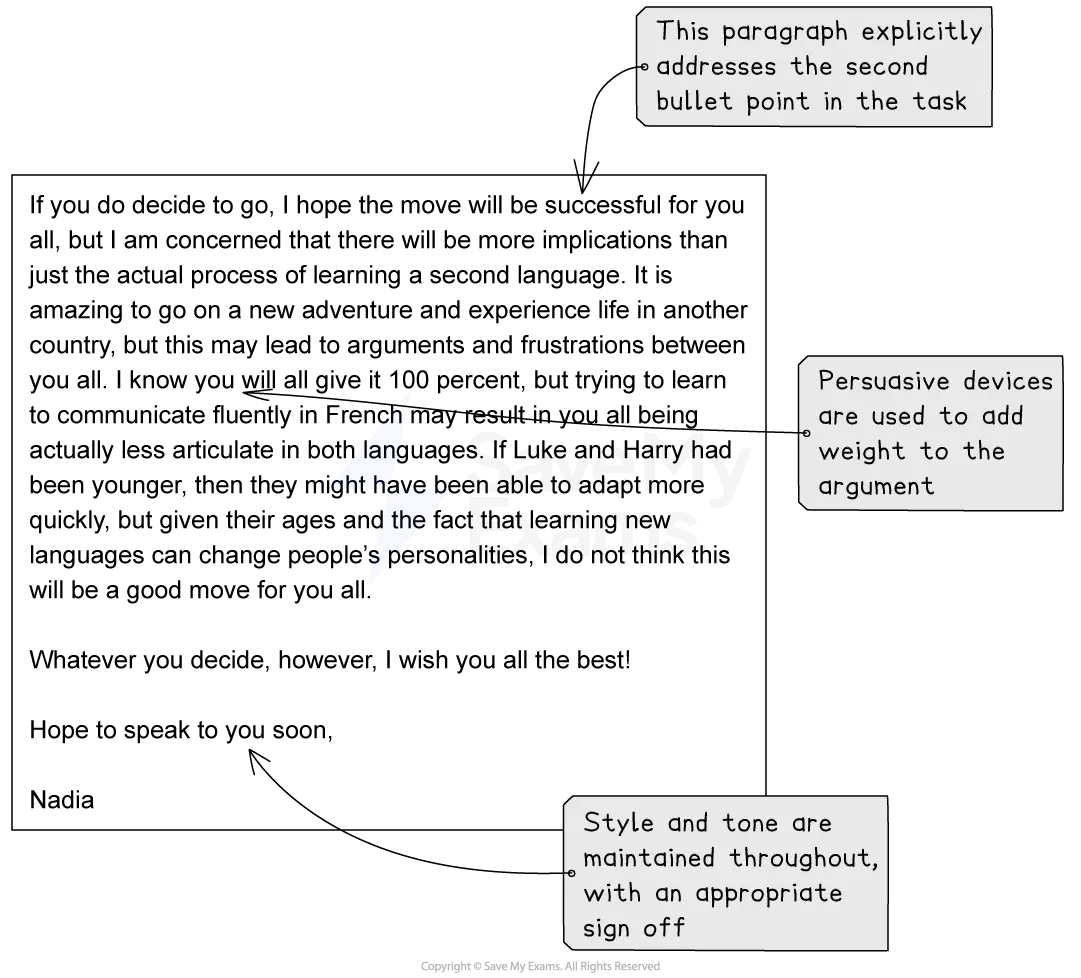
Persuasive devices are used to add weight to the argument
Style and tone are maintained throughout, with an appropriate sign off
Spelling, grammar and punctuation are accurate throughout

Unlock more, it's free!
Join the 100,000+ Students that ❤️ Save My Exams
the (exam) results speak for themselves:

Was this revision note helpful?