Model Answer: Speech (Cambridge (CIE) IGCSE English Language): Revision Note
Syllabus Edition
First teaching 2025
First exams 2027
Exam code: 0500 & 0990

Assignment 1 requires you to select and evaluate facts, opinions and arguments from a text or texts.
You are also required to write in a highly effective and technically accurate style, adapting your form and language to suit your audience and purpose.
The following guide will demonstrate how to approach this task in the format of a speech.
While the task itself is taken from a past exam paper, it is important to note that in your coursework portfolio you are not permitted to use texts or tasks from exam papers. However, we have included this example in order to demonstrate the skills required in order to achieve a top-mark piece of work.
Addressing the reading assessment objectives
Up to 15 marks are available in this task for reading. You are assessed on your ability to evaluate both the explicit and implied ideas, opinions and attitudes expressed in one or two texts, and assimilate them to write a developed and sophisticated response.
Let’s take a look at how you do this, using the following two texts:
Text A
The following passage is an article from a local newspaper about a school in the area and the future of its school council.
Student representation: Do we really care what students think?
The once fashionable idea of giving students a say in how their schools are run is being challenged by a recently appointed head teacher as 'mere lip service to student participation'. As is now common in many schools, students in Mr Aziz's school elect representatives from each year group to attend meetings and discuss their concerns with the school authorities. But Mr Aziz believes that these school councils do more harm than good, draining students' and teachers' energies on a fake body whose decisions do not, and should not, influence children's education. 'The misguided belief that young people should be able to limit the actions of experienced educators is simply wrong,' he says. 'We're accountable to their parents to give them the best education: we cannot waste their time and ours consulting them at every stage about issues which they don't understand.'
One pupil, Sofia, who campaigned enthusiastically over a whole term for the votes of her Year 11 classmates last year, gave Mr Aziz some unexpected support. 'The school council meets every now and then to give the impression that students have a say, but nothing ever happens. We spent ages working on a report about improvements we wanted to see in the school — sensible things like more gym equipment and a wider curriculum. The teachers listened politely but the report was ignored. In class our teachers were even irritated that our homework was late because of all the planning involved!' Sofia's dad also had misgivings. 'We selected this school for its solid academic record. My daughter's here to learn — and I'm paying a lot for that,' he adds wryly.
Mr Aziz says it makes sense to be concerned about individual students' worries and ideas and his door is always open to those who are unhappy about any aspect of school life. 'And I encourage teachers to listen to their students and pass on any concerns to me,' he said. 'But one pupil told me the older representatives on the school council should even be consulted on teacher appointments! I have twenty years' experience to ensure that students leave my school with good academic results and the skills to become useful adults. Student representatives can't and shouldn't interfere with that.'
Text B
The following passage is taken from a guide for teachers about setting up school councils.
There's a transformation taking place for thousands of school students all over the country and it's thanks to their enlightened approach to student participation. This guide contains some good examples of including children and young people in decision-making. We have also included some simple pointers of what makes an effective school council.
Recent research has shown that if a school places the involvement of their students at the heart of everything they do, the benefits and opportunities for them, and for the school, are significantly increased. But it takes real commitment, not just lip service. Young people are very astute. They will quickly identify a lack of commitment and if they do, they will soon become disillusioned. Set out clear aims, explaining what participation is, why it's important, and how to get involved. State clearly what you're prepared to commit and what you expect from them.
The most effective participation is when pupils have a say on the 'real' issues that affect their school. For example, invite them to help shape key policies for the future. Empower them with the responsibility of helping to regulate behaviour, bullying or the environment. Give them the opportunity to influence the development of the curriculum or new teaching initiatives. Give children and young people the chance to make a difference and you'll see the difference... in their attitude to school, to learning, to their teachers and to their peers.
Talk to anyone associated with a school that has a strong student participation policy and they are unanimous in the belief that empowering children and young people in this way has changed school life for the better. Behaviour, attendance and results can improve because more children and young people acquire the self-esteem that comes from improved communication, negotiation and decision-making skills. Children and young people can provide a fresh, new perspective. They see things differently and, because any decision will directly impact on their lives, they often have very clear views and opinions.
To begin with, you should read the texts and highlight the ideas and opinions that could inform your writing. Your response might use the following ideas from these texts:
Text A:
Student representation was “once fashionable”, but it may just be a passing fad
School councils take up too much time and energy from schools and teachers when they have more important things to be getting on with
If student representation is fake or just to tick a box, then it has no substance, especially if views and ideas are not acted upon
Teachers are accountable to parents and should put education first
Even some students are disillusioned with the idea of student representation when nothing is acted upon, especially given the time and effort involved
Experienced teachers should make decisions, not children — trust should be placed in the people appointed to run the school and deliver the education
Text B:
An “enlightened” approach is needed to make school councils work and it takes real commitment
Student participation is very popular and well regarded
Student participation works when children are involved in “real” issues
Students can take responsibility for difficult problems such as behaviour or bullying
Participation can make a difference to students’ attitudes to school
Attendance and results are improved by participation
Students can learn important skills such as negotiation, communication and decision-making
Students can have a fresh eye on issues
Decisions made may have a major impact on them, so students are motivated to participate
Assignment 1 speech model answer
Worked Example
Question
Imagine you are a pupil in a school which does not have a school council.
Write a speech to be given in a school assembly, giving your views on whether or not students should participate in decisions made about the school. Base your speech on what you have read.
[30]
Answer
[30]
Commentary
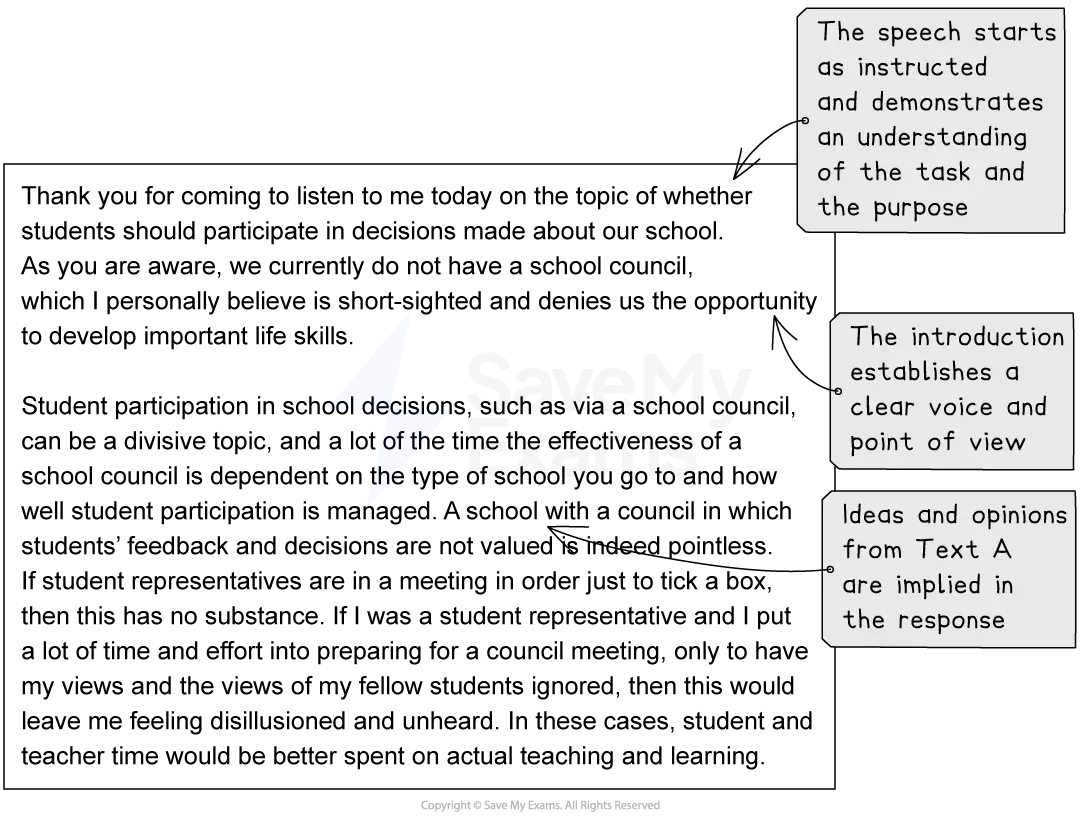
The speech starts as instructed and demonstrates an understanding of the task, its purpose and intended audience
The introduction establishes a clear voice and point of view
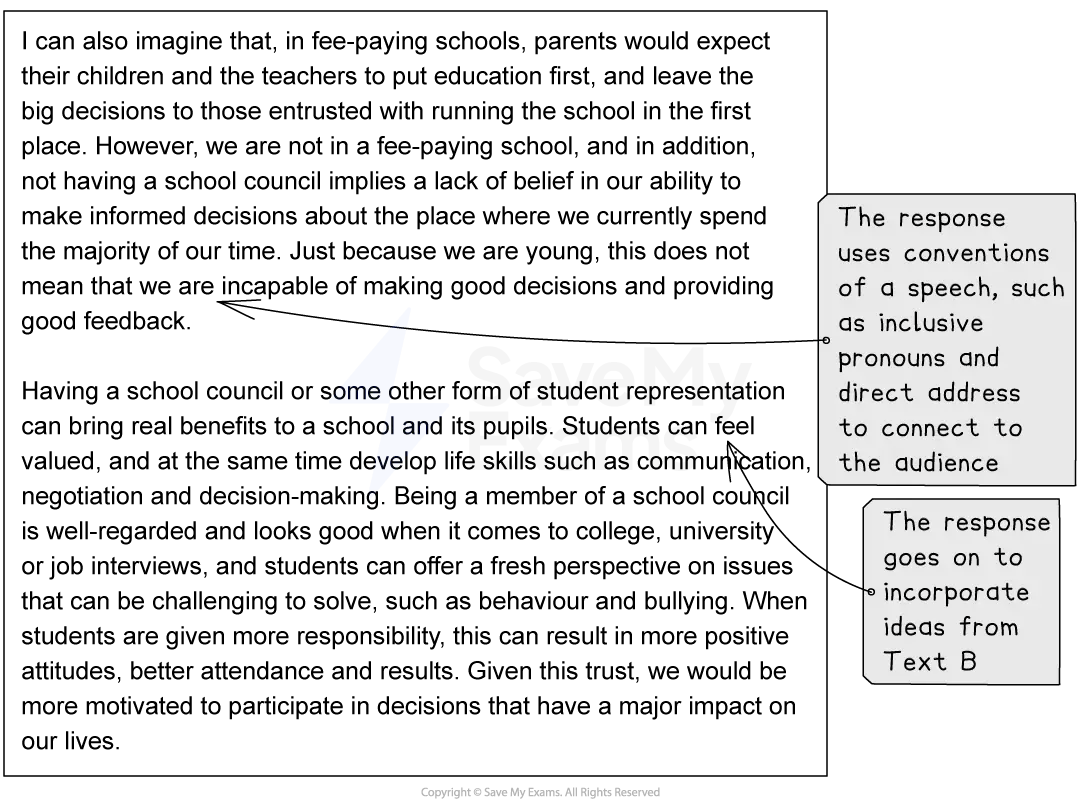
Ideas and opinions from both texts are implied in the response
The response uses conventions of a speech, such as inclusive pronouns and direct address, to connect to the audience
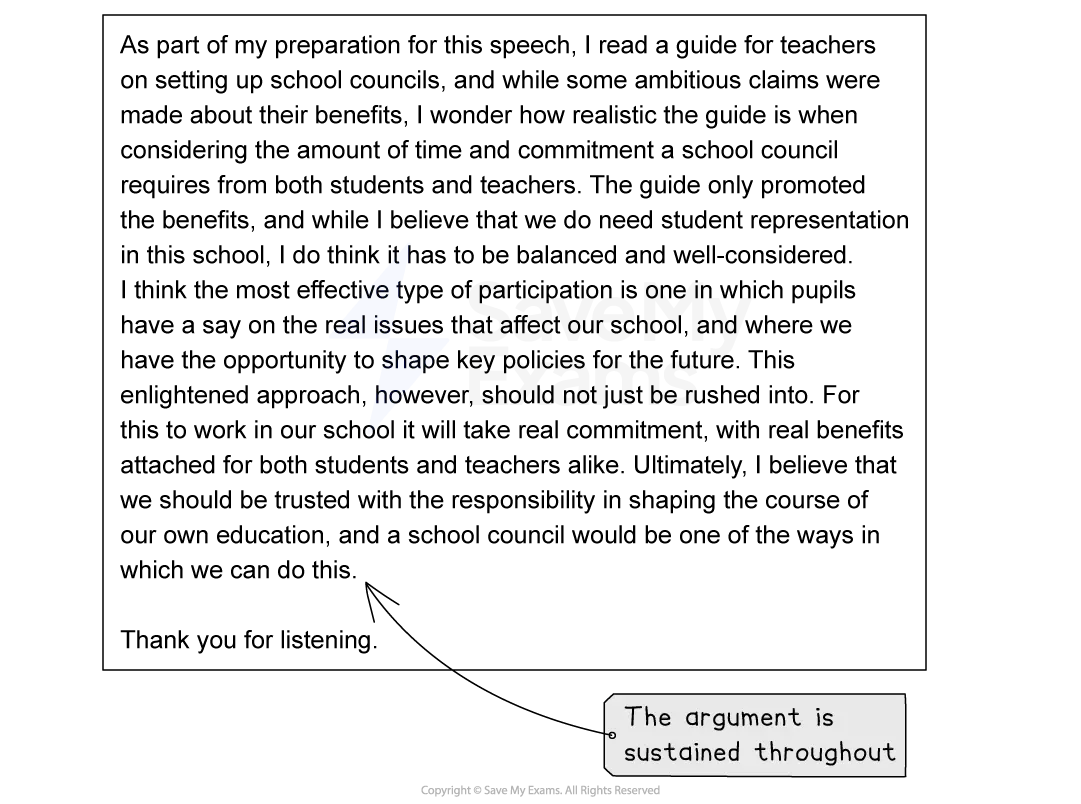
The argument is sustained throughout
Spelling, grammar and punctuation are accurate

Unlock more, it's free!
Join the 100,000+ Students that ❤️ Save My Exams
the (exam) results speak for themselves:

Was this revision note helpful?