How to Answer Question 2(b) (Cambridge (CIE) IGCSE English Language): Revision Note
Syllabus Edition
First teaching 2025
First exams 2027
Exam code: 0500 & 0990

Paper 1: Reading is a compulsory exam for the Cambridge IGCSE First Language English, and examiners recommend that you complete the questions in the order they are set.
For exams from 2027, Question 2 is split into two tasks:
Question 2(a) — a summary task
Question 2(b) — writer’s attitudes and opinions
The following guide will provide you with the information you need to answer Question 2(b) to a high standard. It includes:
An overview of Question 2(b)
Breaking down the question
Steps to success
Exam tips
Overview
Source: Text B
Marks: 5
Time: approximately 5-10 minutes
Skills tested:
Implicit meanings (R2)
Analyse/evaluate (R3)
Breaking down the question
This question tests you on your ability to understand a writer’s attitudes and opinions. The command word is likely to be “assess”, which means to make an informed judgement.
Assessment objective | What this means |
|---|---|
R2: demonstrate understanding of implicit meanings and attitudes | This asks you to work out what the writer is suggesting, hinting at, or feeling, even if they don’t say it directly |
R3: analyse, evaluate and develop facts, ideas and opinions, using appropriate support from the text | This means using the text to build an argument. It involves taking facts and meanings from the text and doing something with them |
Examiner Tips and Tricks
If you are being assessed on R3, the most common mistake students make is simply “lifting” or copying information directly from the text. To get high marks for R3, you must do something with the information. Use the “So what?” test: if the text says “It was raining”, do not just write “It was raining”. You should develop it, such as: “The rain made the journey dangerous and miserable.”
Here is an example of Question 2(b):
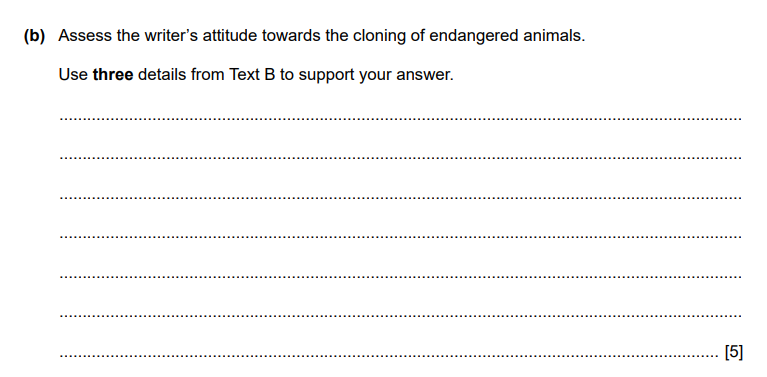
It is important to highlight the key information in the question:
What have you got to do?
What have you got to focus on in the text?
You should do this before you begin scanning the text for your evidence.
Steps to success
Following these steps will give you a strategy for answering this question effectively:
Read the question carefully and highlight:
The command words (what you have to do):
Here it is “assess”
The focus of the question (what you have to look for in the text):
In the example above, it is “the cloning of endangered animals”
Any other instructions you are given:
Here it is “use three details from Text B to support your answer”
Scan Text B and highlight the evidence that answers the question:
In the example above, that would be what the writer says about the cloning of endangered animals
Identify what the writer feels about the question’s focus:
To get full marks, you cannot simply list quotes
You must identify how the writer feels and support that feeling with a specific detail from the text
Use the key words from the question in your answer:
For example: “The writer’s attitude is that they are impressed by the science”
Support each point with specific details from Text B:
For example: “The writer’s attitude is that they are impressed by the science because they call it ‘amazing technology’ and an ‘incredible effort’”
State how this specific detail supports your point:
For example: “The use of positive adjectives shows admiration”
Remember, this is a 5-mark question, so you should aim to spend no more than 5–10 minutes answering it. You will already be familiar with Text B by answering Question 2(a).
Exam tips
Read the command words and the question carefully:
This will allow you to demonstrate a thorough understanding of the requirements of the task
The highest level of the mark scheme (Level 3) rewards candidates who demonstrate clear understanding of the writer’s attitude with relevant support from the text:
Demonstrating understanding is going beyond simply making a point along with a quote copied from the text
You need to do something with the quote
Look for words or phrases in the text that give you a clue about what the writer’s attitude might be:
These might be adjectives, adverbs or emotive verbs (words that suggest conflict or strong feeling)
Ensure you use three separate pieces of evidence in your answer, as the question specifically asks for “three details”
Do not summarise:
This is not a summary task, so do not just retell what happens
Check the command word:
If the question asks you to “assess”, ensure you are making a judgement about the writer’s view
For more advice on how to apply the skills required for success in this question, please see:
Question 2(b) Skills: Supporting your Answer.
For a model answer to this question, please see Question 2(b): Model Answer.

Unlock more, it's free!
Join the 100,000+ Students that ❤️ Save My Exams
the (exam) results speak for themselves:

Was this revision note helpful?