Question 2(a) Skills: How to Summarise (Cambridge (CIE) IGCSE English Language): Revision Note
Syllabus Edition
First teaching 2025
First exams 2027
Exam code: 0500 & 0990

Paper 1: Reading is a compulsory exam for the Cambridge IGCSE First Language English qualification, and examiners recommend that you complete the questions in the order they are set.
For exams from 2027, Question 2 is split into two tasks:
Question 2(a) — a summary task
Question 2(b) — writer’s attitudes and opinions
The sections below will explain what summarising is and how to summarise information effectively.
What is summarising?
Summarising is an important literacy skill, useful not just for your IGCSE in English Language.
When you summarise, you are expressing the most important facts or ideas from a text in shortened form, using your own words.
A summary should effectively explain all of the important information in a text in a clear and concise way, taking only the information that is directly relevant and ignoring less important details.
The key elements of a summary are:
Objectivity: a summary sticks to the facts and is unbiased
Concision: a summary should condense the important information, leaving out unnecessary detail
Structure: a summary should be well-organised, preferably in chronological order, so that it is as clear as possible
Accuracy: the information provided in a summary needs to be correct and reliable
The summary you have to produce in your exam for Question 2(a) needs to get across the information the examiner requires in a clear and accurate way.
This means that you need to distinguish between the important information and the irrelevant information in the text.
However, while summarising as a skill normally allows direct repetition of the words in a text, for this task in the exam you are asked to write in your own words as far as possible. In this way, this task is actually a combination of summarising and paraphrasing, which means rearranging a text and putting it into your own words.
How to summarise in the exam
To complete this task effectively in the exam, it is essential that you understand exactly what you are being asked to summarise.
Let’s consider what exactly you are being asked to summarise in this example from the June 2020 exam paper:
Exam question | What you need to do |
|---|---|
According to Text B, what made Lyuba such a remarkable and precious scientific specimen and what did scientists hope to discover by studying her? | Here, there are two things you are being asked to summarise:
|
Once you have broken down the question, it is possible to go back to the text and identify the information directly relevant to the two bullet points above.
Working through the text in logical order will help you to structure your summary. Let’s look at how to do this, using the first three paragraphs of the text:
Text | Important information (relevant to the focus of the question) |
|---|---|
Only a handful have been found before. But none like her. Her name is Lyuba. A one-month-old baby mammoth, she walked the tundra about 40,000 years ago, then died mysteriously. Discovered on a riverbank in Siberia, she’s the most perfectly preserved woolly mammoth ever discovered. Lyuba has mesmerised the scientific world with her arrival — creating headlines across the globe. “Waking the Baby Mammoth”, a new television programme, tells the tale of this single accidental discovery of a frozen baby mammoth in the Siberian tundra and how the discovery has enriched our understanding of these extinct magnificent beasts. The programme begins with the incredibly fortunate discovery of Lyuba by a reindeer herder who feared that disturbing the remains of the dead might lead to a curse. Too often with such findings, the preserved creature would be dug up and sold, leading to irreversible decomposition and the loss of a treasure trove of valuable information. However, the herder had enough foresight to contact authorities, and scientists began the careful retrieval process. Everyone wanted to know how Lyuba had died. What could she tell us about life during the Ice Age and the Earth’s changing climate? | What made Lyuba such a remarkable and precious scientific specimen:
What scientists hope to discover by studying her:
|
Summarising in continuous form
Normally, when you summarise from a text, you can choose the most appropriate format in which to present your information, such as bullet points. However, in this exam, you are asked to use continuous writing and your own words. Therefore, you need to structure your answer into clear paragraphs, ensuring that you still convey the important information listed above.
A good way to start this is by using the wording of the question. For example:

You then need to start with the first point from the text, but consider how to modify the words in order to make them your own. For example:
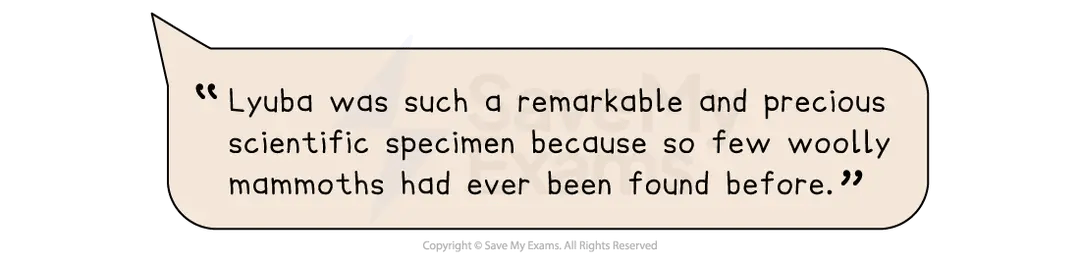
It is also useful to make good use of connectives in order to link your points, to give a sense of overall coherence to your answer. For example:
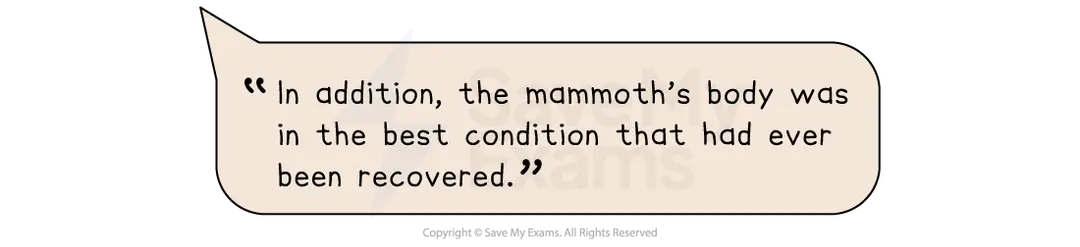
Examiner Tips and Tricks
Ensure that you cover all of the important points, and avoid any unnecessary information, such as Lyuba being the subject of a new television programme. This won’t get you any marks.
A full model answer to a sample question can be found in Question 2(a) Summary: Model Answer.

Unlock more, it's free!
Join the 100,000+ Students that ❤️ Save My Exams
the (exam) results speak for themselves:

Was this revision note helpful?