How to Answer Question 4: Extended Response (Cambridge (CIE) IGCSE English Language): Revision Note
Syllabus Edition
First teaching 2025
First exams 2027
Exam code: 0500 & 0990

Paper 1: Reading is the compulsory exam for the Cambridge IGCSE First Language English qualification , and examiners recommend that you complete the questions in the order they are set.
The following guide will provide you with the information you need to answer Question 4 (Extended Response) to a high standard. It includes:
An overview for Question 4
Breaking down the question
Steps to success
Exam tips
Overview for Question 4
Source: Text C
Marks: 20
Time: approximately 30-35 minutes
Skills tested:
Explicit and implicit meanings (R1 and R2)
Analyse/evaluate (R3)
Writer's effects (R4)
Select and use information (R5)
Clarity (W1)
Organisation and structure (W2)
Vocabulary and sentence structure (W3)
Use of appropriate language (W4)
Word count: 250-300 words
For this task, you will be asked to write in one of six possible formats (genres):
A letter
A report
A journal entry
A speech
An interview
An article
Breaking down the question
Question 4 is quite detailed. It is therefore important that you read the whole of the question and instructions carefully.
The question will follow this formula:
The scenario: "You are Annie. Two months later, you are in LA. You are interviewed by Marty Green on his popular TV show."
The bullets: Three specific points you must cover
The task: "Write a..."
For example:
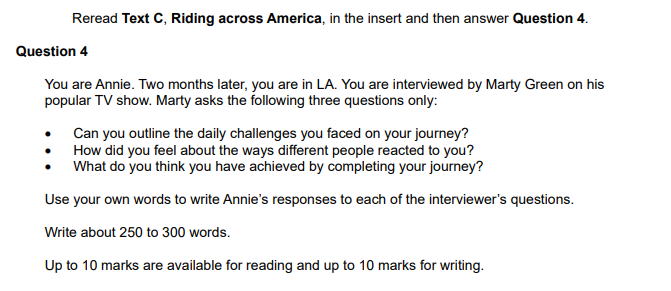
The question is worth 20 marks in total and is broken down as follows:
Assessment Objective tested | What this means | Marks |
|---|---|---|
|
| 10 |
|
| 10 |
You should highlight the key information you have been given, and start by annotating the text for information that answers each of the three bullet points in the question.
Steps to success
Following these steps will give you a strategy for answering this question effectively:
Read the question and highlight:
The important information in the scenario (in the above example, you are asked to imagine that you are "Annie")
The format you are being asked to write in (letter, speech, article, etc.)
The important information from each of the three bullet points that you need to include in your answer
Re-read Text C and annotate any references directly relevant to the focus of the bullet points:
You need roughly 3-4 developed points per bullet point to get full reading marks
Do not just highlight the events; look for feelings, reactions and reasons
Adopt the persona (voice) before you write. Ask yourself:
Who am I?
Who am I talking to?
Work through the bullet points in order:
Maintain your focus on each bullet point — avoid the temptation to write about everything or make up information not directly relevant to the bullet point
Ensure you modify and develop each point. For example:
The text says: "The vet examined the hoof minutely."
You can write: "I felt so insulted when that vet checked every inch of Hero's hooves: he clearly expected to find I had mistreated him."
Here, we have added the feeling (insulted) which wasn't explicitly in the text; this is development
Ensure you write in the format instructed:
This means that if you are being asked to write an interview, then you need to use language and a tone appropriate for this style of writing
You can use the three bullet points as sub-headings, if appropriate
Ensure you leave time at the end to edit and correct your response
You are advised to spend no more than 35 minutes on this question.
Exam tips
Always remember to base your answer on the ideas and details you find in Text C:
If you write your answer without any reference to Text C, you will score very low marks
Keep the intended audience and purpose of writing in mind throughout your answer:
Maintain a consistent voice and style throughout
Do not invent extra information or details outside of what you read in Text C:
Look for clues and evidence in the text to help you make informed judgements about characters and situations
Give equal attention to each of the three bullet points
Do not copy directly from the text:
You need to use your own words as far as possible to express your ideas
Avoid just repeating details of what happens in the text:
Try to develop your ideas by explaining feelings or commenting from the point of view of the character you are writing as
For more advice on how to apply the skills required for success in this question, please see our Question 4 Skills: Extended Response to Reading revision note.

Unlock more, it's free!
Join the 100,000+ Students that ❤️ Save My Exams
the (exam) results speak for themselves:

Was this revision note helpful?