Question 1(a): What the Question is Asking (Cambridge (CIE) IGCSE English Language): Revision Note
Syllabus Edition
First teaching 2025
First exams 2027
Exam code: 0500 & 0990

Section A of Paper 2 of your Cambridge IGCSE First Language English qualification is called Directed Writing and consists of one question that is divided into two parts — 1(a) and 1(b):
Question 1(a) — a structured question
Question 1(b) — a piece of discursive/argumentative/persuasive writing
The following guide will provide you with the information you need to answer Question 1(a) to a high standard. It includes:
An overview of Question 1(a)
Breaking down the question
Steps to success
Exam tips
Overview of Question 1(a)
Source: Text A or Text B
Marks: 5
Time: approximately 5-10 minutes
Skills tested:
Analyse/evaluate (R3)
Writer's effects (R4)
Breaking down the question
This question tests you on your ability to analyse and understand a text before moving on to the longer writing task. You may be asked to:
Analyse: this means to examine a specific focus in detail
Evaluate: this means to make a judgement
You are tested specifically on:
Assessment objective | What this means |
|---|---|
R3: analyse, evaluate and develop facts, ideas and opinions, using appropriate support from the text | This means using the text to build an argument. It involves taking facts and meanings from the text and doing something with them |
R4: demonstrate an understanding of how writers achieve effects and influence readers | This means analysing the writer’s craft. It involves you considering how the writer writes a text and why they make the choices they do. |
Examiner Tips and Tricks
Both Question 1(a) and 1(b) will be based on one or two texts totalling 550–650 words in length. For Question 1(a), make sure you only focus on the extract from the text given to you in the question. You are not expected to use the whole of the text in this answer.
Here is an example of Question 1(a):
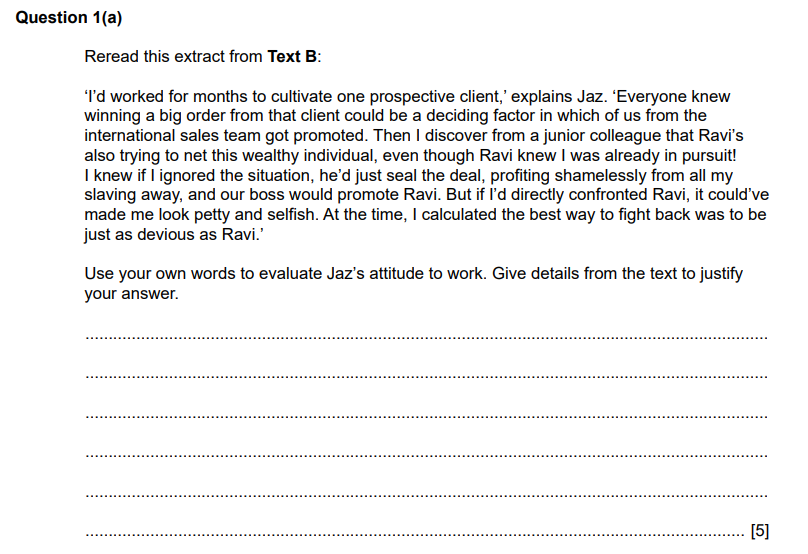
It is important to highlight the key information in the question:
What have you got to do?
What have you got to focus on in the text?
You should do this before you begin scanning the extract for your evidence.
Steps to success
Following these steps will give you a strategy for answering this question effectively:
Read the question carefully and highlight:
The command words (what you have to do):
Here it is “evaluate”
The focus of the question (what you have to look for in the text):
Here it is “Jaz’s attitude to work”
Any other instructions you are given:
Here it is “Give details from the text to justify your answer”
Scan the extract and highlight the evidence that answers the question:
Here, that would be what the writer says about his work
Identify what the writer/subject feels about the question’s focus:
To get full marks, you cannot simply list quotes
You must identify how the writer/subject feels and support that feeling with a specific detail from the text
Use the key words from the question in your answer:
For example: “Jaz’s attitude to work is that they are very competitive”
Support each point with specific details from the extract:
For example: “Jaz’s attitude to work is that they are very competitive as they were ‘in pursuit’ of a ‘wealthy individual’ that a colleague was also trying to ‘net’”
State how this specific detail supports your point:
For example: “The use of hunting imagery suggests that Jaz views the workplace as a battleground or a chase”
Remember, this is a 5-mark question, so you should aim to spend no more than 5–10 minutes answering it.
Exam tips
Read the command words and the question carefully:
This will allow you to demonstrate a thorough understanding of the requirements of the task
The highest level of the mark scheme (Level 3) rewards candidates who demonstrate clear understanding of the writer/subject’s attitude with relevant support from the text:
Demonstrating understanding is going beyond simply making a point along with a quote copied from the text
You need to do something with the quote
Look for words or phrases in the text that give you a clue about what the writer/subject’s attitude might be:
These might be adjectives, adverbs or emotive verbs (words that suggest conflict or strong feeling)
Ensure you use your own words in your answer:
Here, you could look at the subject’s actions and label them with an adjective that is not in the text, such as “ruthless”
Do not summarise:
This is not a summary task, so do not just retell what happens
Check the command word:
If the question asks you to “evaluate”, ensure you are making a judgement based on what you read
Do not repeat the same point:
For example, do not give three examples of Jaz being “hard-working”; this does not demonstrate range
Make 3–4 distinct points
Keep your answer concise:
This question is only worth 5 marks
Do not write an introduction or conclusion
For more advice on how to apply the skills required for success in this question, please see:
Question 1(a) Skills: Evaluation.
For a model answer to this question, please see Question 1(a): Model Answer.

Unlock more, it's free!
Join the 100,000+ Students that ❤️ Save My Exams
the (exam) results speak for themselves:

Was this revision note helpful?