The Route Inspection Algorithm (Edexcel International A Level (IAL) Maths: Decision 1): Exam Questions

Exam code: YMA01

2 hours10 questions
1a
6 marks
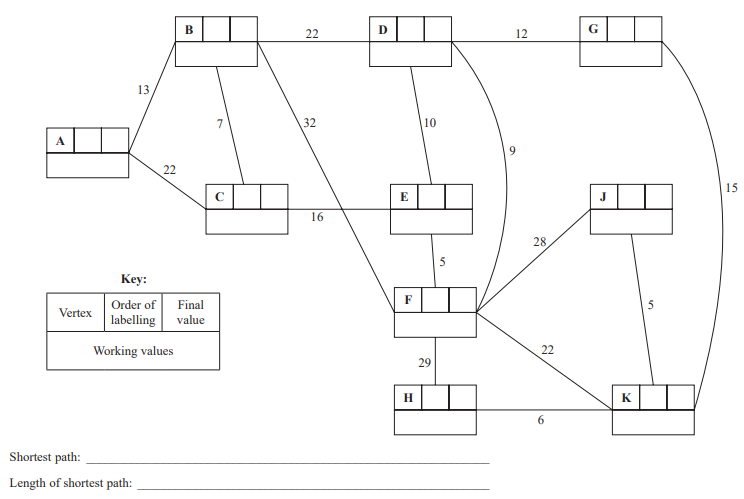
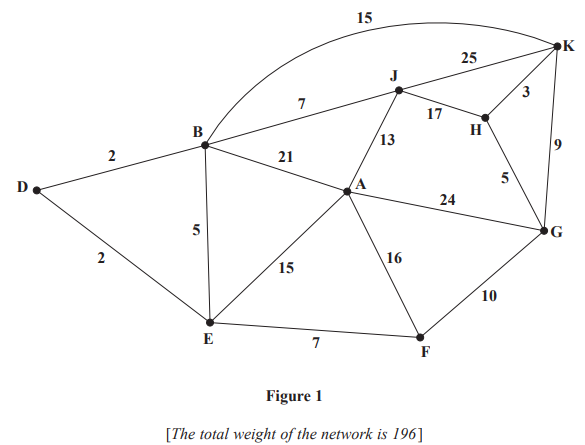
A network diagram with vertices labelled A to K, connected by edges with various weights. The total weight of the network is 196.

Figure 1 models a network of roads. The number on each edge gives the time, in minutes, taken to travel along that road. Oliver wishes to travel by road from A to K as quickly as possible.

Use Dijkstra’s algorithm to find the shortest time needed to travel from A to K. State the quickest route.
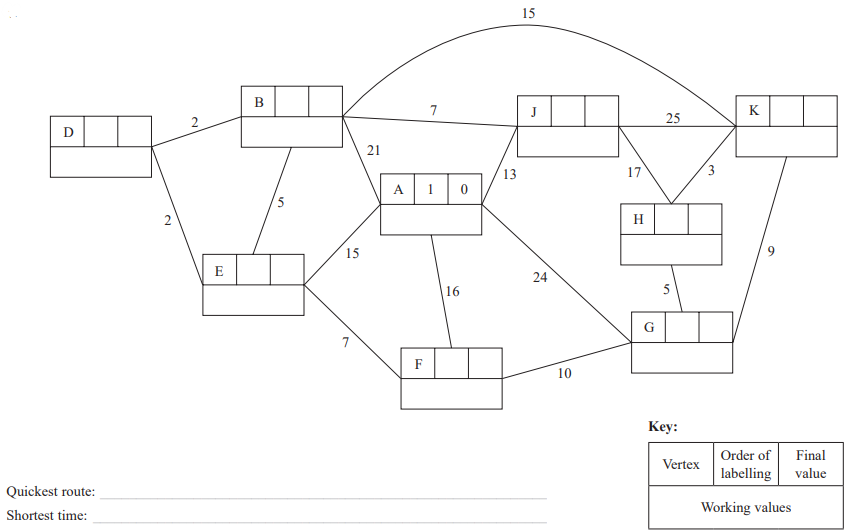
Diagram of a directed graph with vertices A to K, edges labelled with numbers. Includes a key for vertex, order of labelling, final value, and working values.
1b
2 marks

On a particular day Oliver must travel from B to K via A.

Find a route of minimal time from B to K that includes A, and state its length.

1c
7 marks

Oliver needs to travel along each road to check that it is in good repair. He wishes to minimise the total time required to traverse the network.

Use the route inspection algorithm to find the shortest time needed. You must state all combinations of edges that Oliver could repeat, making your method and working clear.

2a
6 marks
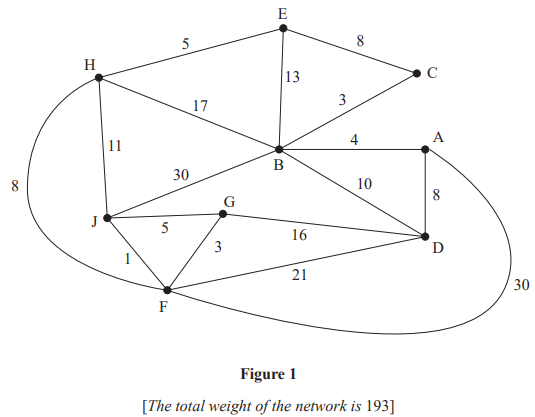
Graph with vertices A-J connected by weighted edges. Notable weights: A-D 8, C-E 8, J-F 1, and total network weight is 193.

Figure 1 represents a network of roads. The number on each edge represents the length, in miles, of the corresponding road. Jan wishes to travel from A to J. She wishes to minimise the distance she travels.

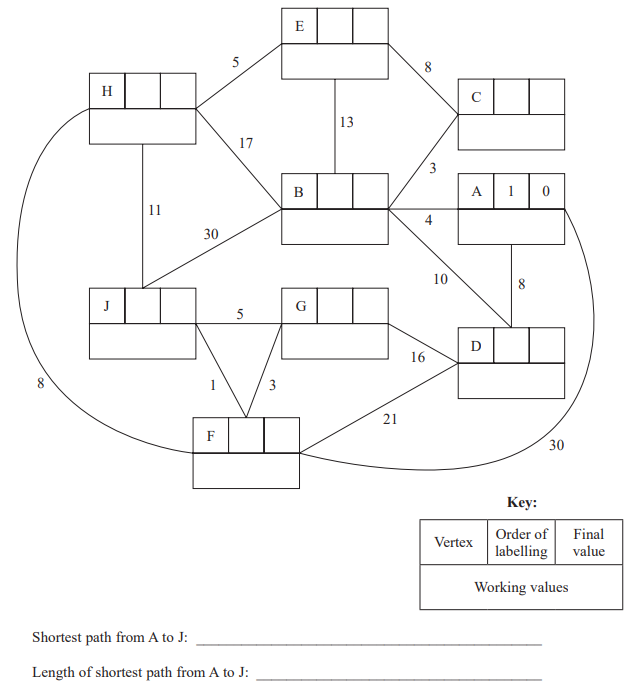
Use Dijkstra’s algorithm to find the shortest path from A to J. Obtain the shortest path and state its length.

Graph diagram with vertices A to J interconnected by weighted edges. Boxes near vertices for order labelling and values. Legend explains values.
2b
2 marks

On Monday, Jan needs to travel from her gym at J to her home at H via her office at A.

State the shortest path from J to H via A and its length.

2c
5 marks

On Tuesday, Jan needs to check each road. She must travel along each road at least once. Jan must start and finish at A.

Use the route inspection algorithm to find the length of the shortest inspection route. State the roads that should be repeated. You should make your method and working clear.

2d
3 marks

On Wednesday, Jan decides to start her inspection route at G but can finish her route at a different node. The inspection route must still traverse each road at least once.

Determine where the route should finish so that the length of the inspection route is minimised. You must give reasons for your answer and state the length of the route.

3a
6 marks
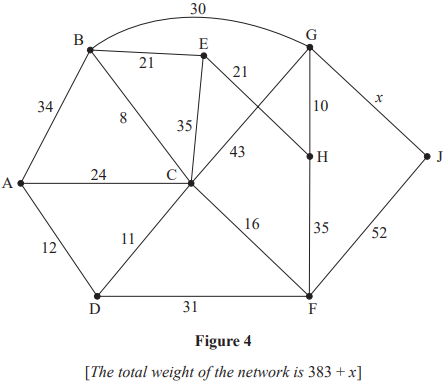
Graph with vertices A to J, connected by edges labelled with weights. The total network weight is 383 plus x.

Figure 4 models a network of roads. The number on each edge gives the time, in minutes, to travel along the corresponding road. The vertices, A, B, C, D, E, F, G, H and J represent nine towns. Ezra wishes to travel from A to H as fast as possible.

The time taken to travel between towns G and J is unknown and is denoted by xminutes.

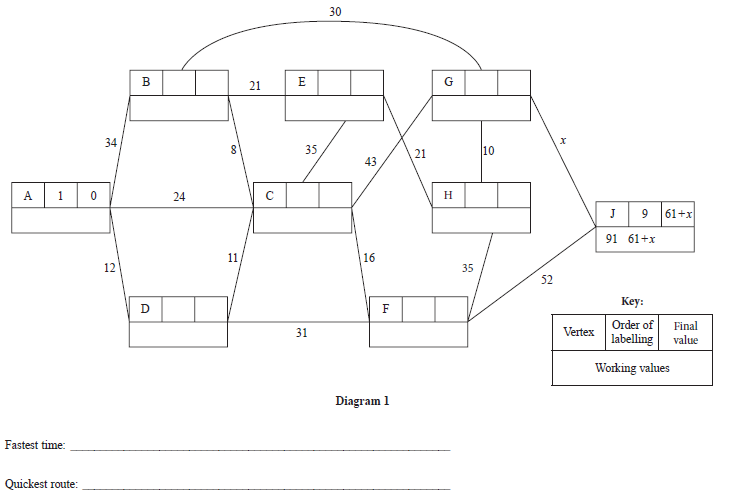
Dijkstra’s algorithm is to be used to find the fastest time to travel from A to H. On Diagram 1 below the “Order of labelling” and “Final value” at A and J, and the “Working values” at J, have already been completed.

Flowchart diagram with nodes A to J showing paths with numeric values. A key explains vertex, order of labelling, final and working values. Labels for fastest time and quickest route.

Use Dijkstra’s algorithm to find the fastest time to travel from A to H. State the quickest route.

3b
6 marks

Ezra needs to travel along each road to check it is in good repair. He wishes to minimise the total time required to traverse the network. Ezra plans to start and finish his inspection route at A. It is given that his route will take at least 440 minutes.

Use the route inspection algorithm and the completed Diagram 1 to find the range of possible values of x.

3c
1 mark

Write down a possible route for Ezra.

3d
2 marks

A new direct road from D to H is under construction and will take 25 minutes to travel along. Ezra will include this new road in a minimum length inspection route starting and finishing at A. It is given that this inspection route takes exactly 488 minutes.

Determine the value of x. You must give reasons for your answer.

4a
3 marks
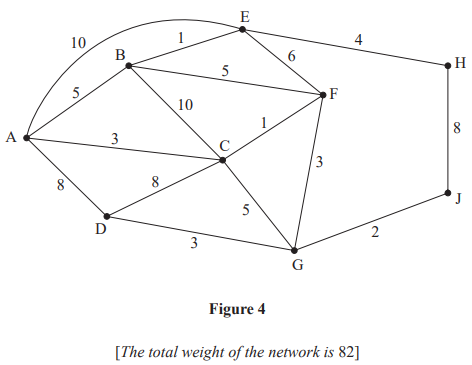
Diagram of a network graph with vertices labelled A to J, connected by weighted edges. Total network weight is 82. Figure 4 depicted below the graph.

Figure 4 represents a network of 16 roads in a city. The number on each arc represents the time taken, in minutes, to travel along the corresponding road.

Chan needs to check that the roads are in good repair. He must travel along each road at least once. Chan will start and finish at his office at G and must minimise the total time taken for his inspection route.

For this inspection route,

find the time taken and state a possible route. You must make your method and reasoning clear.

4b
5 marks

Chan wonders if he can reduce his travel time by starting from his home at B, travelling along each road at least once and finishing at his office at G.

By considering the pairings of all relevant nodes, find any arcs that would need to be traversed twice in the minimum inspection route from B to G. You must make your method clear, showing your working.

4c
2 marks

Determine which of the two routes ending at G is quicker, the one starting at G or the one starting at B. You must justify your answer.

5a
6 marks
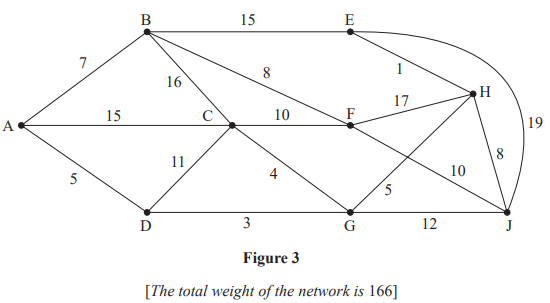
Diagram of a network graph with vertices A-J connected by weighted edges. Total network weight is 166. Arcs are labelled with numerical weights.

Figure 3 models a network of cycle lanes that must be inspected. The number on each arc represents the length, in km, of the corresponding cycle lane. Lance needs to cycle along each lane at least once and wishes to minimise the length of his inspection route.

He must start and finish at A.

Use an appropriate algorithm to find the length of the route. State the cycle lanes that Lance will need to traverse twice. You should make your method and working clear.

5b
1 mark

State the number of times that vertex C appears in Lance’s route.

5c
3 marks

It is now decided that the inspection route may finish at any vertex. Lance will still start at A and must cycle along each lane at least once.

Determine the finishing point so that the length of the route is minimised. You must give reasons for your answer and state the length of this new minimum route.

6a
2 marks
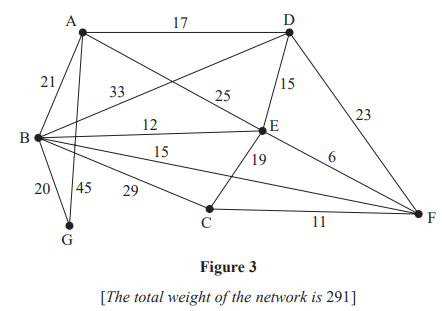
Diagram of a network graph with seven nodes, labelled A to G. Edges connect nodes with weights, totalling 291. Nodes are linked with various lines and numbers.

Figure 3 models a network of roads. The number on each edge gives the length, in km, of the corresponding road. The vertices, A, B, C, D, E, F and G, represent seven towns. Derek needs to visit each town. He will start and finish at A and wishes to minimise the total distance travelled.

By inspection, complete the two copies of the table of least distances.

A

B

C

D

E

F

G

A

-

21

17

25

31

41

B

21

-

26

27

12

15

20

C

26

-

17

11

46

D

17

27

-

15

47

E

25

12

17

15

-

6

32

F

31

15

11

6

-

35

G

41

20

46

47

32

35

-

6b
2 marks

Starting at A, use the nearest neighbour algorithm to find an upper bound for the length of Derek’s route. Write down the route that gives this upper bound.

6c
1 mark

Interpret the route found in (b) in terms of the towns actually visited.

6d
3 marks

Starting by deleting A and all of its arcs, find a lower bound for the route length.

6e
5 marks

Clive needs to travel along the roads to check that they are in good repair. He wishes to minimise the total distance travelled and must start at A and finish at G.

By considering the pairings of all relevant nodes, find the length of Clive’s route. State the edges that need to be traversed twice. You must make your method and working clear.

7a
6 marks
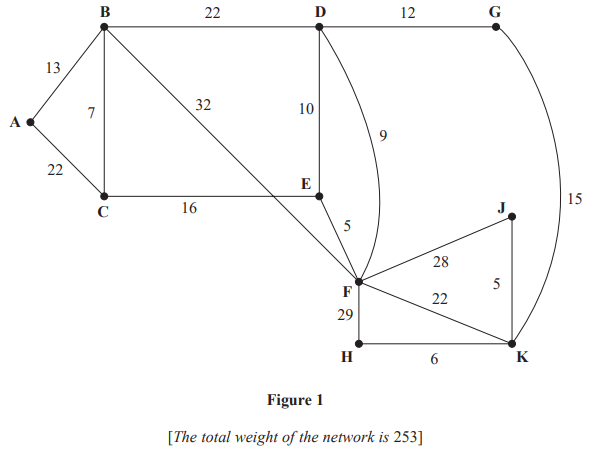
Network diagram with vertices A to K connected by edges with weights. Total network weight is 253.

Figure 1 represents a network of roads between 10 cities, A, B, C, D, E, F, G, H, J and K. The number on each edge represents the length, in miles, of the corresponding road.

One day, Mabintou wishes to travel from A to H. She wishes to minimise the distance she travels.

Use Dijkstra’s algorithm to find the shortest path from A to H. State your path and its length.

Network diagram with vertices A to K, labelled edges indicate weights. Empty boxes for vertex data. Key for labelling and values. Lines for shortest path.
7b
2 marks

On another day, Mabintou wishes to travel from F to K via A.

Find a route of minimum length from F to K via A and state its length.

7c
6 marks

The roads between the cities need to be inspected. James must travel along each road at least once. He wishes to minimise the length of his inspection route. James will start his inspection route at A and finish at J.

By considering the pairings of all relevant nodes, find the length of James’ route. State the arcs that will need to be traversed twice. You must make your method and working clear.

7d
1 mark

State the number of times that James will pass through F.

7e
1 mark

It is now decided to start the inspection route at D. James must minimise the length of his route. He must travel along each road at least once but may finish at any vertex.

State the vertex where the new inspection route will finish.

7f
1 mark

Calculate the difference between the lengths of the two inspection routes.

8a
7 marks
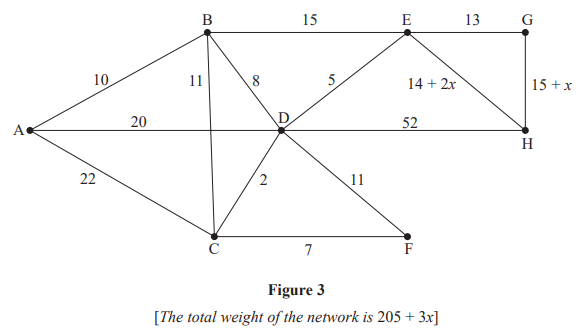
Diagram of a network of connected points labelled A to H with weighted edges, total weight is 205 + 3x, figure 3 caption below.

Figure 3 represents a network of roads. The number on each arc represents the time taken, in minutes, to drive along the corresponding road.

Malcolm wishes to minimise the time spent driving from his home at A to his office at H. The delays from roadworks on two of the roads leading in to H vary daily, and so the time taken to drive along these roads is expressed in terms of x, where x is fixed for any given day and x greater than 0

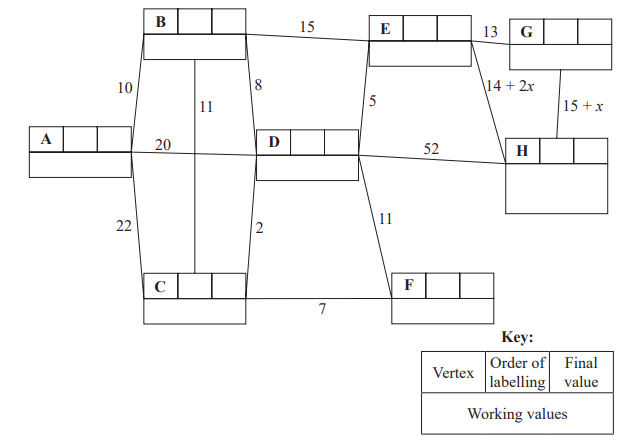
Use Dijkstra’s algorithm to find the possible routes that minimise the driving time from A to H. State the length of each route, leaving your answer in terms of x where necessary.

Flow network diagram with vertices A to H connected by directed edges with weights. Includes a key for vertex, order of labelling, and values.
8b
4 marks

On Monday, Malcolm needs to check each road. He must travel along each road at least once. He must start and finish at H and minimise the total time taken for his inspection route.

Malcolm finds that his minimum duration inspection route requires him to traverse exactly four roads twice and the total time it takes to complete his inspection route is 307 minutes.

Calculate the minimum time taken for Malcolm to travel from A to H on Monday. You must make your method and working clear.

9a
6 marks
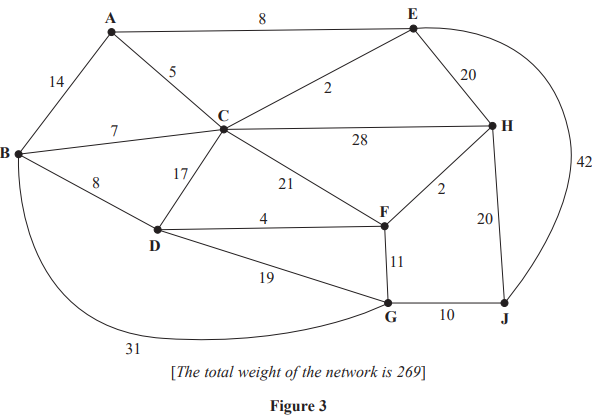
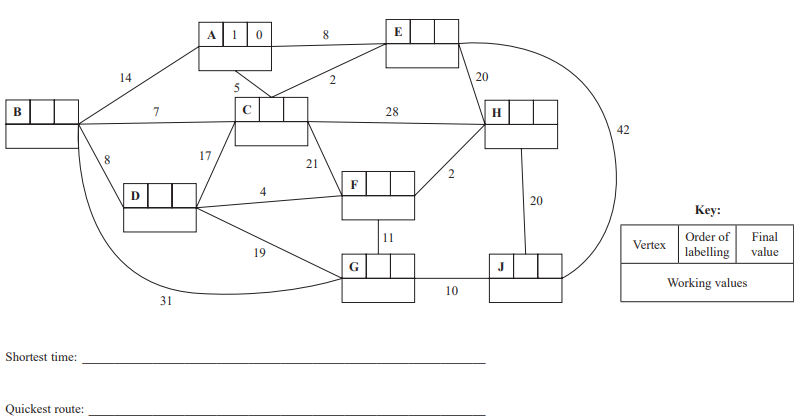
Graph with nodes A-J connected by edges with weights, total weight is 269. Notable weights: A-B 14, B-D 8, C-E 2, E-H 20, H-J 20, B-G 31.

Figure 3 models a network of roads. The number on each edge gives the time taken, in minutes, to travel along the corresponding road.

Use Dijkstra's algorithm to find the shortest time needed to travel from A to J. State the quickest route.

Network diagram with vertices A to J showing paths with numeric weights. Includes a key for order of labelling and final value with space for shortest time and quickest route.
9b
5 marks

Alan needs to travel along all the roads to check that they are in good repair. He wishes to complete his route as quickly as possible and will start at his home, H, and finish at his workplace, D.

By considering the pairings of all relevant nodes, find the arcs that will need to be traversed twice in Alan's inspection route from H to D. You must make your method and working clear.

9c
2 marks

For Alan's inspection route from H to D

(i) state the number of times vertex C will appear,

(ii) state the number of times vertex D will appear.

9d
2 marks

Determine whether it would be quicker for Alan to start and finish his inspection route at H, instead of starting at H and finishing at D. You must explain your reasoning and show all your working.

10a
2 marks

Pupils from ten schools are visiting a museum on the same day. The museum needs to allocate each school to a tour group. The maximum size of each tour group is 42 pupils. A group may include pupils from more than one school. Pupils from each school must be kept in the same tour group. The numbers of pupils visiting from each school are given below.

8 17 9 14 18 12 22 10 15 7

Calculate a lower bound for the number of tour groups required. You must make your method clear.

10b
2 marks

8 17 9 14 18 12 22 10 15 7

Using the above list, apply the first-fit bin packing algorithm to allocate the pupils visiting from each school to tour groups.

10c
4 marks

8 17 9 14 18 12 22 10 15 7

The above list of numbers is to be sorted into descending order.

Perform a quick sort to obtain the sorted list. You should show the result of each pass and identify your pivots clearly

10d
2 marks

Using your sorted list from (c), apply the first-fit decreasing bin packing algorithm to obtain a second allocation of pupils to tour groups.

10e
4 marks
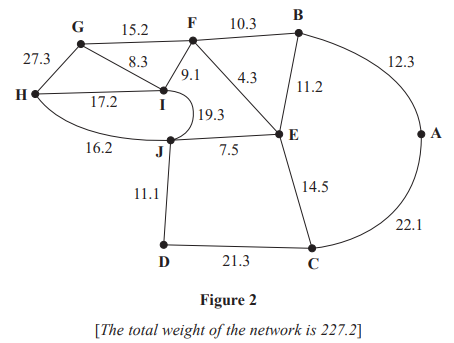
Diagram of a network with nodes labelled A to J and edges labelled with weights. The total weight is 227.2.

Figure 2 represents the corridors in the museum. The number on each arc is the length, in metres, of the corresponding corridor. Sally is a tour guide in the museum and she must travel along each corridor at least once during each tour. Sally wishes to minimise the length of her route. She must start and finish at the museum’s entrance at A.

Use an appropriate algorithm to find the corridors that Sally will need to traverse twice. You should make your method and working clear.

10f
2 marks

Write down a possible shortest route, giving its length.

10g
2 marks

Sally is now allowed to start at H and finish her route at a different vertex. A route of minimum length that includes each corridor at least once needs to be found.

State the finishing vertex of Sally’s new route and calculate the difference in length between this new route and the route found in (f).