Critical Path Analysis (Edexcel International A Level (IAL) Maths: Decision 1): Exam Questions

Exam code: YMA01

3 hours16 questions
1a
2 marks
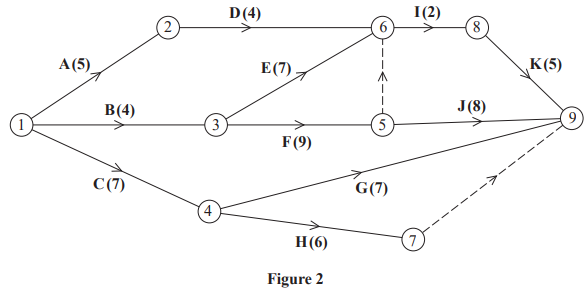
Diagram of a directed graph with nodes numbered 1 to 9, connected by labelled edges; weights in parentheses. Node 5 to 6 has a dashed edge.

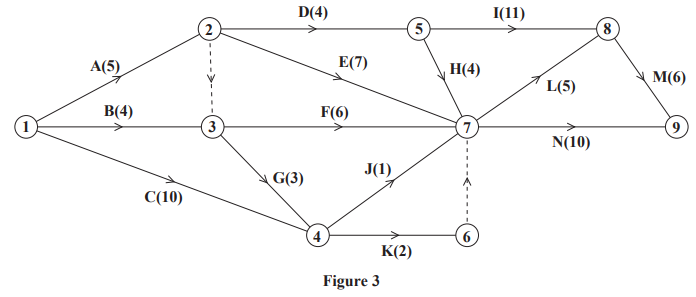
A project is modelled by the activity network shown in Figure 2. The activities are represented by the arcs. The number in brackets on each arc gives the time required, in hours, to complete the activity. The numbers in circles are the event numbers. Each activity requires one worker.

Explain the significance of the dummy activity

(i) from event 5 to event 6

(ii) from event 7 to event 9

1b
4 marks

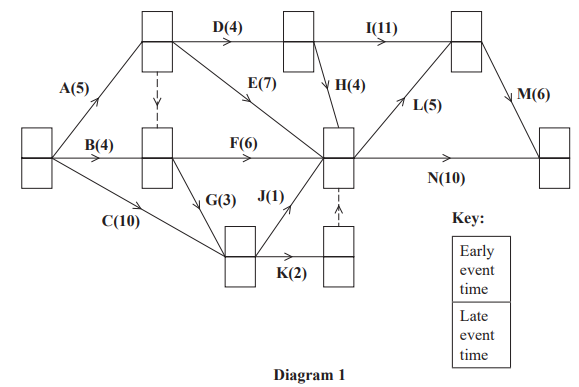
Complete Diagram 3 to show the early event times and the late event times.
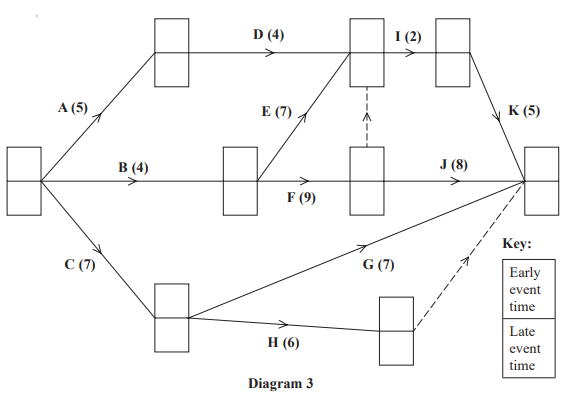
Flowchart with nodes A to K, numbers in brackets. Arrows depict task flow; solid for direct, dashed for alternate routes. Key shows early and late event times.
1c
1 mark

State the minimum project completion time.

1d
2 marks

Calculate a lower bound for the minimum number of workers required to complete the project in the minimum time. You must show your working.

1e
4 marks

On Grid 1, draw a cascade (Gantt) chart for this project.
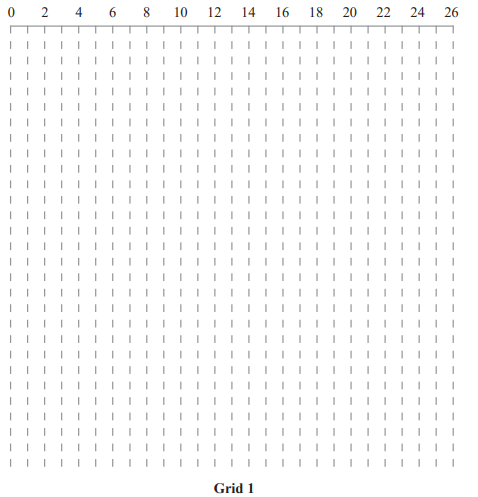
A blank grid titled "Grid 1" with numbered horizontal and vertical axes from 0 to 26. Vertical dashed lines are drawn at even-numbered intervals.
1f
3 marks

On Grid 2 , construct a scheduling diagram to show that this project can be completed with three workers in just one more hour than the minimum project completion time.
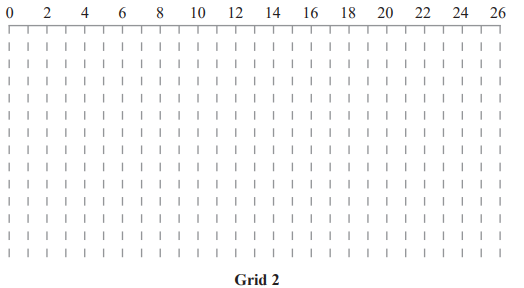
Numbered grid from 0 to 26 at the top, with vertical dashed lines; labelled "Grid 2" at the bottom.
2a
2 marks
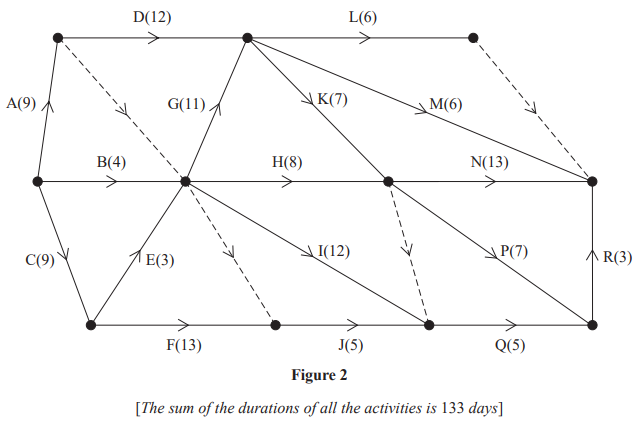
Flowchart with nodes and directed arrows, showing tasks labeled A to R with durations. The total duration of all activities is 133 days.

A project is modelled by the activity network shown in Figure 2. The activities are represented by the arcs. The number in brackets on each arc gives the time, in days, to complete the activity. Each activity requires one worker. The project is to be completed in the shortest possible time.

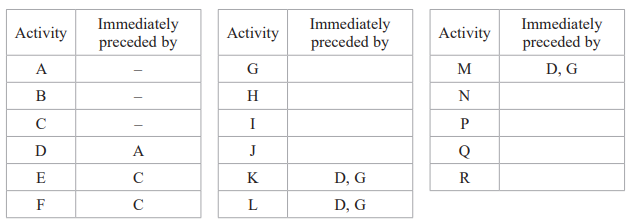
Complete the precedence table below.

Three tables showing activities and their predecessors. Table 1: A, B (-) C, F (C) D (A) E (C). Table 2: G, H, I, J (-) K, L (D, G). Table 3: M (D, G) N, P, Q, R (-).
2b
4 marks

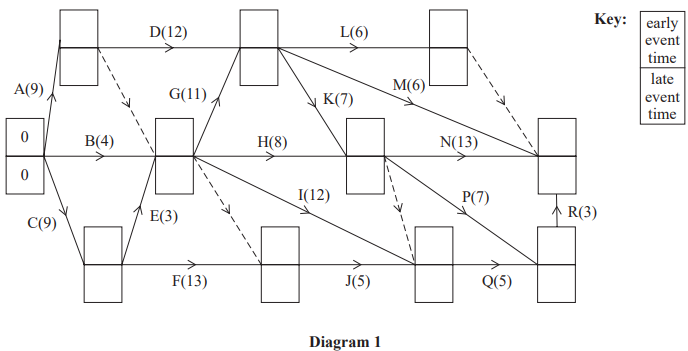
Complete Diagram 1 to show the early event times and the late event times.

Flowchart diagram with nodes labelled A to R, showing task dependencies and durations. Solid arrows indicate primary paths; dashed arrows are alternate transitions.
2c
1 mark

State the critical activities.

2d
1 mark

Calculate the total float for activity J. You must make the numbers you use in your calculation clear.

2e
1 mark

Calculate a lower bound for the number of workers needed to complete the project in the minimum time. You must show your working.

2f
4 marks

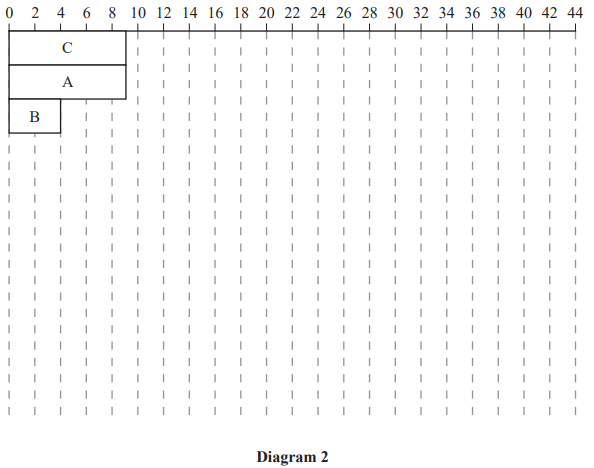
Diagram 2 below shows a partly completed scheduling diagram for this project.

Horizontal Gantt chart with three tasks: C, A, and B. Task C spans 0 to 8, A from 3 to 11, and B from 0 to 3. Labelled "Diagram 2."

Complete the scheduling diagram, using the minimum number of workers, so that the project is completed in the minimum time.

3a
2 marks
Flowchart titled Figure 1 with nodes labelled A to N, numerical values, and arrows indicating direction between nodes, forming multiple pathways.

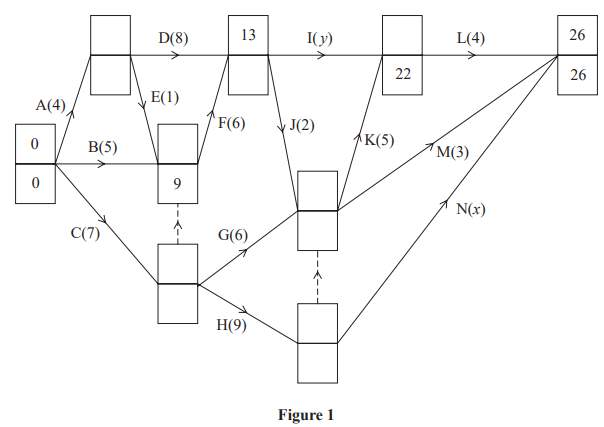
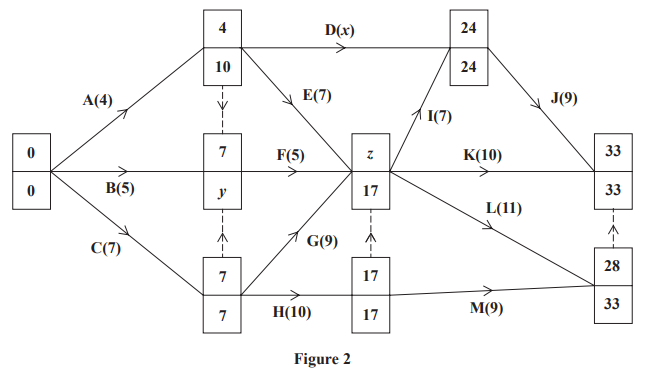
The network in Figure 1 shows the activities that need to be undertaken to complete a project. Each activity is represented by an arc and the duration of the activity, in days, is shown in brackets. The early event times and late event times are to be shown at each vertex and some have been completed.

Given that

  • CHN is the critical path for the project

  • the total float on activity B is twice the duration of the total float on activity I

find the value of x and show that the value of y is 7

3b
3 marks

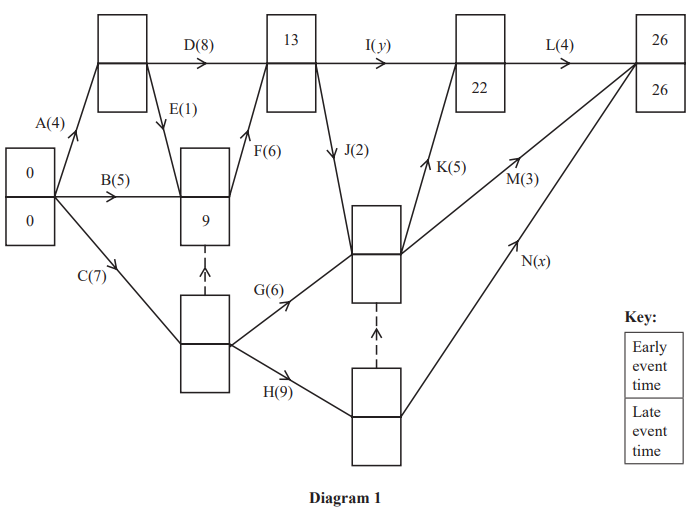
Calculate the missing early event times and late event times and hence complete Diagram 1.

Flowchart with nodes, arrows, and labelled paths A to N, showing project scheduling. Key: early and late event times. Nodes have event times; Diagram 1.
3c
6 marks

Each activity requires one worker, and the project must be completed in the shortest possible time.

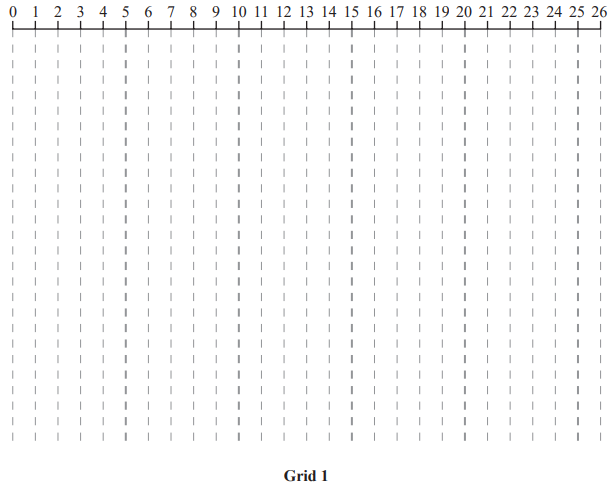
Draw a cascade chart for this project on Grid 1 below and use it to determine the minimum number of workers needed to complete the project in the shortest possible time. You must make specific reference to time and activities.

Numbered grid with vertical dashed lines from 0 to 26, labelled "Grid 1" at the bottom, with no other visible content.
4a
5 marks

The precedence table shows the eleven activities required to complete a project.

Activity

Immediately preceding activities

A

-

B

-

C

-

D

A, B

E

A, B

F

B, C

G

B, C

H

D

I

D, E, F, G

J

H, I

K

D, E, F

Draw the activity network for the project, using activity on arc and the minimum number of dummies.

4b
4 marks
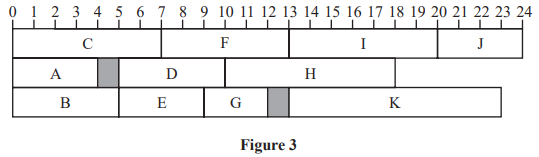
Gantt chart with tasks A to K, each spanning different times. Tasks C and G have highlighted sections. Time is marked from 0 to 24 on top.

Figure 3 shows a schedule for the project. Each of the activities shown in the precedence table requires one worker. The time taken to complete each activity is in hours and the project is to be completed in the minimum possible time.

(i) State the minimum completion time for the project.

(ii) State the critical activities.

(iii) State the total float on activity G and the total float on activity K.

5
5 marks

Activity

Immediately preceding activities

A

-

B

-

C

-

D

A, B, C

E

A, B, C

F

C

G

F

H

D

I

D, E, G

J

D, E

Draw the activity network described in the precedence table above, using activity on arc and exactly 4 dummies.

6a
4 marks
Flowchart depicting a network of nodes and arrows with values, showing a structured process or algorithm, labelled as "Figure 3" at the bottom.

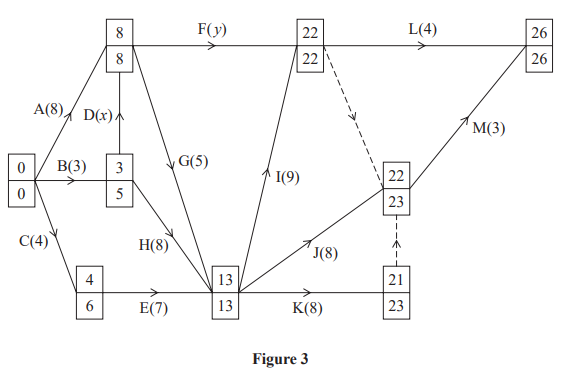
The network in Figure 3 shows the activities that need to be undertaken by a company to complete a project. Each activity is represented by an arc. The duration of the activity, in days, is shown in brackets. Each activity requires exactly one worker. The early event times and the late event times are shown at the vertices.

It is given that the total float on activity F is twice the total float on activity D.

It is also given that the total duration of the activities on the path BDFM is 10 days less than the duration of the critical path.

Determine the value of x and the value of y. You must make your method and working clear.

6b
4 marks

Draw a cascade chart for this project on Grid 1.

Vertical dashed grid lines numbered from 0 to 28 at two-unit intervals, labelled "Grid 1" at the bottom.
6c
2 marks

Use your cascade chart to determine the minimum number of workers needed to complete the project in the shortest possible time. You must make specific reference to time and activities. (You do not need to provide a schedule of the activities.)

7a
2 marks
Flowchart diagram with nodes and directional arrows. Nodes are labelled with numbers and include pathways like A(5), B(6), and others leading to endpoint G.

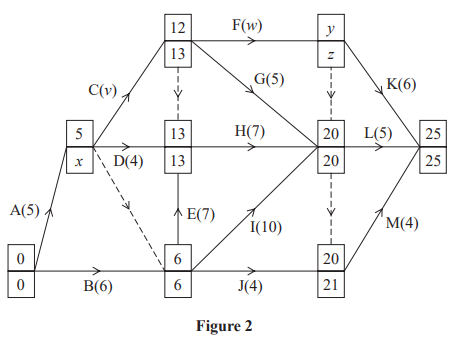
The network in Figure 2 shows the activities that need to be carried out by a company to complete a project. Each activity is represented by an arc, and the duration, in days, is shown in brackets. Each activity requires one worker. The early event times and the late event times are shown at each vertex.

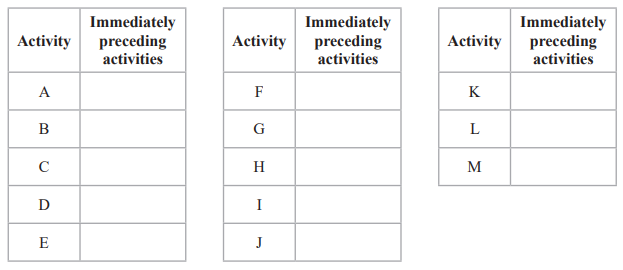
Complete the precedence table below.

Three tables listing activities A to M with columns for immediately preceding activities, all of which are blank.
7b
3 marks

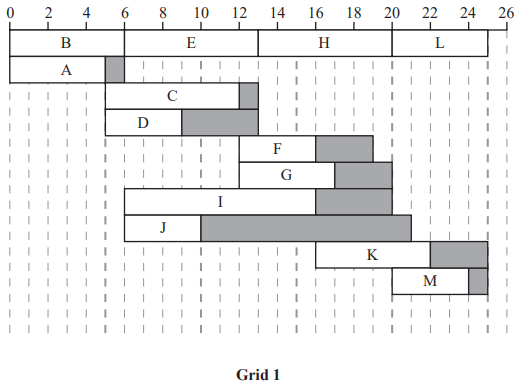
A cascade chart for this project is shown on Grid 1.

Bar chart titled "Grid 1" showing labelled segments A to M on a horizontal timeline from 0 to 26, with alternating shades and varying lengths.

Use Figure 2 and Grid 1 to find the values of v, w, x, y and z.

7c
1 mark

The project is to be completed in the minimum time using as few workers as possible.

Calculate a lower bound for the minimum number of workers required. You must show your working.

7d
3 marks

On Grid 2 , construct a scheduling diagram for this project.

Vertical grid lines numbered at the top from 0 to 26, evenly spaced; titled "Grid 2" at the bottom.
7e
2 marks

Before the project begins it is found that activity F will require an additional 5 hours to complete. The durations of all other activities are unchanged. The project is still to be completed in the shortest possible time using as few workers as possible.

State the new minimum project completion time and state the new critical path.

8a
4 marks
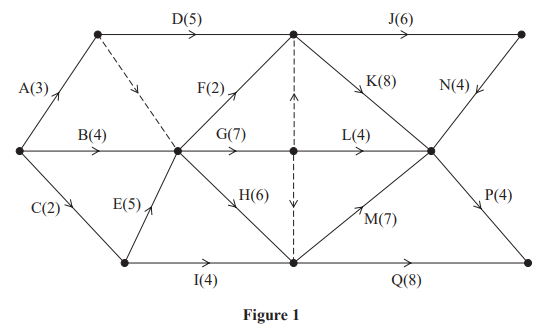
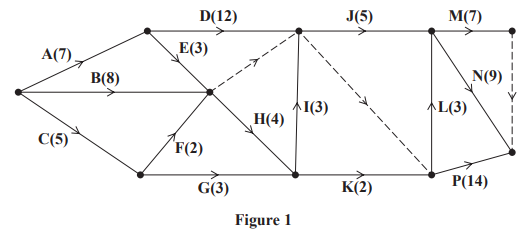
Graph diagram with nodes connected by directed edges, each labelled with letters and numbers, showing various pathways and directions.

A project is modelled by the activity network shown in Figure 1. The activities are represented by the arcs. The number in brackets on each arc gives the time, in hours, to complete the corresponding activity. Each activity requires one worker. The project is to be completed in the shortest possible time.

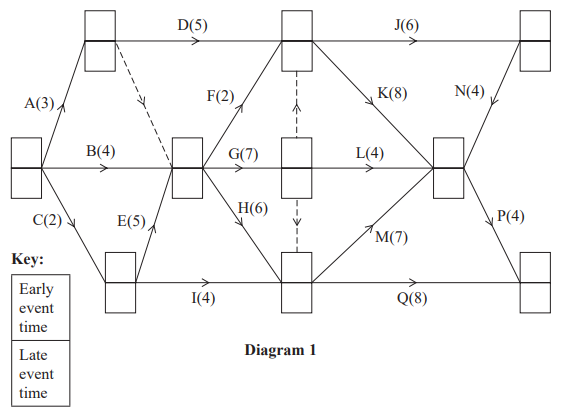
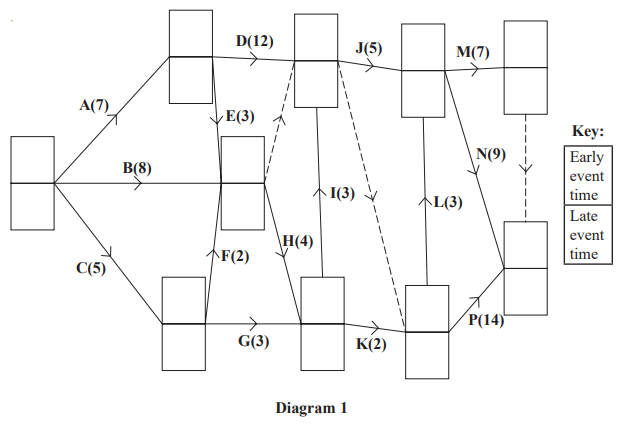
Complete Diagram 1 to show the early event times and the late event times.

Flowchart diagram with nodes and connecting arrows representing a project schedule. Includes task labels (A to Q) with durations and a key for event times.
8b
4 marks

Draw a cascade chart for this project on Grid 1.

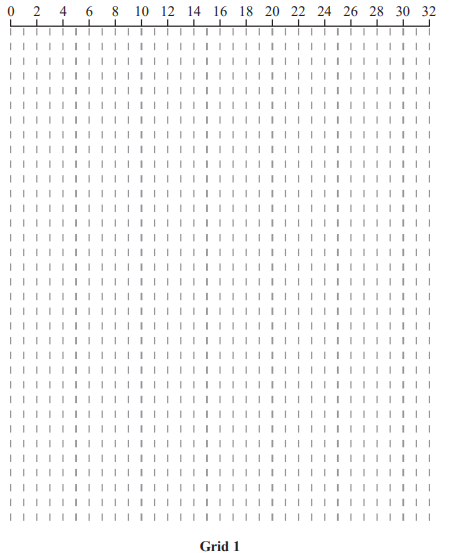
Grid with numbered vertical lines from 0 to 32 at the top, labelled "Grid 1" at the bottom, featuring dashed lines evenly spaced across the page.
8c
2 marks

Use your cascade chart to determine the minimum number of workers needed to complete the project in the shortest possible time. You must make specific reference to time and activities. (You do not need to provide a schedule of the activities.)

9a
5 marks

Activity

Immediately preceding activities

A

-

B

-

C

-

D

A

E

A

F

A, B, C

G

C

H

G

I

D, E, F, H

J

I

K

I

L

I

M

L

Draw the activity network for the project described in the precedence table above, using activity on arc and the minimum number of dummies.

9b
2 marks

State which activity is guaranteed to be critical, giving a reason for your answer.

9c
2 marks

It is given that each activity in the table takes two hours to complete.

State the minimum completion time and write down the critical path for the project

10a
3 marks

Activity

Duration (days)

Immediately preceding activities

A

4

-

B

7

-

C

6

-

D

10

A

E

5

A

F

7

C

G

6

B, C, E

H

6

B, C, E

I

7

B, C, E

J

9

D, H

K

8

B, C, E

L

4

F, G, K

M

6

F, G, K

N

7

F, G

P

5

M, N

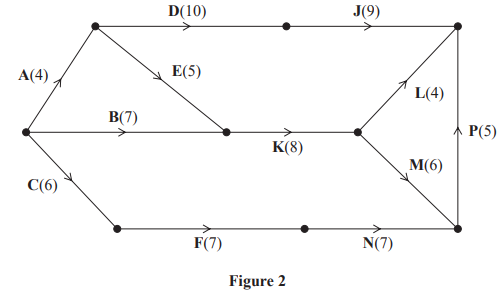
The table above shows the activities required for the completion of a building project. For each activity the table shows the duration, in days, and the immediately preceding activities. Each activity requires one worker. The project is to be completed in the shortest possible time.

Flowchart diagram with nodes A to P, each labelled with numbers in brackets, connected by directed arrows. Named Figure 2 at the bottom.

Figure 2 shows a partially completed activity network used to model the project. The activities are represented by the arcs and the numbers in brackets on the arcs are the times taken, in days, to complete each activity

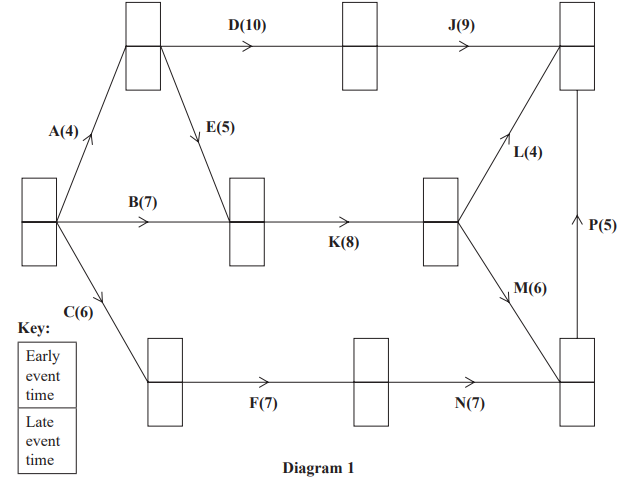
Complete the network in Diagram 1 by adding activities G, H and I and the minimum number of dummies.

Flowchart of interconnected tasks labeled A to P, with durations. Includes a key describing early and late event times. Shows project scheduling pathways.
10b
4 marks

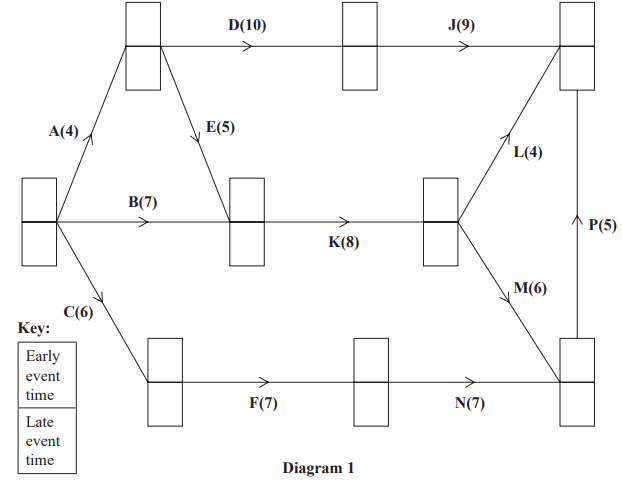
Add the early event times and the late event times to Diagram 1

Flowchart with nodes and arrows depicting project tasks. Tasks A to P have durations indicated in parentheses. Key defines early and late event times.
10c
1 mark

State the critical activities.

10d
2 marks

Calculate a lower bound for the number of workers needed to complete the project in the shortest possible time. You must show your working.

10e
3 marks

Schedule the activities on Grid 1, using the minimum number of workers, so that the project is completed in the minimum time.

Numbered grid with vertical dashed lines and a script-style font. Numbers range from 0 to 32. Labelled "Grid 1" at the bottom.
11a
5 marks

Draw the activity network described by the precedence table below, using activity on arc. Use dummies only where necessary.

Activity

Immediately preceding activities

A

-

B

-

C

A

D

A, B

E

C, D

F

D

G

C

H

G

I

G

J

E, F, I

K

F

11b
1 mark

Given that K is a critical activity,

state which other activities must also be critical.

11c
1 mark

Given instead that all activities shown in the precedence table have the same duration and K is not necessarily critical,

state the critical path for the network.

12a
4 marks
Directed graph with nodes labelled A to P, numbered arrows indicating connections, weights in brackets, and dashed lines showing alternative paths.

A project is modelled by the activity network shown in Figure 1. The activities are represented by the arcs. The number in brackets on each arc gives the time, in days, to complete the corresponding activity. Each activity requires exactly one worker. The project is to be completed in the shortest possible time.

Complete Diagram 1 to show the early event times and the late event times.

Flowchart of a network diagram with nodes A-P, each with numbered values in brackets. Includes solid and dashed connecting arrows and a key for event times.
12b
2 marks

Calculate a lower bound for the number of workers needed to complete the project in the minimum time. You must show your working.

12c
4 marks

Schedule the activities on Grid 1 below, using the minimum number of workers so that the project is completed in the minimum time.

A grid labelled "Grid 1" with a number line on top ranging from 0 to 36, marked in increments of 2, with vertical dashed lines beneath each number.
12d
2 marks

Additional resources become available, which can shorten the duration of one of activities D, G or P by one day.

Determine which of these three activities should be shortened to allow the project to be completed in the minimum time. You must give reasons for your answer.

13a
3 marks
Flowchart diagram with numbered boxes and directional arrows labelled A to M. Arrows indicate connections between boxes, with some boxes showing multiple numbers.

The network in Figure 2 shows the activities that need to be undertaken by a company to complete a project. Each activity is represented by an arc and the duration, in days, is shown in brackets. Each activity requires one worker. The early event times and late event times are shown at each vertex.

The total float on activity D is twice the total float on activity E.

Find the values of x, y and z

13b
4 marks

Draw a cascade chart for this project on Grid 1

Grid paper marked as Grid 1 with a numbered horizontal axis from 0 to 34 at the top, featuring light vertical dotted lines across the sheet.
13c
2 marks

Use your cascade chart to determine a lower bound for the minimum number of workers needed to complete the project in the shortest possible time. You must make specific reference to time and activities. (You do not need to provide a schedule of the activities.)

14a
5 marks

Activity

Immediately preceding activities

A

B

C

D

A

E

C

F

A, B, C

G

A, B, C

H

D, F, G

I

A, B, C

J

D, F, G

K

H

L

D, E, F, G, I


Draw the activity network described in the precedence table above, using activity on arc. Your activity network must contain only the minimum number of dummies.

14b
2 marks

Given that all critical paths for the network include activity H,

state which activities cannot be critical.

15a
2 marks
Flow diagram with nodes 1 to 9, showing paths and weights between them, such as A(5), B(4), C(10), illustrating a network sequence.

A project is modelled by the activity network shown in Figure 3. The activities are represented by the arcs. The number in brackets on each arc gives the time required, in hours, to complete the corresponding activity. The numbers in circles are the event numbers.

Explain the significance of the dummy activity

(i) from event 2 to event 3

(ii) from event 6 to even

15b
4 marks

Complete Diagram 1 to show the early event times and the late event times.

Flowchart diagram of tasks A to M with durations in parentheses. Arrows indicate dependencies. Includes a key for early and late event times.
15c
2 marks

State the minimum project completion time and list the critical activities.

15d
3 marks

The duration of activity H changes to x hours.

Find, in terms of x where necessary,

(i) the possible new early event time for event 7

(ii) the possible new late event time for event 7

15e
1 mark

Given that the duration of activity H is such that the minimum project completion time is four hours greater than the time found in (c),

determine the value of x.

16a
5 marks

Activity

Immediately preceding activities

A

-

B

-

C

-

D

-

E

A

F

A, B, C

G

C

H

C

I

D, H

J

E

K

E

L

F,G, I

M

G,I

Draw the activity network described in the precedence table, using activity on arc and exactly four dummies.

16b
1 mark

Given that there is a unique critical path for the network and that K is a critical activity,

state the critical path for the network.

16c
2 marks

Given instead that all the activities shown in the precedence table have the same duration and K is not necessarily critical,

state all the possible critical paths for the network.