Hardest IB Computer Science Questions & How to Answer Them

Written by: Robert Hampton
Reviewed by: James Woodhouse
Published
Contents
- 1. Key takeaways
- 2. Why The Hardest IB Computer Science Questions Feel So Tough
- 3. A Step-by-Step Method For High-Level IB CS Questions
- 4. Examples Of The Hardest IB Computer Science Questions
- 5. IB Command Terms: Your Roadmap To Marks
- 6. How To Practise The Hardest IB Computer Science Questions
- 7. Frequently Asked Questions About The Hardest IB Computer Science Questions
- 8. Final Thoughts: Turning Hard Questions Into Marks
The hardest IB Computer Science questions can feel brutal, especially at Higher Level. I have watched strong students freeze in front of a recursive trace, a dense Paper 3 ethics scenario, or an 8 mark evaluate question that seems to be about everything at once. The good news is that even the hardest IB Computer Science questions are predictable once you know how examiners think and how the mark schemes are structured.
If you want a full revision plan alongside this guide, read our article on how to revise IB Computer Science first, then use this page to sharpen your exam technique on the most demanding questions.
As IB examiners and teachers, we see the same patterns year after year. High scoring students are not magically smarter, they are just better at:
Reading command terms correctly
Linking every point to the scenario
Writing in clear, technical, examiner friendly paragraphs
This guide will walk you through those skills using realistic examples, so that the hardest questions become opportunities rather than disasters.
Key takeaways
The hardest IB Computer Science questions combine multiple topics, use demanding command terms, and often involve unseen scenarios
Command terms like evaluate, discuss, and justify dictate how you structure your answer and where marks are awarded
Topics that most often cause problems include recursion, object-oriented programming, Big O notation, system design, and ethics and data
Top level answers use precise technical vocabulary, one clear point per paragraph, and constant links back to the context
Regular practice with exam-style questions, plus feedback from tools like Smart Mark, allows you to move from vague explanations to exam-ready answers.
Why The Hardest IB Computer Science Questions Feel So Tough
IB Computer Science is built to test computational thinking, not just memory. The official subject brief (opens in a new tab) emphasises problem solving, algorithmic thinking, programming, and evaluation of real world systems, at both SL and HL.
Several features combine to make the hardest questions feel intimidating.
Multiple topics in one question
Higher mark questions often blend areas of the syllabus. For example:
Trace an algorithm, then comment on time complexity
Design a class hierarchy, then justify your design against given requirements
Evaluate a system design while considering security, performance, and user impact
You are rarely tested on a single idea in isolation, especially at HL.
Demanding command terms
There is a big difference between:
Describe: what it is or what happens
Explain: why it happens or how it works
Evaluate: strengths, weaknesses, and a justified conclusion
If you ignore the command term, you can write a full page and still miss half the marks. The IB assessment objectives explicitly reward students who match their response style to the command word.
Unseen and abstract scenarios
You are expected to apply familiar concepts to new situations:
A data structure you know, used in a system you have never seen
A networking or security scenario based on a case study
An ethical dilemma involving AI, big data, or social media
HL questions in particular move away from pure recall and into conceptual reasoning.
Paper 3 and real world judgement
For HL, Paper 3 uses a pre-released case study and asks you to analyse implications, stakeholders, and trade-offs. There is usually more than one acceptable answer, but you must justify your view logically and consistently with the case study.
That combination of breadth, depth and judgement is exactly what makes the hardest IB Computer Science questions challenging, and it is also why universities value the course.
A Step-by-Step Method For High-Level IB CS Questions
When you hit a question that looks impossible, slow down and follow a fixed routine.
Step 1: Read the command term carefully
Explain – give reasons, use “because” and “this means that”
Evaluate – advantages, disadvantages, then a justified conclusion
Justify – argue why your choice is best compared with alternatives
Discuss – present multiple perspectives with reasoning
Underline the command term and keep it visible as you write. This keeps you aligned with the mark scheme.
Step 2: Break the question into micro tasks
Most high-mark questions contain several hidden mini tasks. For example, an 8 mark evaluate might require you to:
Identify stakeholders
Give at least two developed advantages
Give at least two developed disadvantages
Reach a balanced conclusion
Jot these down briefly before you start writing.
Step 3: Use precise technical language
Replace vague phrases like:
“The code is better”
with:
“This algorithm has O(log n) time complexity, so it scales more efficiently than a linear search as n increases”
Precise vocabulary is one of the easiest ways to lift an answer from mid band to top band. If you struggle with definitions, the IB Computer Science glossary is a good place to review key terms quickly.
Step 4: Anchor every point in the scenario
Examiners are not impressed by generic textbook paragraphs. They want to see that you have applied your knowledge to this specific case.
If the context is a hospital, talk about patient records, clinical staff, and emergencies
If the scenario is social media, refer to users, content moderation, and recommendation algorithms
A good rule: every paragraph should contain at least one reference to the scenario.
Step 5: Think like a developer, not a note taker
Ask yourself:
What would a real developer, systems analyst, or engineer worry about here
Performance, maintainability, user experience, security, cost, ethics
When your answer shows awareness of these trade-offs, you sound like the kind of candidate the IB descriptors are written for.
Examples Of The Hardest IB Computer Science Questions
Let us walk through four realistic examples that illustrate common “hard question” patterns in IB Computer Science. These are in the style of IB questions, not real past paper items.
Question 1 – Tracing A Recursive Algorithm (Paper 1)
Topic focus: recursion, tracing, base case reasoning
Question
The following recursive method is written in Java. Trace the execution of mystery(4) and state the final output. [4 marks]
public static int mystery(int n) {
if (n <= 1) {
return 1;
}
return n + mystery(n - 2);
}
Why it feels hard
You must keep track of multiple calls
The step size is n - 2 rather than n - 1, which throws many students
You only get 4 marks, so the question moves quickly
Examiner style approach
Build a trace table as you go.
Call | Condition | Return value |
mystery(4) | 4 > 1 | 4 + mystery(2) |
mystery(2) | 2 > 1 | 2 + mystery(0) |
mystery(0) | 0 <= 1 | 1 |
Now work back up the call stack:
mystery(0)returns 1mystery(2)returns 2 + 1 = 3mystery(4)returns 4 + 3 = 7
Final output: 7
Typical mark split
1 mark – correct base case return value
2 marks – correct intermediate working or trace
1 mark – correct final answer
Common mistakes
Forgetting that
ndecreases by 2, not 1Not working back from the base case
Writing the correct answer with no working, then losing method marks if the question requires a trace
Revision tip
Try writing a few tiny recursive functions of your own and tracing them out on paper. In my experience teaching IB students over the years, this simple habit is one of the fastest ways to build real confidence. It trains you to slow down, spot the pattern, and follow each call one step at a time, so those intimidating exam traces start to feel completely manageable.
Question 2 – Object Oriented Design In Java Or Python (Paper 2 HL)
Topic focus: class design, inheritance, encapsulation, polymorphism
Question
A zoo management system needs to represent different animals. All animals have a name and age. Mammals have a furColour attribute, while Birds have a wingspan attribute. Design an appropriate class hierarchy. Include constructors and at least one polymorphic method. Justify your design decisions. [8 marks]
You might answer in Java, Python, or another approved language, depending on what your school teaches.
Model outline
Create an abstract superclass
AnimalCreate subclasses
MammalandBirdthat extend or inherit fromAnimalStore attributes as private or protected fields
Include an abstract or virtual method such as
makeSound()
Sample Java style skeleton
public abstract class Animal {
private String name;
private int age;
public Animal(String name, int age) {
this.name = name;
this.age = age;
}
public abstract String makeSound();
}
public class Mammal extends Animal {
private String furColour;
public Mammal(String name, int age, String furColour) {
super(name, age);
this.furColour = furColour;
}
@Override
public String makeSound() {
return "Generic mammal sound";
}
}
public class Bird extends Animal {
private double wingspan;
public Bird(String name, int age, double wingspan) {
super(name, age);
this.wingspan = wingspan;
}
@Override
public String makeSound() {
return "Chirp";
}
}
Justification for full marks
Animal is abstract because you never need a generic animal object, only specific types
Fields are private, which enforces encapsulation and protects internal state
makeSound() is abstract in Animal and overridden in each subclass, demonstrating polymorphism
The hierarchy avoids code duplication by placing shared attributes in the superclass
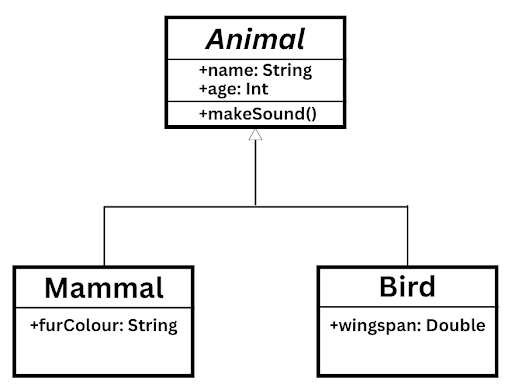
UML class diagram showing Animal as an abstract superclass with Mammal and Bird as subclasses, each adding their own attributes and overriding makeSound().
Where many students drop marks
Writing correct code but not explaining design choices
Forgetting to use inheritance at all, and writing three unrelated classes
Ignoring the command term justify
Question 3 – Evaluating A System Design (Paper 1 Extended Response)
Topic focus: system fundamentals, databases, security, evaluation, ethics
Question
A hospital wants to implement a new electronic patient record system to replace paper files. Evaluate the decision to move to a digital system. [8 marks]
High scoring structure
2 to 3 well developed advantages with examples
2 to 3 well developed disadvantages with examples
Clear reference to stakeholders
A balanced, justified conclusion
Sample structure
Accessibility and safety
Doctors can access patient records quickly from any authorised workstation, which speeds up treatment in emergencies and reduces errors caused by illegible handwriting.Data analysis and planning
Digital records allow the hospital to analyse trends, identify high-risk patients, and allocate resources more effectively.Cost and implementation risk
Initial costs for hardware, software, integration, and training are high. During the transition, staff may have to maintain both paper and digital systems, increasing workload.Security and privacy
Centralised digital records are vulnerable to cyberattacks and data breaches. A serious incident could expose thousands of records and breach data protection laws.System reliability
If the system goes down, staff cannot easily access patient information. Paper records do not depend on network connectivity.Conclusion
The project is worthwhile if the hospital invests in strong security, backup systems, and staff training. Without those safeguards, the risks could outweigh the benefits.
Mark scheme style split
2 marks – advantages with technical or contextual detail
2 marks – disadvantages with technical or contextual detail
2 marks – range of stakeholders and impacts
2 marks – balanced conclusion that follows from the argument
Question 4 – Big Data, AI And Ethics (Paper 3 HL)
Topic focus: Paper 3 case study, ethics, stakeholders, automated decision making
Question
A social media company uses AI algorithms to automatically detect and remove harmful content. Analyse the ethical implications of this automated moderation system. [9 marks]
Your paper 3 case study will give a specific context, but the skills are similar.
High level answer outline
Technical context: AI moderation uses machine learning models trained on large datasets to classify content at scale
Benefits
Harmful content (hate speech, explicit violence, illegal material) can be removed quickly
Users, especially younger or vulnerable groups, are better protected
Human moderators are shielded from some of the worst material
Risks and fairness
Models may embed bias if training data is unbalanced, leading to over removal of content from certain groups
Cultural and linguistic nuances are hard for automated systems, increasing the risk of unfair censorship
Transparency and accountability
Users may not understand why their content was removed
Limited appeal mechanisms undermine trust and accountability
Freedom of expression and false positives
Legitimate political debate, journalism, or satire may be incorrectly flagged
During elections or protests, this can distort public discourse
Privacy and surveillance
Constant monitoring of content creates detailed profiles of user behaviour
Raises concerns about long-term data storage and potential misuse
Stakeholder perspectives
Company: legal compliance, brand safety, reduced moderation costs
Users: safety, privacy, ability to express opinions
Society: wider impact on democracy, marginalised voices, and the spread of misinformation
To reach the top band, link your points to ethical ideas such as justice, privacy, autonomy, and accountability, and tie everything to the specific details of the case study in that exam session.
For a wider strategy on reaching Level 7 in Paper 3 and the rest of the course, combine this guide with our exam-focused article on how to get a 7 in IB Computer Science.
IB Command Terms: Your Roadmap To Marks
The IB Computer Science subject brief sets out clear assessment objectives, and command terms are the bridge between those objectives and your answers.
Here is how to treat them in computer science questions.
Command term | What examiners want | Example in CS context |
Define | Short, precise meaning, usually 1 sentence | Define encapsulation |
Describe | What it is or what happens, with key features | Describe how a stack operates |
Explain | Why or how something works, with cause and effect | Explain why binary search is more efficient than linear search |
Compare | Similarities and differences between two things | Compare arrays and linked lists |
Discuss | Balanced argument with multiple perspectives | Discuss the impact of AI in healthcare |
Evaluate | Strengths, weaknesses, and justified conclusion | Evaluate the use of cloud storage in a school |
Justify | Clear reasons why your choice is best | Justify using a hash table for a dictionary application |
Features of a Level 7 style response
Correct and consistent technical terminology
One main point per paragraph, properly developed
Reference to the scenario and stakeholders
Direct match to the command term
Evidence of understanding, not just memorisation
If you want more guidance on exam technique across all three papers, our detailed guide on how to get a 7 in IB Computer Science breaks this down further.
How To Practise The Hardest IB Computer Science Questions
Reading about hard questions is a start. Beating them requires regular, focused practice.
Use past papers strategically
Start with untimed practice while checking your notes
Move towards full timed papers as the exam approaches
Always mark your answers against the mark scheme, not just “check roughly”
Drill command terms with flashcards
Build a set of flashcards with:
Command term on the front
Required structure and a Computer Science example on the back
Code and trace by hand
Paper 2 does not give you an IDE. Practise:
Writing short functions or methods for standard algorithms
Tracing through loops, recursion, and data structure operations
Building your own trace tables for tricky questions
Frequently Asked Questions About The Hardest IB Computer Science Questions
Do HL and SL students get the same hard questions?
Not exactly.
Both SL and HL share the core content, but HL students face:
Additional Paper 1 questions on HL extension topics, such as abstract data structures and resource management
A separate Paper 2 focusing on more complex programming and option content
Paper 3, which only HL students sit, based on a pre-released case study
The style of hard questions is similar cross level, but HL questions tend to be more abstract and require deeper analysis
What are the hardest topics in IB Computer Science?
This varies, but from years of teaching and reviewing exam performance, the same topics keep appearing:
Recursion – particularly tracing and designing recursive solutions
Object-oriented programming – inheritance, polymorphism, and designing good class structures
Databases and SQL – especially complex joins and normalisation
Big O notation – reasoning about algorithmic complexity and comparing approaches
System design and architecture – integrating multiple components into a coherent solution
Ethics and social impacts – extended writing that links technical details to real-world consequences
These topics are demanding because they require real understanding, not just flashcard level recall.
Can I use Python or Java in the exam, and does it affect hard questions?
Your school chooses whether you sit Paper 2 in Java or Python. You do not switch language on exam day.
Hard Paper 2 questions exist in both languages. What matters is that you:
Know your chosen language syntax reliably
Understand standard library routines provided in the IB documentation
Can design algorithms independently of any one language
Paper 1 often uses pseudocode or language agnostic notation, so the hardest Paper 1 questions test your algorithmic thinking more than your syntax. The IB subject brief confirms that algorithmic thinking is assessed in pseudocode to keep the focus on logic, not language quirks.
Final Thoughts: Turning Hard Questions Into Marks
The hardest IB Computer Science questions are not designed to trick you; they are designed to reveal how well you can think like a computer scientist.
When you can:
Trace a recursive algorithm calmly
Design and justify an object-oriented solution
Evaluate a complex system with stakeholders and ethics in mind
Match your writing to command terms with confidence
You are doing exactly what the IB Computer Science course intends, and exactly what examiners are trained to reward.
Use high-quality, exam board-specific resources, practise under timed conditions, and get feedback through tools like Smart Mark, flashcards, and Target Tests. Over time, the questions that once looked impossible become familiar patterns you know how to break apart and solve.
You are not aiming for perfection; you are aiming for structured, precise, and consistent answers. With the right habits, the hardest IB Computer Science questions become the ones that pull your grade up, not down.
References
IB Computer Science Guide (HL Specification) (opens in a new tab)
IB Computer Science Guide (SL Specification) (opens in a new tab)
IB Computer Science Subject Brief (opens in a new tab)
Save My Exams: IB Computer Science Glossary
Was this article helpful?
Sign up for articles sent directly to your inbox
Receive news, articles and guides directly from our team of experts.

Share this article




 written revision resources that improve your