Hardest IGCSE Geography Questions & How to Answer Them

Written by: Bridgette Barrett
Reviewed by: Natasha Smith
Last updated
Contents
- 1. Key Takeaways
- 2. What Makes an IGCSE Geography Question Hard?
- 3. Exam Structure Overview
- 4. Sample Hard Questions with Model Answers
- 5. How to Structure High-Mark Geography Answers
- 6. Common Mistakes in Difficult Questions
- 7. Revision Tips for High-Level Questions
- 8. Frequently Asked Questions
- 9. Final Thoughts
Staring at a 7,8 or 12-mark IGCSE Geography question and feeling your brain just... stop? You're definitely not alone. Thousands of students hit the same wall every year when they see extended response questions asking them to evaluate, justify, or discuss "to what extent."
Here's the frustrating bit: you've done the revision. You know your case studies. But when exam day arrives, and you see that first extended response question, your mind goes blank. How much detail should you include? Are you even answering the right thing? How do you structure this properly?
Good news: even the toughest IGCSE Geography questions become manageable when you know the tricks.
Over the last 25 years, I have worked with hundreds of students preparing for their Geography IGCSEs, and here at Save My Exams, we prepare resources used by many more.
This guide shares everything we've learnt. We'll walk you through real exam questions at the hardest level, show you model answers that hit mark scheme gold standards, and teach you the proven techniques that consistently help students bag those Grade 8s and 9s (or A*/A grades for international students).
Every strategy here has been tested with real students and refined based on their actual results. Let's get you properly exam-ready.
Key Takeaways
Practise with the most difficult IGCSE Geography questions to build confidence
Learn how to structure 7-mark, 8-mark and 12-mark answers using proven techniques
Discover how to apply case study details effectively without wasting time
Avoid common exam pitfalls that cost students valuable marks
What Makes an IGCSE Geography Question Hard?
Not all Geography questions are created equal. Some ask you to label a diagram or recall a fact. Easy. The hardest ones? They're a whole different beast.
We've spent years analysing IGCSE Geography papers – over 15 years' worth – and examiner reports. Here's what consistently trips students up.
Unfamiliar contexts often throw students off balance. Exam boards give you data, graphs, or scenarios you've never seen before. You might get details about a city you haven't studied, or climate data from somewhere random. This tests whether you can actually apply your geography knowledge, not just repeat memorised facts.
Extended response questions are where things get tough. These 7-mark, 8-mark and 12-mark questions need proper, structured paragraphs, not just lists of facts. (opens in a new tab)According to Cambridge Assessment International Education (opens in a new tab), these questions test your ability to "analyse, evaluate and construct arguments." From my time as an examiner, I can tell you: students usually know the content but struggle to structure it properly.
Evaluative command words increase the difficulty. Words like "to what extent," "justify," "discuss," and "evaluate" want balanced arguments. You can't just dump everything you know – you need to weigh up different perspectives and reach a judgement. Our analysis of examiner reports shows this is the biggest mark difference between Grade 6 and Grade 9 students.
Data interpretation under pressure is another challenge. When questions combine unfamiliar graphs, maps, or photos with extended writing, you need to extract information quickly and apply your geographical knowledge. Many students freeze when they see data they don't recognise.
The hardest questions deliberately test whether you can think like a geographer, not just memorise like one. Understanding this difference is absolutely crucial for smashing your exam.
Exam Structure Overview
Understanding where the tough questions are helps you prepare strategically. Both Cambridge and Edexcel IGCSE Geography follow similar structures, though there are slight differences.
Each exam board splits Geography into separate papers focusing on different skills and content. The hardest questions typically appear in extended response sections, where you're expected to write detailed, evaluative answers.
Paper 1 – Physical Geography
Paper 1 focuses on natural environments and processes. This is where you'll find challenging questions on coastal landforms and management, river processes and flooding, ecosystems, and climate change.
Cambridge IGCSE Paper 1 (opens in a new tab) includes topics like plate tectonics, rivers, coasts and ecosystems. The 7-mark questions here often ask you to explain the importance of different issues or assess the success of different approaches. The Edexcel IGCSE Paper 1 (opens in a new tab) covers similar topics, and the 8-mark questions will ask you to analyse sources of information.
Paper 2 – Human Geography
Paper 2 tests your understanding of how people interact with places. Expect tough questions on population dynamics and migration, rapid urbanisation in lower-income countries (LICs), economic development and inequality, and resource management.
These questions are particularly challenging because they require specific case study knowledge. A vague answer about "a city in India" won't cut it – you need precise details about Mumbai, for example, including facts and figures.
Cambridge's Paper 2 (opens in a new tab) expects you to "use case study material to support explanations and arguments." This is non-negotiable for top marks.
Paper 4 (Cambridge) – Skills and Fieldwork
This paper catches many students off guard. It tests your ability to work with unfamiliar data and interpret maps. However, there are no longer (above a 4-mark) questions in this paper.
Sample Hard Questions with Model Answers
Let's tackle some actual exam-style questions. These represent the difficulty level you'll face in your IGCSE exams. Pay close attention to how each answer is structured.
Question 1 – 8-Mark River regime question (Edexcel)
“Analyse the factors that affect the river regime shown in Figure 1c.”
Model Answer:
The river regime in Figure 1c is influenced by both the physical features and the land uses in the drainage basin. A river regime means how the discharge changes over time. At gauging station A, the hydrograph is much “flashier”, with a high peak discharge of around 70 cumecs and a short lag time. This is because the river there flows through an urban area (shown in grey on Figure 1c), where impermeable surfaces like roads stop infiltration and increase surface run-off. Water reaches the channel quickly, so discharge rises sharply after the storm.
In contrast, gauging station B shows a much lower peak discharge and a longer lag time. This part of the basin has more forested land, shown by the tree symbols. Trees intercept rainfall and encourage infiltration, so the water travels more slowly to the river. There is also pastoral farming upstream, which usually allows more infiltration than urban land, reducing run-off and slowing the response to rainfall.
Because the drainage basin includes many tributaries flowing through different land uses, the rivers react differently to the same storm. Overall, Figure 1c shows that human land use, like urbanisation, creates rapid changes in discharge, while natural vegetation leads to a calmer, slower river regime with a delayed peak.
Why this answer works: It directly addresses "analyse," provides specific information taken from the source, considers the different factors, and reaches a balanced conclusion with clear judgement about which are the most important factors for each of the two gauging stations.
Question 2 – 7-Mark Climate change question (Cambridge)
"For a named country you have studied, explain how managing climate change involves both reducing causes (mitigation) and responding to change (adaptation)."
Model Answer:
Bangladesh is a country already experiencing many impacts of climate change. The country is managing climate change through both mitigation strategies to reduce causes and adaptation measures to respond to climate impacts.
Bangladesh has launched the Bangladesh Renewable Energy Policy (2008), which aims to increase the amount of renewable energy, for example, solar power programmes in rural areas. This will reduce the reliance on fossil fuels, and plans to build nine new coal plants have been abandoned, reducing the emissions of greenhouse gases.
Other mitigation strategies include the implementation of sustainable transport systems and the reduction of fossil fuel dependency. Bangladesh aims to have 15% electric powered vehicles by 2030. This will reduce the amount of fossil fuels used for fuel and, therefore, the amount of greenhouse gas emissions.
However, Bangladesh has also focused on adaptation. Construction of submersible and raised roads, which can withstand flooding, reduces the impact of climate change on transport. As well as the building of 6,000 km of coastal embankments to protect coastal areas from sea level rise. This helps to protect the farmland from erosion, reducing migration away from these areas.
Why this answer works: It explains multiple examples of adaptation and mitigation relating to climate change, includes facts and statistics, and shows clear cause-and-effect relationships, for example, the abandonment of the coal plants leading to reduced emissions. This demonstrates the detailed explanation Cambridge's 7-mark questions require.
Question 3 – 8-Mark Economic activity question (Edexcel)
"Study Figure 1c below.
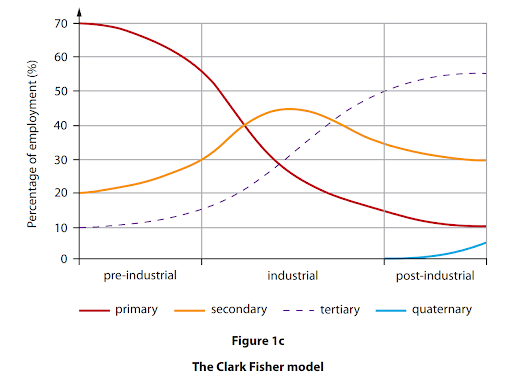
Analyse the reasons for changes in primary and quaternary employment.”
Model Answer:
Figure 1c shows clear changes in both primary and quaternary employment as an economy develops.
Primary employment decreases over time. In the pre-industrial stage, a high percentage of people work in the primary sector because countries rely heavily on natural resources such as farming, fishing and mining. During the industrial stage, there is a steep fall in primary employment. This is because of mechanisation in agriculture, meaning fewer workers are needed, and because people move to towns and cities for factory jobs (rural–urban migration). In the post-industrial stage, primary employment continues to fall but more slowly, reaching a low level of around 10%, showing it is much less important in developed economies.
In contrast, quaternary employment increases, but only in the post-industrial stage. Figure 1c shows quaternary starting from almost 0% and rising to about 5%. This growth happens because post-industrial economies are wealthier and focus more on knowledge, information and research and development. Advances in ICT, globalisation and higher levels of education lead to more jobs in areas such as universities, scientific research and data management. However, the percentage remains relatively low because quaternary jobs are highly specialised and require skilled workers.
Overall, the changes show how economic development leads to a shift away from primary activities towards knowledge-based sectors like quaternary.
Why this answer works: It clearly describes trends shown in Figure 1c, not just general theory.
It identifies the trends in primary and quaternary employment. There are precise references to the figure, which is essential for higher marks. The answer correctly explains what primary and quaternary activities are, and it links sectoral change to economic development, which is a key concept in the indicative content.
Question 4 – 7-Mark Coastal Management (Cambridge)
"Explain how coastal management strategies can reduce the impacts of coastal erosion." [7 marks]
Model Answer:
Hard engineering strategies provide immediate protection against coastal erosion. Sea walls, like the concrete structure at Holderness on the east coast of England, absorb wave energy and prevent the cliff base from being undercut. At Mappleton, rock armour (large boulders placed at the cliff base) has successfully protected the village since 1991, reducing erosion rates from 2 metres per year to almost zero. However, these structures are expensive – the Mappleton defences cost £2 million – and can increase erosion further down the coast by interrupting longshore drift.
Soft engineering strategies work with natural processes to manage erosion more sustainably. Beach nourishment involves adding sand to beaches to absorb wave energy before it reaches cliffs. At Seaford in Sussex, 3.7 million cubic metres of shingle were added to create a wider beach, which naturally protects the coastline. This method costs less than hard engineering and looks more natural, though the sediment needs replacing every few years as it gets washed away.
Managed retreat is increasingly used where the coast is less developed. At Medmerry in West Sussex, coastal defences were deliberately removed, and 7km of new coastline was allowed to flood naturally, creating salt marshes that absorb wave energy. This strategy accepts some land loss but creates valuable habitats and provides long-term protection at a lower cost. However, it's only suitable where there's no valuable property at risk.
Overall, a combination of strategies is usually most effective. Hard engineering protects high-value areas like towns, soft engineering provides sustainable protection for beaches, and managed retreat is appropriate for low-value agricultural land. The choice depends on the local situation, costs, and environmental priorities.
Why this answer works: It explains multiple strategies with specific case study examples, includes facts and figures (costs, erosion rates, quantities), shows how each strategy reduces erosion impacts, and evaluates the effectiveness and limitations of different approaches. This demonstrates the detailed explanation and evaluation that 7-mark questions require.
Question 5 – 12-Mark Fragile Environment (Edexcel)
"Evaluate the success of strategies used to protect tropical rainforests." [12 marks]
Model Answer:
International protection strategies have achieved some success in safeguarding tropical rainforests. The REDD+ programme (Reducing Emissions from Deforestation and Forest Degradation) provides financial incentives for countries to protect forests. In Ecuador, the Yasuní-ITT initiative aimed to keep oil reserves underground in exchange for international payments, though this ultimately failed when funding fell short. More successfully, the Amazon Fund in Brazil has raised over $1.3 billion from international donors since 2008, funding conservation projects that reduced deforestation by 70% between 2004 and 2012. However, international strategies struggle when national governments change priorities, as seen when Brazil's deforestation rates increased again after 2019 under new political leadership.
National government strategies can be highly effective when properly enforced. Costa Rica's Payment for Ecosystem Services (PES) programme pays landowners to protect forest on their land rather than clearing it for agriculture. This increased Costa Rica's forest cover from 21% in 1987 to over 52% by 2020, one of the world's greatest conservation success stories. Brazil's creation of protected areas, including the Tumucumaque National Park (3.9 million hectares), provides legal protection for vast forest areas. However, enforcement remains challenging – illegal logging continues even in protected zones, and between 2019-2021 deforestation in the Brazilian Amazon increased by 73%, showing that laws alone aren't enough without proper monitoring and penalties.
Local community involvement strategies recognise that indigenous peoples are often the best forest protectors. In the Peruvian Amazon, indigenous reserves like the Asháninka territory have maintained 90% forest cover compared to only 45% in neighbouring unprotected areas. Community forest management in Nepal has successfully reduced deforestation by giving local people control and benefits from sustainable forestry. However, these strategies only work when communities have genuine legal rights – land conflicts and a lack of formal recognition undermine many local conservation efforts.
Sustainable economic alternatives aim to make forests more valuable alive than dead. Ecotourism in Costa Rica generates over $4 billion annually, providing strong economic incentives for conservation. Sustainable harvesting of products like Brazil nuts, rubber, and açaí berries offers income without destroying the forest. However, these alternatives often can't compete financially with cattle ranching or soy farming – a hectare cleared for cattle can earn far more than ecotourism or sustainable harvesting, making it difficult to persuade landowners to protect the forest.
In conclusion, no single strategy is sufficient to protect tropical rainforests. The most successful approaches combine international funding, strong national enforcement, genuine community involvement, and sustainable economic alternatives. Costa Rica demonstrates that this integrated approach works, but success requires sustained political will, adequate funding, and addressing the underlying economic drivers of deforestation. Where any of these elements are missing, protection efforts struggle – as shown by the recent increases in Amazon deforestation when political priorities shifted.
Why this answer works: It evaluates multiple strategies at different scales with detailed case study evidence, includes specific statistics and facts, shows both successes and failures of each approach, demonstrates understanding of interconnections between strategies, and reaches a balanced, justified conclusion. This shows the depth, evaluation and synthesis that 12-mark questions demand.
How to Structure High-Mark Geography Answers
Knowing your content is only half the battle. The other half is presenting it effectively. Years of marking top-scoring exam scripts have helped me to identify the exact structures that consistently earn high marks.
Top students follow clear frameworks that help examiners immediately recognise the quality of their geographical thinking. Let's break down the proven approach.
Planning the Answer
Never start writing immediately. Spend 30-60 seconds planning, even in timed conditions. Exam performance shows that students who plan their extended answers tend to score higher than those who don't.
First, underline the command word in the question. "Evaluate" and “analyse” require different content than "describe" or "explain." Examiner reports consistently highlight that misunderstanding command words is one of the key reasons students lose marks.
Next, identify what the question is really asking. A question about urbanisation might specifically ask about causes, effects, or solutions. Make sure you're answering that precise focus. I have seen countless well-written answers that scored poorly simply because they addressed the wrong aspect of the topic.
Create a quick bullet point plan with your main points. For a 7 or 8-mark question, aim for 3-4 substantial paragraphs plus a conclusion. For 12-mark questions, 4-5 paragraphs work well.
Select your case studies at the planning stage. Don't just write about the first example that comes to mind – choose the one with the most relevant, detailed evidence for this specific question.
This planning time isn't wasted. It prevents you from going off-topic or forgetting important points halfway through.
Building Evaluation into Your Answer
Evaluation is what separates good answers from excellent ones. But what does "evaluate" actually mean?
Use the PEEL structure to build strong paragraphs:
Point: State your main argument or idea
Evidence: Back it up with specific case study details, facts, or figures
Explanation: Explain how this evidence supports your point
Link: Connect back to the question
For evaluative questions, extend this to include alternative views or limitations. Don't just argue one side – show you understand the complexity.
Words and phrases that demonstrate evaluation include: "however," "on the other hand," "although," "in contrast," "this suggests that," "the evidence indicates," and "this is significant because."
Your conclusion is crucial in evaluative questions. Don't just repeat your introduction. Make a clear judgement that answers the question directly. Phrases like "overall," "on balance," or "the most significant factor is" signal you're reaching a reasoned conclusion.
Cambridge Assessment mark schemes (opens in a new tab) award the highest marks to answers that "weigh up evidence and reach a balanced conclusion." Make sure you actually make a judgement, don't just sit on the fence.
Case Studies: Quality Over Quantity
Many students panic and write everything they know about a case study. This is a mistake.
Select relevant details only. If the question asks about flood management, don't describe the location's climate, history, and economy. Focus on the flood management strategies and their effectiveness.
Include specific facts and figures. "Many people" is vague. "2,000 people per day" is precise and impressive. Names, dates, statistics, and locations all boost your marks.
Use your case studies to answer the question, not to show off knowledge. Every piece of case study information should directly support a point you're making.
For example, if discussing urbanisation challenges, you might write: "Traffic congestion in Mumbai means the average commute time is 90 minutes, reducing productivity and quality of life." This is focused, specific, and relevant.
Compare this to: "Mumbai is a megacity in India with a population of over 20 million. It has problems with traffic congestion, pollution, and inadequate housing. Many people live in slums like Dharavi." This dumps information without explanation or relevance.
Edexcel IGCSE Geography mark schemes (opens in a new tab) explicitly state that "place-specific detail" must be "relevant and accurate" to achieve top marks.
Common Mistakes in Difficult Questions
After reviewing thousands of student responses and consulting with experienced IGCSE examiners, we've identified the mistakes that most frequently cost students marks. Avoiding these pitfalls can instantly improve your grade.
Misreading the command word is the number one avoidable error. Many students lose marks by describing when they should be explaining, or explaining when they should be evaluating. "Describe" means say what something is like. "Explain" means give reasons why. "Evaluate" means weigh up evidence and judge. Match your answer to what's actually being asked.
Including irrelevant case study material wastes precious exam time and earns zero marks. Our analysis shows students typically spend 20-25% of their writing time on irrelevant background information. If you're asked about population policies, don't spend a paragraph describing the country's location and physical geography. Stay laser-focused on policies.
Not linking points to the question is perhaps the most common error among otherwise strong students. You might write perfectly accurate Geography, but if it doesn't answer the specific question, you won't get marks. When completing practice questions in lessons, I remind my students that every paragraph should clearly relate to the question.
Weak conclusions in evaluation questions limit your marks significantly. A conclusion that says "there are advantages and disadvantages to both" isn't evaluative – it's sitting on the fence. Mark schemes explicitly reward clear judgements based on evidence. This single improvement can boost your grade from a level 3 to a level 4.
Vague language undermines otherwise solid answers. Replace "a lot," "many," and "some" with specific numbers. Instead of "recently," give an actual year or date range.
Poor time management means rushing extended responses or leaving them incomplete. In a typical exam, allocate roughly one mark per minute. A 9-mark question deserves 9-10 minutes of careful writing, not 3 minutes of panicked scribbling.
Forgetting to use the resources provided is surprisingly common. If a graph or map is included, the question expects you to reference it. Examiner feedback shows that students who engage with the provided resources score markedly higher than those who ignore them.
Revision Tips for High-Level Questions
Preparing for difficult questions requires targeted practice, not just reading notes. These strategies are based on techniques used by our highest-performing students and validated by educational research.
Create detailed flashcards for case study facts. Include specific names, dates, statistics, and locations. Test yourself regularly, focusing on the case studies most relevant to common exam topics.
Write timed 7-mark, 8-mark and 12-mark answers regularly. Use past papers or specimen questions from Cambridge International or Pearson Edexcel. Time yourself strictly. This builds exam stamina and helps you understand how much you can write in the allocated time.
Review examiner reports from previous exam series. (opens in a new tab)Cambridge (opens in a new tab) and Edexcel (opens in a new tab) both publish these reports showing exactly what examiners wanted to see and the common mistakes students made. This is insider knowledge straight from the people who mark your exams – use it strategically.
Practise with friends or peer-marking helps you see different approaches to the same question. Mark each other's answers using official mark schemes, or for CIE, use Save My Exams Smart Mark. Then discuss why certain responses earned more marks. Research (opens in a new tab) shows that peer assessment improves metacognitive skills and exam performance.
Focus on command words. Create a revision sheet with each command word, its meaning, and what a good answer looks like. Practice converting describe questions into explain questions, or explain questions into evaluate questions for the same topic. This develops the flexible thinking which examiners reward.
Identify your strengths and weaknesses. Use a checklist or the Save My Exams Strengths and Weaknesses tool, this will help you to focus on the areas where you are weaker.
Create mind maps for each major topic with your best case study for that theme, key terms, and potential exam questions. One side of A4 per topic forces you to identify the most important information. This active processing significantly improves retention compared to passive note-reading.
Frequently Asked Questions
Which topics have the hardest questions in IGCSE Geography?
Climate change and its management consistently produce difficult questions because it requires knowledge at multiple scales – international agreements, national policies, and local actions. Questions often ask you to evaluate effectiveness, which demands balanced argumentation.
Urbanisation generates challenging questions because you need detailed case study knowledge and must apply it to unfamiliar contexts. Questions about informal settlements, traffic management, or push-pull factors require specific examples.
River and coastal management questions are tough because they combine physical processes with human management strategies. You need to understand both the science and the decision-making, then evaluate which approaches work best.
How do I get full marks on 7-mark and 8-mark questions?
Full marks on a 7-mark or 8-mark question require three well-developed points OR two very detailed points with evaluation.
Each point needs:
A clear statement
Specific case study evidence
Explanation linking back to the question
For example, if asked about urbanisation problems:
Point: Traffic congestion reduces the quality of life in rapidly growing cities.
Evidence: In Lagos, Nigeria, commuters spend an average of 3 hours daily in traffic.
Explanation: This reduces productivity, increases air pollution, and limits time for family and leisure activities.
Repeat this structure 2-3 times, ensuring each point is distinct and relevant to the question.
How much case study detail should I include?
Use the "three facts rule" for each case study you mention. Include:
The name and location
A specific statistic or date
Detailed evidence directly relevant to the question
For example: "The Thames Barrier in London (location) has protected the city from flooding over 200 times since 1982 (statistic), preventing approximately £2 billion worth of damage annually (relevant evidence)."
Avoid writing entire paragraphs of background information. Every fact should earn marks by supporting your argument.
Final Thoughts
Difficult IGCSE Geography questions aren't designed to trick you – they're opportunities to demonstrate your understanding and secure top grades.
The students who excel are the ones who practise regularly, structure their answers clearly, and include specific case study evidence. They understand command words, manage their time effectively, and make balanced judgements in evaluative questions.
My experience working with hundreds of IGCSE students shows a clear pattern: those who follow structured revision plans and practise extended answers consistently outperform those who rely on passive reading. The techniques in this guide have been refined through analysis of top-scoring exam scripts and feedback from experienced IGCSE examiners.
With the strategies outlined here, you now have everything you need to approach even the hardest IGCSE Geography questions with confidence. Start practising with past papers, build your bank of detailed case studies, and master the PEEL structure.
Remember: every difficult question you practise now is one less surprise in your actual exam. The difference between a Grade 7 and a Grade 9 often comes down to exam technique rather than knowledge. Put in the work with these proven methods, and those Grade 8s and 9s (or A*/A grades) are well within your reach.
At Save My Exams, we're committed to helping you succeed. If you need more support, our platform offers thousands of exam-style questions, detailed mark schemes, and step-by-step model answers created by qualified teachers and former examiners. You've got this.
References
Cambridge International - IGCSE Geography Past Papers and Mark Schemes (opens in a new tab)
Pearson Edexcel - International GCSE Geography Specification (opens in a new tab)
Edexcel IGCSE Geography Mark Schemes (opens in a new tab)
Pearson Edexcel - International GCSE Geography Resources (opens in a new tab)
Cambridge Assessment International Education - IGCSE Geography Syllabus 2023-2025 (opens in a new tab)
Support for Early Careers Teachers (opens in a new tab)
Sign up for articles sent directly to your inbox
Receive news, articles and guides directly from our team of experts.

Share this article














 written revision resources that improve your