Homeschooling Statistics UK 2026: Insights from 3,000+ Students

Written by: Emma Dow
Reviewed by: Holly Barrow
Published
Contents
- 1. Key Takeaways: Top Homeschooling Statistics
- 2. Student Experience: Homeschooling vs School (Primary Data)
- 3. Homeschooling in the UK: Key Statistics
- 4. Benefits and Challenges of Homeschooling
- 5. The State of Homeschooling in the UK
- 6. Inequality & Access
- 7. The Future of Homeschooling
- 8. Learn at Home with Save My Exams
- 9. Appendix: Full List of Homeschooling Statistics
- 10. References
To find out what life looks like for homeschooled students, we surveyed 5,934 students globally in March 2026, including 3,507 based in the UK.
We asked students - taught across a range of settings - about how they learn, how confident they feel, how often they socialise, and whether they'd change their education if they could.
We've combined our exclusive survey data with the latest secondary research to provide a complete picture of UK homeschooling.
Key Takeaways: Top Homeschooling Statistics
Around 1 in 3 homeschooled students (32%) say they would prefer to be in school.
10% of school students say they would prefer to be homeschooled.
51% of homeschooled students would not change their education type.
60% of homeschooled students say online revision resources are their most effective learning tool.
79% of homeschooled students say their setup helps them learn effectively.
28% of homeschooled students rarely or never interact socially with other students.
39% of homeschooled students are dissatisfied with their social life.
Staying motivated is the biggest challenge for 29% of homeschooled students.
Student Experience: Homeschooling vs School (Primary Data)
The following data is from our full global survey of 5,934 students, including both UK and non-UK respondents. This gives us a larger sample of homeschooled students for more reliable comparisons.
We've highlighted the UK-specific findings in a dedicated section below.
Who We Surveyed: Student Demographics
We surveyed students in March 2026 to understand how different types of education affect day-to-day learning, wellbeing, and social life. Here's how the global sample breaks down:
Total respondents: 5,934
UK-based: 3,507 (59%)
Non-UK: 2,427 (41%)
Education type - all respondents:
State school: 2,639 (45%)
Private school: 2,924 (49%)
Homeschooling: 222 (4%)
Hybrid learning: 149 (3%)
UK respondents by education type:
State school: 2,501 (71%)
Private school: 869 (25%)
Homeschooling: 97 (3%)
Hybrid learning: 40 (1%)
Learning Structure & Study Habits
One of the biggest practical differences between homeschooling and school is how students structure their day.
How structured is the typical routine?
School students are more likely to follow a structured routine than homeschooled students:
Routine type | School students | Homeschooled students |
Very structured | 22% | 21% |
Some structure | 48% | 36% |
Mostly flexible | 19% | 25% |
No fixed routine | 11% | 18% |
How many hours do students study each day?
Study time per day | School students | Homeschooled students |
6+ hours | 33% | 26% |
4-6 hours | 27% | 36% |
2-4 hours | 27% | 30% |
Fewer than 2 hours | 13% | 8% |
Academic Confidence
76% of homeschooled students feel somewhat or very confident in their academic progress - nearly identical to school students (77%).
19% of homeschooled students say they're not very confident, again identical to school students (19%).
6% of homeschooled students say they're not confident at all, compared to 3% of school students.
Social Interaction & Social Satisfaction
This is where the gap between homeschooling and school is most apparent.
How often do students interact socially with peers?
Three quarters of school students interact with other students daily.
29% of homeschooled students rarely or never interact with other students their age
Only 3% of school students say the same.
How satisfied are students with their social life?
The reduced social contact has a clear effect on satisfaction:
81% of school students are somewhat or very satisfied with their social life.
39% of homeschooled students are dissatisfied with their social life - more than double the school rate of 19%.
15% of homeschooled students say they're not satisfied at all, compared to 4% of school students.
Challenges Faced by Students
Every type of education comes with its own set of challenges. Here's what students in each group said is hardest about their setup.
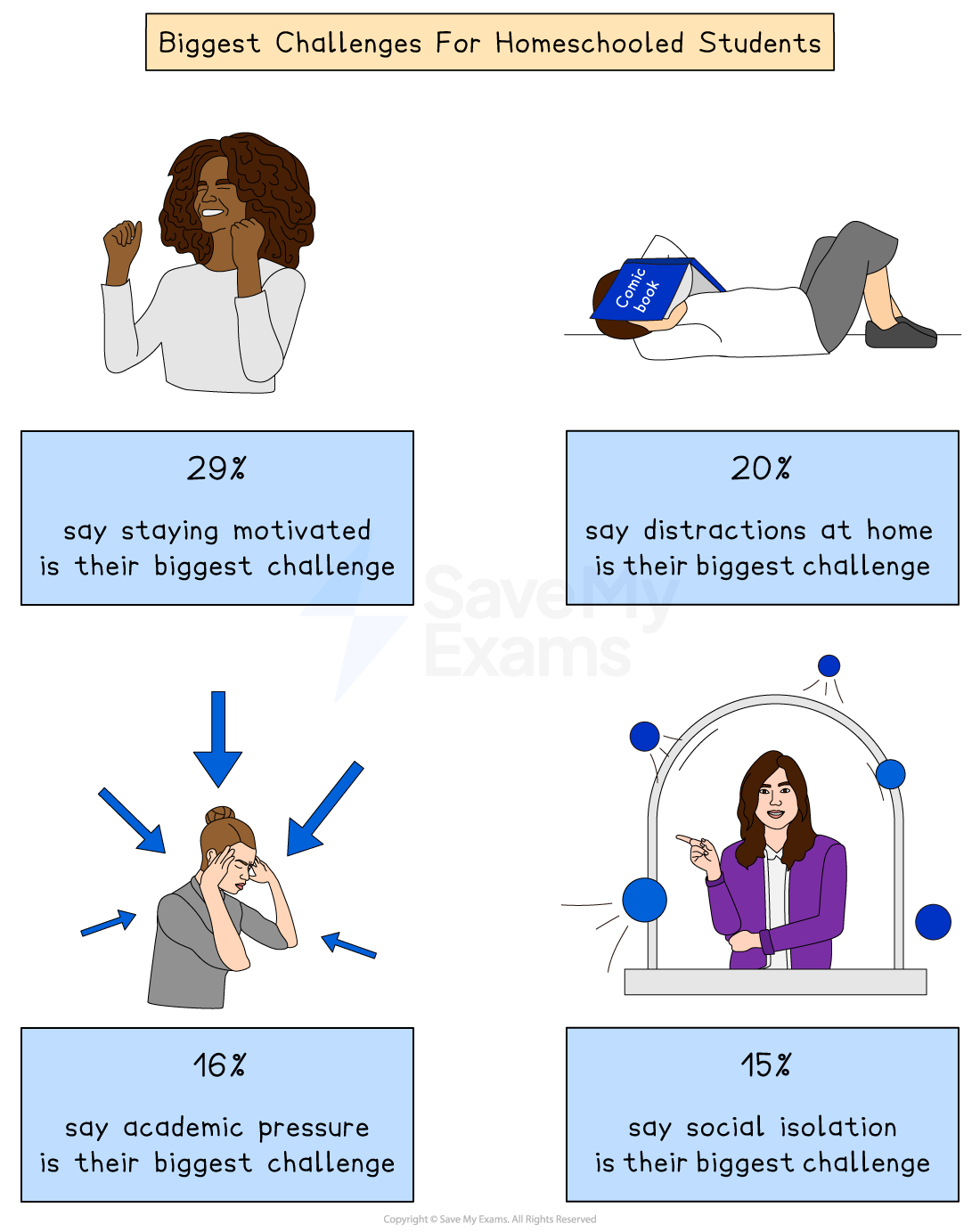
Homeschooled students' biggest challenges:
29% say staying motivated is their biggest challenge
20% say distractions at home
16% say academic pressure
15% say social isolation
School students' biggest challenges:
45% say staying motivated
23% say academic pressure
14% say distractions at home
3% say social isolation
Social isolation is five times more likely to be flagged as a challenge by homeschooled students than school students.
Learning Methods & Support Systems
Both groups were asked which learning method they find most effective. Online revision resources come out on top for each group.
6 out of 10 homeschooled students say online revision resources are their most effective learning method - 57% of school students say the same.
14% of homeschooled students find private tutoring most effective, compared to 11% of school students
Only 9% of homeschooled students say school lessons delivered by teachers are most effective, which makes sense given their education type.
Education Preferences & Switching Intent
If students could choose any type of education, what would they pick?
Homeschooled students:
Just over half (51%) would keep being homeschooled.
32% would prefer to be in school.
12% are not sure.
School students:
64% prefer their current setup.
10% would prefer homeschooling.
17% are not sure.
9% would prefer a different type of school.
School students show stronger overall satisfaction with their current education type. But the 10% of school students who say they'd prefer homeschooling represents a meaningful pool of students who feel the school system isn't right for them.
UK-Specific Homeschooling Insights
Here's a summary of the most interesting findings from UK-only homeschooled students:
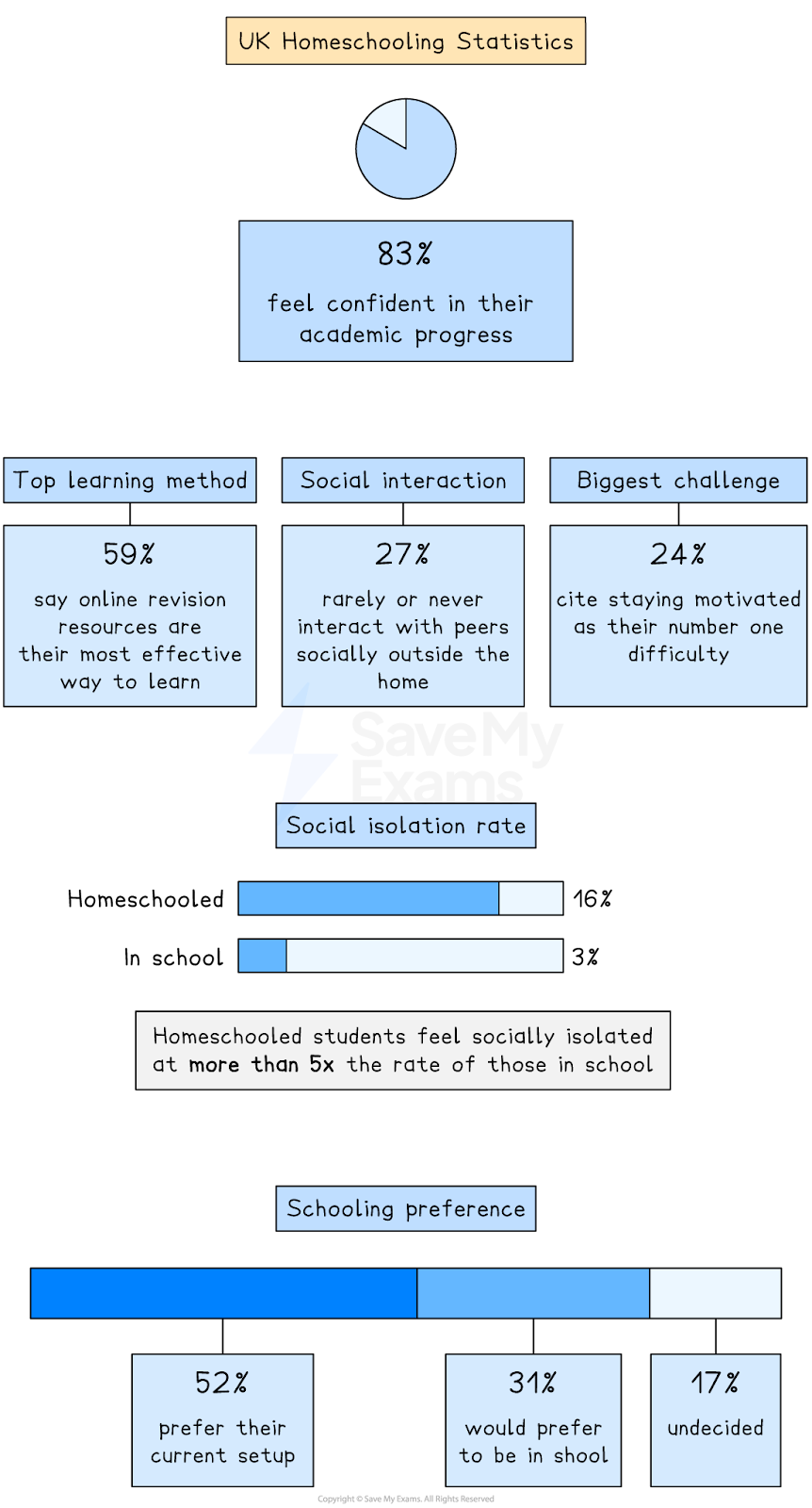
UK homeschooled students are more confident than the global average, with 83% feeling somewhat or very confident in their academic progress.
38% of UK homeschooled students say their education helps them learn significantly.
27% of UK homeschooled students rarely or never interact with peers socially.
38% of UK homeschooled students are dissatisfied with their social life.
Staying motivated is the biggest challenge for 24% of UK homeschooled students.
Social isolation is a challenge for 16% of UK homeschooled students - more than five times the UK school rate of 3%.
59% of UK homeschooled students say online revision resources are their most effective learning method.
52% of UK homeschooled students prefer their current setup, consistent with the global homeschool figure.
31% of UK homeschooled students would prefer to be in school.
Homeschooling in the UK: Key Statistics
Number of Homeschooled Students in the UK
The number of children being educated at home in the UK has increased over the past decade:
There were approximately 126,000 children registered as electively home educated in England in the 2025/26 autumn term (Explore Education Statistics). However, this may be an underestimate, as registration is not compulsory in England. The real number could be much higher.
Reasons for Homeschooling
Families choose to homeschool for a wide range of reasons.
Concerns about the school environment are among the most frequently cited reasons for choosing home education (16%) (House of Commons Library).
22% of parents choose to homeschool because they feel that their child’s SEN isn’t being met by a school environment (Educational Freedom).
19% of parents stated that a different educational philosophy was their reason for homeschooling (Evaluation and Research in Education).
If you're considering homeschooling, our comprehensive parent guide has more details on how to get started.
Demographics of Homeschooled Students
In our survey, UK homeschooled respondents had this qualification split:
IGCSE (36%)
GCSE (30%)
A Level (30%)
IB/Other (3%)
9 out of 10 local authorities state that they can’t identify every child in home education (Centre for Social Justice).
In Hertfordshire, 18% of homeschooled students have never been to school, while 78% have some previous school experience (University of Hertfordshire).
Benefits and Challenges of Homeschooling
Perceived Benefits of Homeschooling
Flexible pacing and a low-pressure environment are two perceived benefits of homeschooling (Learn Direct).
Homeschooling can provide a more personalised learning experience that can be difficult to replicate in traditional classrooms (National Extension College).
78% of peer-reviewed studies from the US suggest home-educated students may perform better than their school-educated peers academically (NHERI).
Common Challenges of Homeschooling
About 30% of home-educated pupils change status within a year, indicating a high level of movement between school and home (CSJ).
During the Covid lockdown in 2020, 36% of parents stated that homeschooling negatively affected their child’s wellbeing (Office of National Statistics).
The State of Homeschooling in the UK
Trends Over Time
Homeschooling in the UK is becoming a more popular education choice.
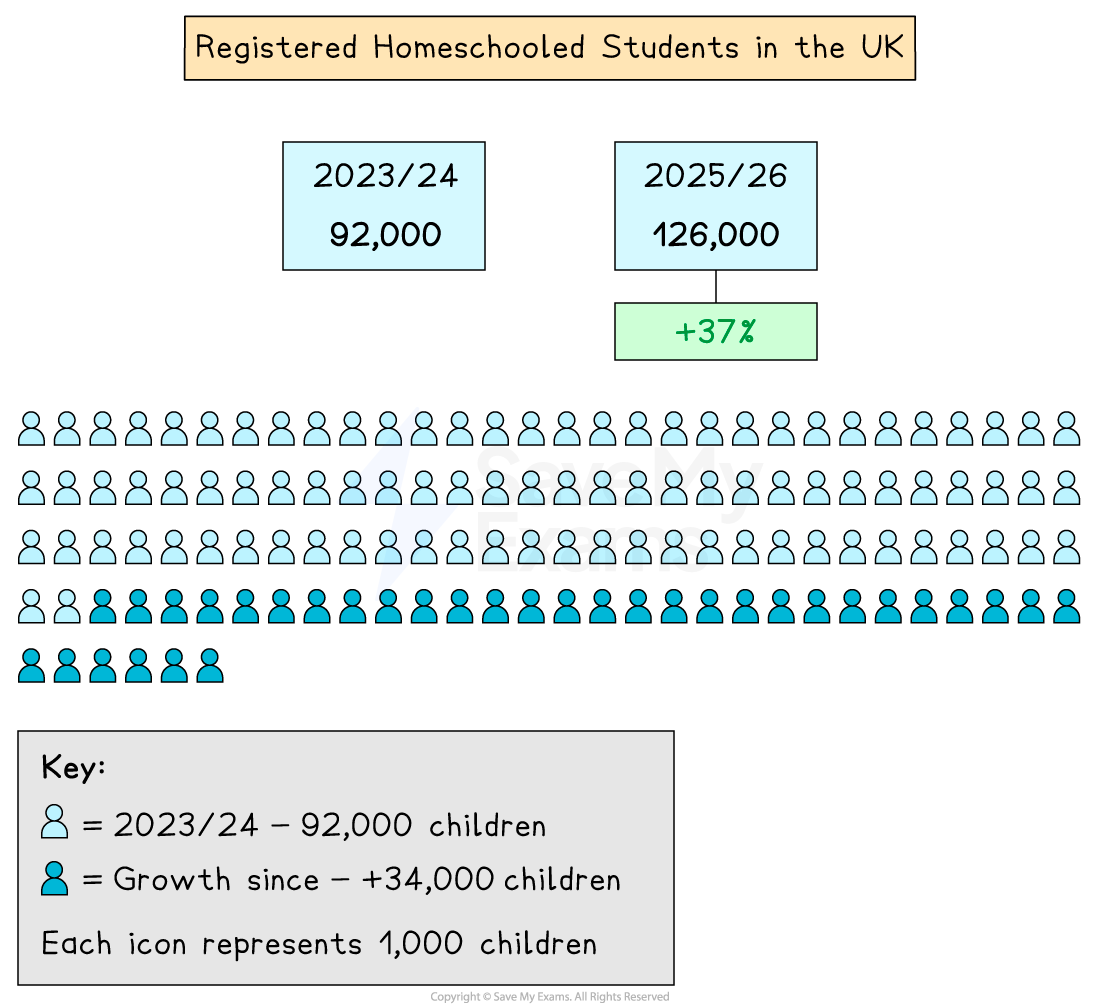
The number of registered home-educated children in England has increased from 92,000 in 2023/24 to 126,000 in 2025/26 (Explore Education Statistics).
In 2024, the number of children being home educated was at its highest level since the pandemic (BBC News).
The biggest reason for parents choosing to homeschool has shifted from philosophical reasons in the autumn term of 2022/23 to mental health reasons in the summer term of 2023/24 (Explore Education Statistics).
Inequality & Access
Socioeconomic Differences and Risks of Educational Gaps
In better off families in England 40% of children study five hours a day, against 26% in disadvantaged homes (Sutton Trust).
An estimated 1.14-1.78 million children don’t have access to a device to access home learning (City and Guilds).
9% of UK homeschooled students in our global survey cite lack of support as their biggest challenge (Save My Exams Survey, 2026).
The Future of Homeschooling
Growth of Hybrid Learning
Hybrid learning is a mix of home education and school attendance. Our survey captured 149 hybrid learners globally and 40 in the UK.
Hybrid learners show the lowest overall satisfaction of any group: only 38% prefer their current setup (Save My Exams Survey, 2026).
22% of hybrid learners say they would prefer full homeschooling (Save My Exams Survey, 2026).
Hybrid learners interact socially at a higher rate than homeschoolers (41% daily) (Save My Exams Survey, 2026).
Role of Online Learning Platforms
The UK Edtech sector grew by 72% in 2020 (Business.gov.uk (opens in a new tab)).
83% of children aged 12 to 15 say that online learning platforms help their learning (Ofcom).
Two-thirds of the world’s school-aged children (1.3 billion) don’t have access to the internet at home (UNICEF).
There was a 52% increase in children’s screen time between 2020 and 2022 (UK Parliament).
Learn at Home with Save My Exams
Homeschooling can be a positive choice for many, but staying motivated and making sure you’re covering the right content can feel like a lot to manage.
That’s where having the right support makes a difference.
Save My Exams is designed to give you structure without taking away the flexibility of homeschooling.
Whether you’re revising for GCSEs, A Levels, IB, or IGCSEs, you have access to a huge bank of examiner-written revision resources tailored to your syllabus - all in one place. Everything you need is at your fingertips, so you can stay focused, feel confident, and keep making progress.
Appendix: Full List of Homeschooling Statistics
Here's every statistic referenced in this article, in one place.
Around 1 in 3 homeschooled students (32%) say they would prefer to be in school (Save My Exams Survey, 2026)
10% of school students say they would prefer to be homeschooled (Save My Exams Survey, 2026)
79% of homeschooled students say their setup helps them learn effectively (Save My Exams Survey, 2026)
28% of homeschooled students rarely or never interact socially with other students (Save My Exams Survey, 2026)
39% of homeschooled students are dissatisfied with their social life (Save My Exams Survey, 2026)
Staying motivated is the biggest challenge for 29% of homeschooled students (Save My Exams Survey, 2026)
60% of homeschooled students say online revision resources are their most effective learning tool (Save My Exams Survey, 2026)
51% of homeschooled students would not change their education type (Save My Exams Survey, 2026)
22% of school students describe their routine as very structured, compared to 21% of homeschooled students (Save My Exams Survey, 2026)
47% of school students have some structure, compared to 36% of homeschooled students (Save My Exams Survey, 2026)
25% of homeschooled students describe their routine as mostly flexible — compared to 20% of school students (Save My Exams Survey, 2026)
18% of homeschooled students have no fixed routine at all, compared to 12% of school students (Save My Exams Survey, 2026)
33% of school students study for more than 6 hours a day, compared to 26% of homeschooled students (Save My Exams Survey, 2026)
36% of homeschooled students study for 4–6 hours, compared to 27% of school students (Save My Exams Survey, 2026)
30% of homeschooled students study for 2–4 hours, a similar share to school students at 27% (Save My Exams Survey, 2026)
8% of homeschooled students study for fewer than 2 hours a day (Save My Exams Survey, 2026)
75% of homeschooled students feel somewhat or very confident in their academic progress (Save My Exams Survey, 2026)
78% of school students feel the same (Save My Exams Survey, 2026)
19% of homeschooled students say they're not very confident, the same percentage as school students (Save My Exams Survey, 2026)
6% of homeschooled students say they're not confident at all, compared to 3% of school students (Save My Exams Survey, 2026)
Three quarters of school students interact with other students daily.
29% of homeschooled students rarely or never interact with other students their age
Only 3% of school students say the same.
81% of school students are somewhat or very satisfied with their social life.
39% of homeschooled students are dissatisfied with their social life - more than double the school rate of 19%.
15% of homeschooled students say they're not satisfied at all, compared to 4% of school students.
29% of homeschooled students say staying motivated is their biggest challenge - compared with 45% of school students (Save My Exams Survey, 2026)
6 out of 10 homeschooled students say online revision resources are their most effective learning method (Save My Exams Survey, 2026)
14% of homeschooled students find private tutoring the most effective learning method, compared to 11% of school students (Save My Exams Survey, 2026)
Only 9% of homeschooled students say school lessons delivered by teachers are most effective, which makes sense given their education type (Save My Exams Survey, 2026)
Just over half (51%) of homeschooled students would not change their education type (Save My Exams Survey, 2026)
32% of homeschooled students would prefer to be in school (Save My Exams Survey, 2026)
64% of school students would not change their education type (Save My Exams Survey, 2026)
10% of school students would prefer to be homeschooled (Save My Exams Survey, 2026)
83% of UK homeschooled students feel somewhat or very confident in their academic progress, compared to 75.2% globally (Save My Exams Survey, 2026)
38% of UK homeschooled students say their education helps them learn significantly (Save My Exams Survey, 2026)
27% of UK homeschooled students rarely or never interact with peers socially (Save My Exams Survey, 2026)
38% of UK homeschooled students are dissatisfied with their social life (Save My Exams Survey, 2026)
Staying motivated is the biggest challenge for 24% of UK homeschooled students (Save My Exams Survey, 2026)
Social isolation is a challenge for 16% of UK homeschooled students — more than five times the UK school rate of 3% (Save My Exams Survey, 2026)
59% of UK homeschooled students say online revision resources are their most effective learning method (Save My Exams Survey, 2026)
52% of UK homeschooled students prefer their education type (Save My Exams Survey, 2026)
31% of UK homeschooled students would prefer to be in school (Save My Exams Survey, 2026)
There were approximately 111,700 children registered as electively home educated in England in the 2024/25 autumn term (Explore Education Statistics)
Concerns about the school environment are among the most frequently cited reasons for choosing home education (16%) (House of Commons Library)
9 out of 10 local authorities state that they can’t identify every child in home education (Centre for Social Justice)
22% of parents choose homeschooling because they feel that their child’s SEN isn’t being met by a school environment (Educational Freedom).
In Hertfordshire, 18% of homeschooled students had never been to school, while 78% had some previous school experience (University of Hertfordshire)
19% of parents stated that a different educational philosophy was their reason for homeschooling (Evaluation and Research in Education)
Flexible pacing and a low-pressure environment are two perceived benefits of homeschooling (Learn Direct)
Homeschooling can provide a more personalised learning experience that can be difficult to replicate in traditional classrooms (National Extension College)
78% of peer-reviewed studies from the US suggests home-educated students may perform better than their school-educated peers academically (NHERI)
About 30% of home-educated pupils change status within a year, indicating a high level of movement and uncertainty (CSJ)
During the Covid lockdown, 36% of parents stated that homeschooling negatively affected their child’s wellbeing (Office of National Statistics)
The number of registered home-educated children in England has increased from 92,000 in 2023/24 to 126,000 in 2025/26 (Explore Education Statistics)
In 2024, the number of children being home educated was at its highest level since the pandemic (BBC News)
9% of UK homeschooled students in our global survey cite lack of support as their biggest challenge (Save My Exams Survey, 2026)
In better off families in England 40% of children study five hours a day, against 26% in disadvantaged homes (Sutton Trust)
An estimated 1.14-1.78 million children don’t have access to a device to access home learning (City and Guilds)
Hybrid learners show the lowest overall satisfaction of any group: only 38% prefer their current setup (Save My Exams Survey, 2026)
22% of hybrid learners say they would actually prefer full homeschooling (Save My Exams Survey, 2026)
Hybrid learners interact socially at a higher rate than homeschoolers (41% daily) Save My Exams Survey, 2026)
The UK Edtech sector grew by 72% in 2020 (Business.gov.uk (opens in a new tab))
83% of children aged 12 to 15 say that online learning platforms help their learning (Ofcom)
Two-thirds of the world’s school-aged children (1.3 billion) don’t have access to the internet at home (UNICEF)
There was a 52% increase in children’s screen time between 2020 and 2022 (UK Parliament)
References
Primary Research:
Save My Exams Homeschooling Survey (2026) - 5,934 students globally.
Secondary Research:
Explore Education Statistics (opens in a new tab)
House of Commons Library (opens in a new tab)
Centre for Social Justice (opens in a new tab)
University of Hertfordshire (opens in a new tab)
Evaluation and Research in Education (opens in a new tab)
Learn Direct (opens in a new tab)
National Extension College (opens in a new tab)
NHERI (opens in a new tab)
CSJ (opens in a new tab)
Office of National Statistics (opens in a new tab)
BBC News (opens in a new tab)
Sutton Trust (opens in a new tab)
City and Guilds (opens in a new tab)
Business.gov.uk (opens in a new tab)
Ofcom (opens in a new tab)
Unicef (opens in a new tab)
UK Parliament (opens in a new tab)
Was this article helpful?
Sign up for articles sent directly to your inbox
Receive news, articles and guides directly from our team of experts.

Share this article

 written revision resources that improve your