Cell Structure (SQA National 5 Biology): Exam Questions

Exam code: X807 75

23 mins8 questions
1a2 marks

Students carried out an investigation to compare the ultrastructure of typical bacterial and fungal cells.
A woman in a lab coat uses a microscope in a laboratory setting, focusing attentively on a sample slide under the lens.

(i) The table shows their results for fungal cells.

Complete the column for the bacterial cell by placing a tick () in the appropriate boxes.

[1]

Structure

Bacterial cell

Fungal cell

Cell wall

Nucleus

Mitochondria

Ribosomes

Plasmid

Cell membrane

Vacuole

(ii) The structure of the cell wall in the fungal cells was found to be different to that of a plant cell.

Name the structural carbohydrate that makes up a plant cell wall.

[1]

1b
Sme Calculator
1 mark

On average, muscle cells contain 2500 mitochondria, liver cells contain 2000 mitochondria and cheek cells have 200.

Calculate the simple whole number ratio of the number of mitochondria in these cells.

...................... : .................. : .....................

muscle cell liver cell cheek cell

1c2 marks

Explain why a muscle cell contains a large number of mitochondria.

21 mark

Cells in the stomach produce enzymes to help digest food.

Identify the structure where these enzymes are produced.

  • Mitochondrion

  • Nucleus

  • Ribosome

  • Cell membrane

3
Sme Calculator
1 mark

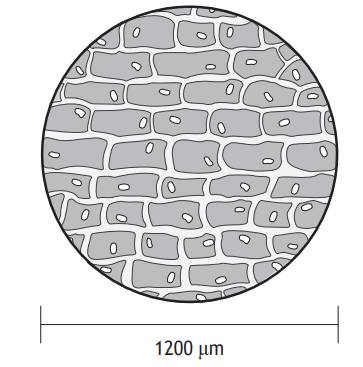
The diagram shows cells viewed under a microscope at a magnification of ×100.

Microscopic view of rectangular plant cells with prominent cell walls and small oval structures inside, with a diameter scale of 1200 micrometres.

What is the average length, in µm, of the cells shown?

  • 2.4

  • 12

  • 240

  • 24 000

4a2 marks

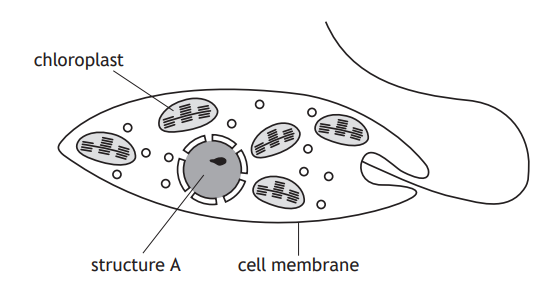
Euglena is a single celled organism found in water.

The diagram shows some of the structures within Euglena.

Diagram of a single-celled organism with a labelled chloroplast, cell membrane, structure A, and an extending tail-like structure.

(i) Name structure A.

[1]

(ii) Give the function of a chloroplast.

[1]

4b1 mark

Suggest why Euglena is not a typical plant cell.

4c
Sme Calculator
1 mark

The average body length of a Euglena is 50 micrometres.

They can travel 1.3 body lengths in one second.

Calculate how many micrometres a Euglena could travel in 30 seconds.

................................micrometres

51 mark

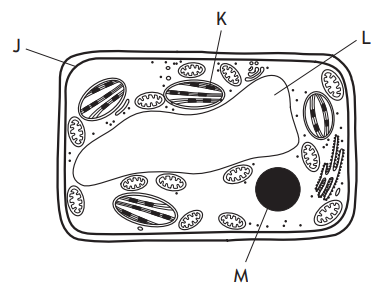
The diagram shows a typical plant cell.

Illustration of a plant cell showing organelles: cell wall (J), central vacuole (K), chloroplasts (L), mitochondria, and nucleus (M), with labels.

Which of the labelled structures would also be found in a typical animal cell?

  • J and K only

  • J and M only

  • L and K only

  • L and M only

6a2 marks

Cells vary in their size and structure.

Both bacterial and fungal cells have a cell wall.

(i) Name one other structure that can be found in both bacterial and fungal cells.

[1]

(ii) Plant cells also have a cell wall.

Name the material that plant cell walls are made of.

[1]

6b
Sme Calculator
2 marks

The average size of different types of cell are shown in the table.

Cell type

Average size (μm)

Animal

32.0

Bacterial

0.8

Fungal

6.4

Plant

52.0

(i) Calculate how many times bigger the average plant cell is compared to the average bacterial cell.

[1]

.................................times bigger

(ii) Apart from the difference in size, give one other difference between typical bacterial and plant cells.

[1]

7a
Sme Calculator
2 marks

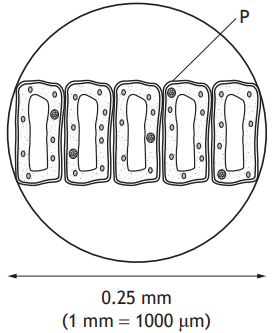
Palisade mesophyll cells are found in leaves and carry out photosynthesis.

The diagram shows a layer of these cells viewed under a microscope.

Microscopic view of six adjacent plant cells, each with visible nuclei and cell walls. Diameter label reads 0.25 mm, equivalent to 250 microns.

(i) Name structure P.

[1]

(ii) Calculate the average width of a single palisade mesophyll cell in micrometres (µm).

[1]

..............................µm

7b1 mark

Describe the difference that would be found in the ultrastructure of plant cells that do not carry out photosynthesis.

8a2 marks

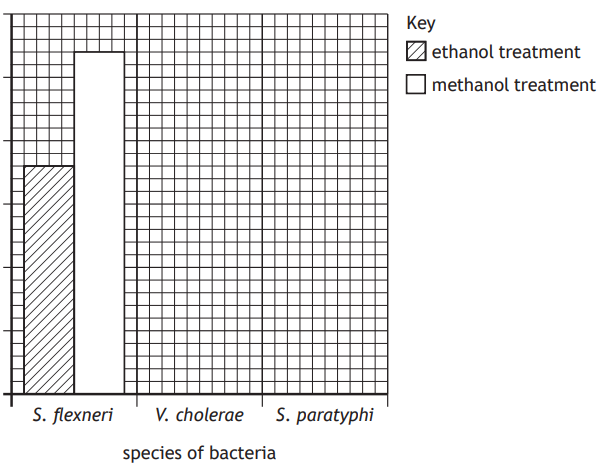
A study was carried out to investigate the effect of using the chemicals ethanol and methanol on bacterial growth.

Controls without either chemical were also set up.

The results in the table show the growth of three species of bacteria as a percentage of the overall bacterial growth in the control experiment.

Species of bacteria

Bacterial growth (percentage of control)

Ethanol treatment

Methanol treatment

S. flexneri

36

54

V. cholerae

45

44

S. paratyphi

4

12

On the grid, complete the vertical axis by adding a label and scale, and plot the remaining bars to show bacterial growth for V. cholerae and S. paratyphi.

Bar chart comparing ethanol and methanol treatment on S. flexneri, V. cholerae, and S. paratyphi. Only S. flexneri has bars for both treatments.
8b1 mark

It was concluded that ethanol was more effective than methanol at preventing bacterial growth.

Tick one box to identify whether this conclusion is valid or invalid.

Give a reason for your answer.

Valid square invalid square

Reason...............................................................................................................

8c1 mark

The researchers used a 6% ethanol solution in their study.

Predict the effect of using a 3% ethanol solution instead, on the growth of the bacteria.