1
1 mark
Which of the following builds up in animal cells as a result of fermentation?
Lactate
Ethanol
Glucose
Carbon dioxide
Was this exam question helpful?
Exam code: X807 75
Which of the following builds up in animal cells as a result of fermentation?
Lactate
Ethanol
Glucose
Carbon dioxide
Was this exam question helpful?
The apparatus shown was set up to investigate the effect of temperature on fermentation in yeast.
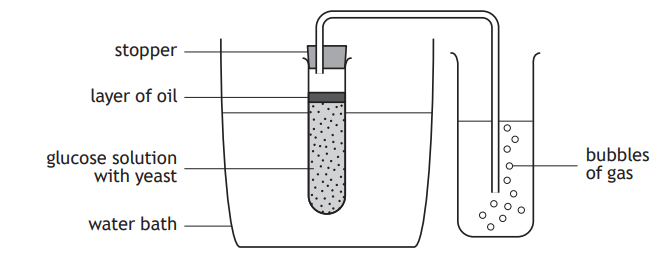
The investigation was carried out at 15 °C and repeated at 20 °C and 30 °C. The number of gas bubbles produced was counted.
Which two variables should be kept constant during the investigation?
Temperature and time left for
Type of yeast and time left for
Temperature and carbon dioxide concentration
Type of yeast and carbon dioxide concentration
Was this exam question helpful?
Describe the breakdown of glucose in animal cells when oxygen is present.
Was this exam question helpful?
In a study, scientists interviewed 350 British athletes competing in different sports including: cycling, swimming, rowing, athletics, football, hockey, and rugby. Approximately half of these athletes have tooth decay compared to a third of adults the same age.
The study showed that these athletes put more effort into looking after their teeth with 95% of them brushing their teeth twice a day compared to 75% of the general public. Only 21% of the general public floss their teeth regularly compared to 44% of the athletes.
The study also found that smoking rates in the athletes were found to be lower and overall diets were better compared to the general public.
However, ‘88% of elite athletes used sports drinks, 56% used energy bars, and 72% used energy gels frequently during training and competitions,’ said one of the researchers, adding that ‘the sugar in these products increases the risk of tooth decay, and their acidity increases the risk of tooth erosion’.
The scientists were surprised to find that elite athletes have more tooth decay than the general public.
Use information from the passage to explain why this finding was unexpected.

Calculate how many of the athletes flossed regularly.
.............................
Suggest a reason why this study may not be valid.
The table shows the nutritional content of a sports energy bar.
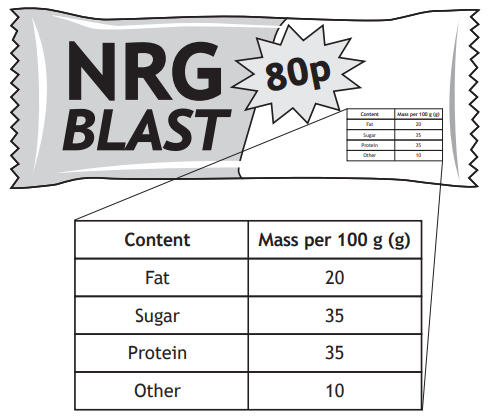
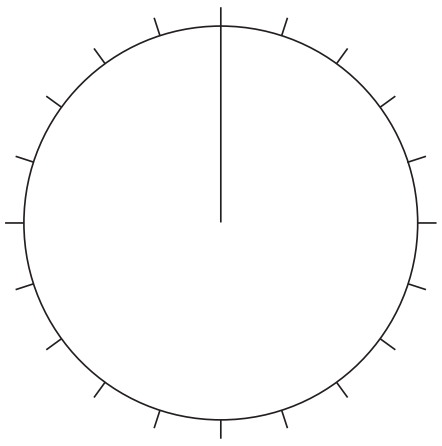
Use the information in the table to complete the pie chart.
(An additional pie chart, if required, can be found on page 29.)
Was this exam question helpful?
A respirometer was set up as shown to investigate respiration in maggots.
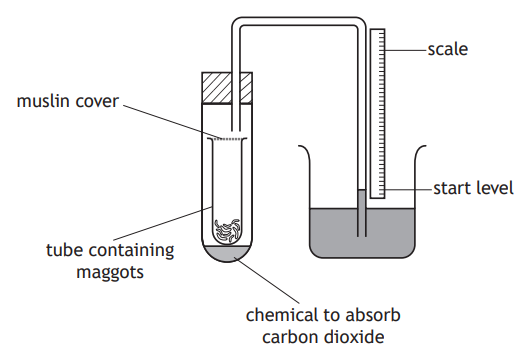
Which of the following would be a suitable control for this investigation?
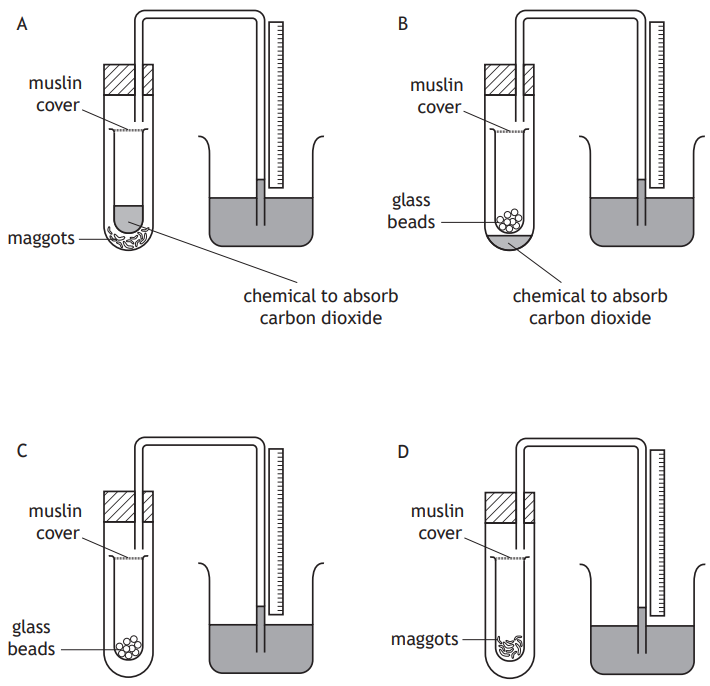
Was this exam question helpful?
The diagram represents processes that generate ATP in muscle cells.
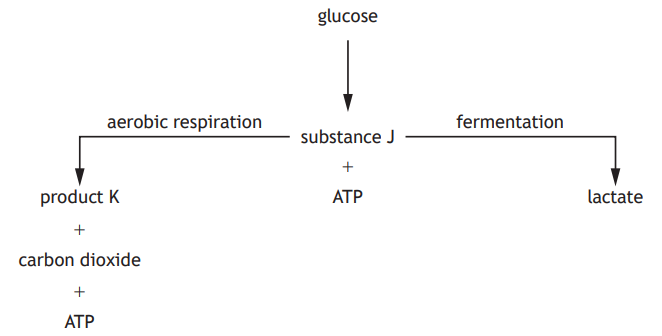
(i) Name substance J and product K.
[2]
Substance J..................................................................................
Product K......................................................................................
(ii) State the number of ATP molecules that would be produced from each molecule of glucose during fermentation.
[1]
Name the cell structure where aerobic respiration is completed.
Suggest why a muscle cell might carry out fermentation rather than aerobic respiration.
Was this exam question helpful?
The concentration of lactate in the blood of a long distance cyclist was measured whilst cycling at different speeds.
The graph shows these measurements at the start and end of the competition season.
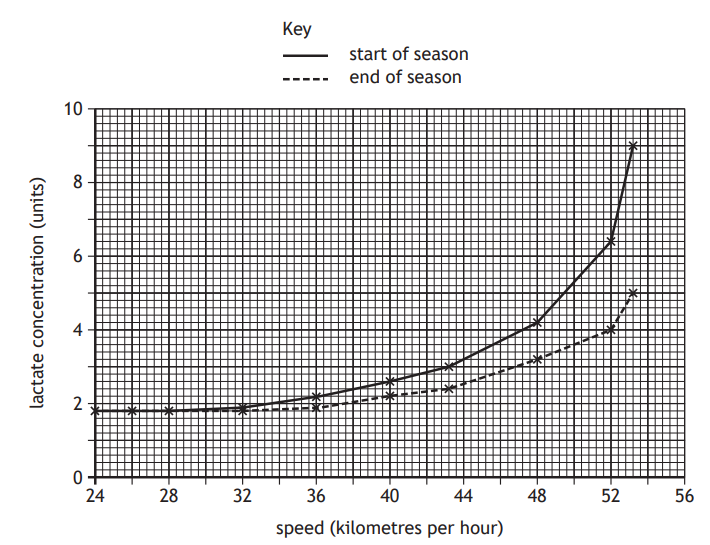
What was the lactate concentration at the start of the season when the cyclist was travelling at 40 kilometres per hour?
...........................units
Calculate the percentage decrease in lactate concentration at the end of the season compared to the start of the season when the cyclist was travelling at 52 kilometres per hour.
......................................%
Calculate how many times greater the maximum lactate concentration was at the start of the season compared to the end of the season.
...................................times
Was this exam question helpful?
Fermentation in yeast cells occurs in the
cytoplasm
mitochondria
plasmids
ribosomes.
Was this exam question helpful?
An earthworm with a mass of 7 g uses up 3.5 cm3 of oxygen in 25 minutes.
Calculate the volume of oxygen used by this earthworm in 1 minute.
0.02 cm3
0.14 cm3
0.5 cm3
1.02 cm3
Was this exam question helpful?
Muscle cells can carry out different types of respiration.
Name the type of respiration that yields the most ATP per glucose molecule.
The diagram shows a summary of one type of respiration in muscle cells.
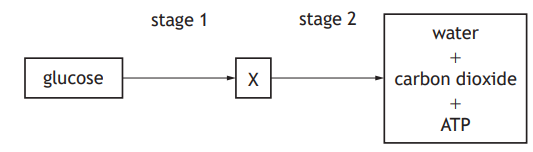
(i) Name substance X.
[1]
(ii) Name the substance that must be present for stage 2 to occur.
[1]
The number of mitochondria found in four different cells is shown in the table.
Cell | Number of mitochondria per cell |
Red blood | 0 |
Skin | 800 |
Liver | 1300 |
Muscle | 7000 |
(i) Calculate the simplest whole number ratio of mitochondria in muscle cells to skin cells.
[1]
......................... : .......................
muscle skin
(ii) State why a muscle cell requires more mitochondria than a skin cell.
[1]
Was this exam question helpful?
The following statements relate to cellular processes:
Completed in the mitochondria.
Affected by temperature.
Release oxygen.
Which of the statements are correct for aerobic respiration?
1 and 2 only
1 and 3 only
2 and 3 only
1, 2 and 3
Was this exam question helpful?
Describe similarities and differences in the process of fermentation in yeast cells and muscle cells.
Was this exam question helpful?
The following apparatus was set up to investigate aerobic respiration in peas.
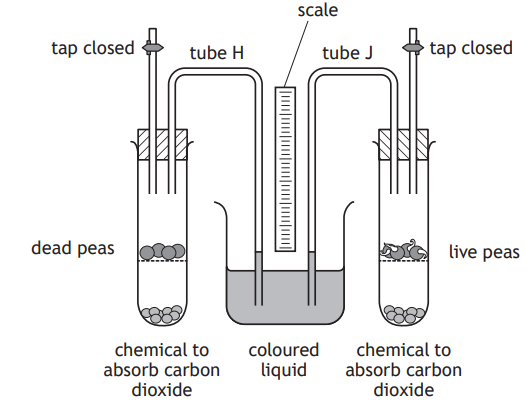
When peas respire this alters the composition of the gases in the test tubes, causing a change in the liquid levels in tubes H and J.
Liquid levels were recorded as shown in the table.
Liquid level (mm) | |||
Tube | At start | 30 minutes | 60 minutes |
H | 0 | 0 | 0 |
J | 0 | 25.5 | 40.8 |
Explain why the same number of peas were placed in both test tubes.
Calculate the percentage increase between the 30 minute and 60 minute readings in tube J.
......................%
Give a suitable conclusion for this investigation.
Suggest an improvement to this investigation that would make the results more reliable.
Was this exam question helpful?